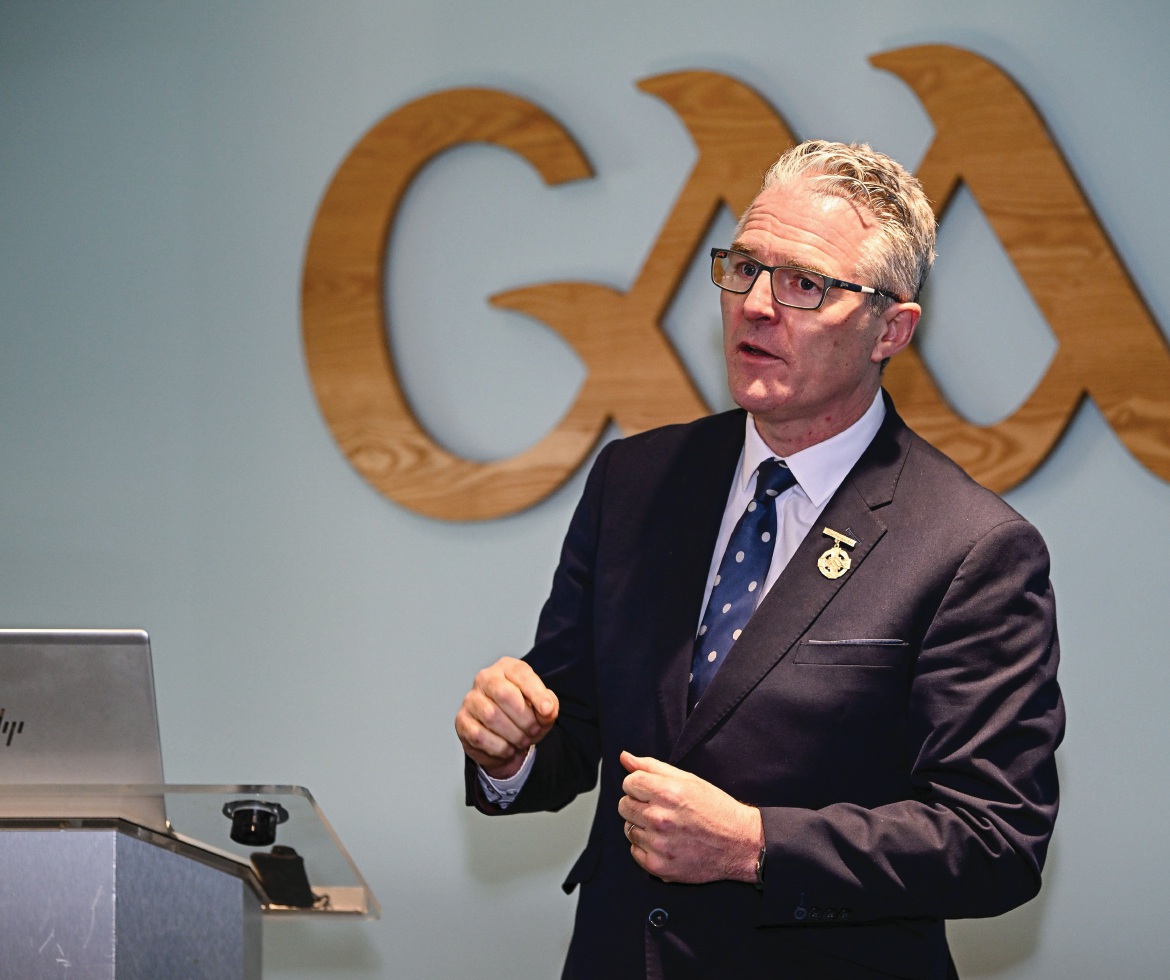


JARLATH Burns has defended the GAA from accusations of misogyny after Mary McAleese questioned whether there was sufficient support within the organisation for women to have a greater role in senior decision-making.
The GAA president said he was disappointed by remarks made by the former President of Ireland, describing them as “very regrettable” and saying they had caused offence among members of the association’s Management Committee.
McAleese stepped down this week as chair of the committee overseeing the proposed integration of the GAA, Ladies Gaelic Football Association and Camogie Association. Her resignation followed the GAA’s decision to reconsider the planned timetable for bringing the three organisations together.
She said she believed some within the GAA were “not entirely happy about the idea of including women in decision-making at the top level of Gaelic sports.”
Burns rejected the suggestion that women were being excluded from positions of influence, pointing instead to changes introduced during his presidency.
Speaking on RTÉ Radio 1, Burns said the GAA had introduced a 40 percent gender quota and that women now accounted for nine of the 19 places on its Management Committee.
“That’s nearly 50% female representation on the GAA’s Management Committee, which is the highest committee in the GAA,” Burns said.
He also pointed to the number of women in leadership positions across the organisation, saying five national committees are currently chaired by women.
Burns said he hoped McAleese would reconsider the comments she made following her resignation.
“I just hope that in the fullness of time, Dr McAleese will reflect on that part of her remarks yesterday and maybe clarify them, because it is quite offensive to the people who are on that committee,” he said.
The disagreement comes as the proposed merger of the three Gaelic games organisations faces a major setback, with the previously targeted April 2027 completion date now in doubt.
Burns said financial considerations were a significant factor in the delay, particularly when it comes to bringing funding for women’s inter-county teams up to the same level as the men’s game.
Asked if that was essentially the issue, he replied: “Probably in a nutshell, yes, that’s it, because we just don’t have the resources currently to be able to provide for that.”
He stressed, however, that the financial difficulty did not mean the GAA had abandoned the integration project.
Burns said the organisation remained committed to the principle, but argued that “equity is a staging post on the road to equality”.
The main challenge, he explained, was at elite inter-county level rather than within clubs or the wider national structure.
“It’s mainly at the high performance level, not at club level, not at national level, it’s the high performance county level,” he said.
The cost of preparing county teams is central to the debate. Burns said expenditure currently stands at around €45 million and warned that providing identical resources to men’s and women’s teams could effectively double that figure.
“We actually have a poor record in the GAA of controlling expenditure currently. If we go straight into equality, the €45 million which we currently spend preparing county teams goes to €90 million. We just simply cannot sustain that.”
He argued that the GAA already operates an approach based on need when distributing resources between its codes.
If football is the stronger developing code in a particular county, he said, it receives greater investment; the same principle applies to hurling where appropriate.
Burns also highlighted the practical burden placed on volunteers responsible for running county organisations, pointing to costs associated with development squads, equipment, nutrition, gym facilities, panel sizes, training, transport, travel and training camps.
“You have to remember that GAA county secretaries reside in a world of logistics and GAA treasurers reside in the world of invoices,” he said. “And we have to be respectful of those volunteers.”
Despite the dispute with McAleese, Burns said he remained firmly behind the objective of bringing the three organisations together.
“I’m still absolutely committed to integration,” he said.
The GAA has also rejected suggestions that opposition to women in senior positions is responsible for the stalled process, with director general Tom Ryan arguing that unresolved questions around organisational structures are at the heart of the delay.
Receive quality journalism wherever you are, on any device. Keep up to date from the comfort of your own home with a digital subscription.
Any time | Any place | Anywhere
Get the app for the best Gaelic Life experience