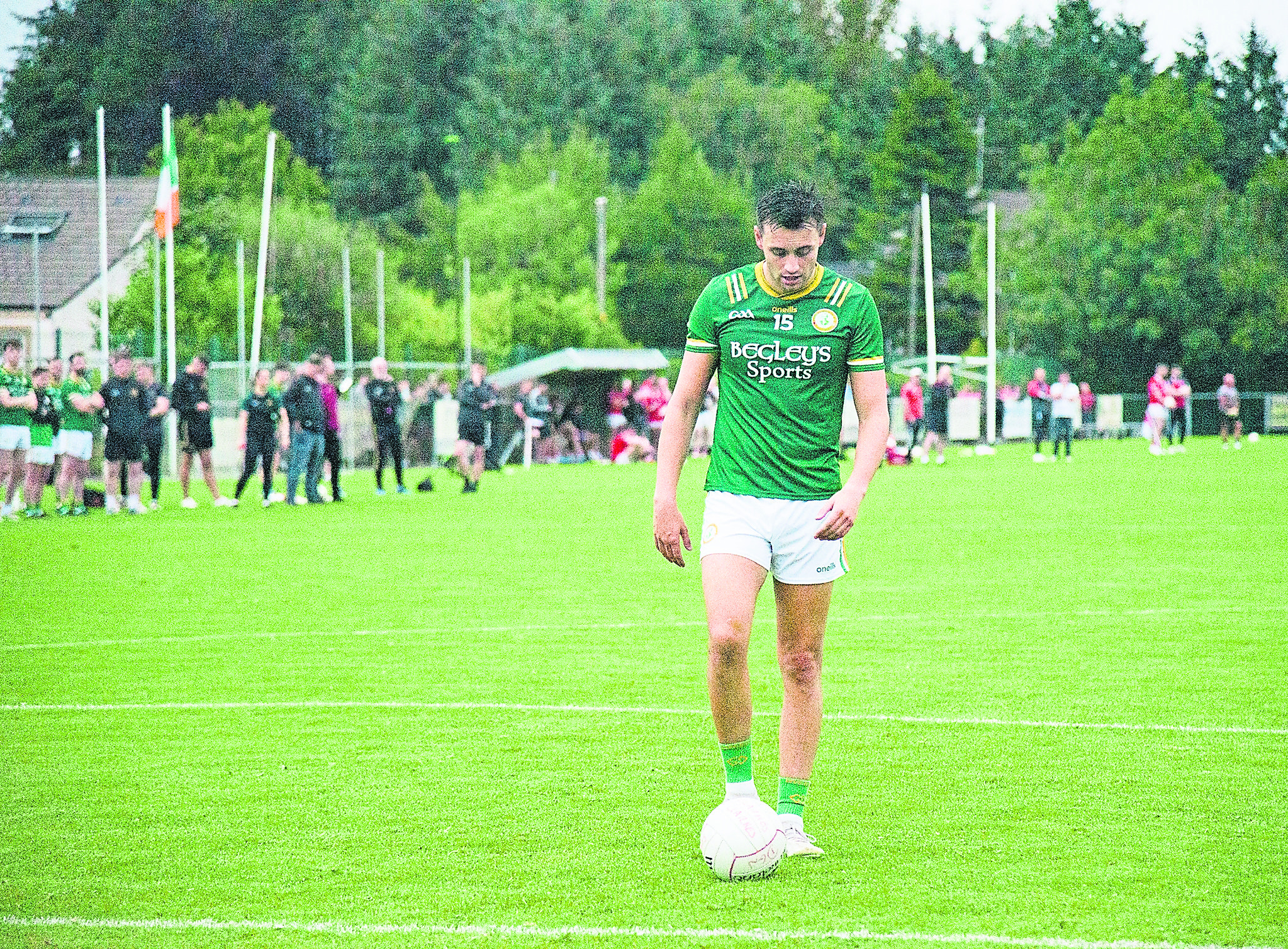


LAST Friday night in the Tyrone Senior League, Dungannon beat Trillick 0-25 to 0-17. Trillick lost heavily, despite kicking the ball over the bar more times than Dungannon and playing the better football.
They lost because Dungannon have a two-point specialist, Paul Donaghy, who kicked nine two-pointers. Dungannon’s next highest scorers on the night managed 0-1 apiece.
All of Trillick’s scores, like Donegal’s in the All-Ireland final, were one-pointers. Trillick put the ball over the bar 17 times. Dungannon put the ball over the bar just 16 times, yet trounced Trillick by eight points, a humiliation in a game where Trillick were the better team.
Two-pointers are skewing the fairness of the contest.
Knockmore played Balla in the first round of the Mayo Senior Championship and with a few minutes to go to half time had built a five-point lead against a strong wind and a strong opposition. Then, Balla were awarded two frees in succession outside the 40-metre arc and floated them over in the gale. When the ref blew the half-time whistle there was only a point in it and it felt weird.
If a team is fortunate enough to have a two-point specialist, they now have an enormous advantage. A free 41 metres out is almost as good as a goal and far less bother. A free 41 metres out with a gale at your back is a cinch.
If the referee moves the ball forward 50 metres for the ball not being handed back promptly or an exasperated remark by a player, then a two-point specialist can bring it back out to the 40-metre line and exact a scarcely fair punishment.
The two-point specialist in Mayo is Evan Regan, or ‘Tony Yeboah’ as I call him, since his left foot reminds me of Yeboah’s thunderous comic book volleys when he played for Leeds.
In the Stephenites’ first-round game against Ballyhaunis, he scored five two-pointers, four in the first half with the wind, which killed the game.
For Evan, anywhere from 60 metres in is a straightforward putt. Outside of the boot, instep, it matters not. In an era where anything that might remotely be physical contact is a free, he is an extraordinary weapon, again skewing the natural balance of the contest.
I think back to when I was playing. Anthony Tohill, 6’5″, built like Captain America, could sweep frees over the bar from 60 metres at his cush. If there had been two-pointers then, how many more games would we have won? How many championships? Or Bryan Sheehan, the Cahirciveen phenomenon whose long-frees were a fairground attraction.
It is clear from this first season of the new rules that it is imperative to find and develop two-point specialists, like the kickers in American football.
Teams at all levels that have such a kicker will have a huge advantage. An advantage that they do not have to earn in the traditional way, that is, by playing better football than the opposition.
A two-point specialist, regardless of his general ability, is now absolutely worth it. It no longer matters if you are being outplayed. And if you have a gale force breeze blowing, then a single two-point specialist can win the game in a single half.
Jim Gavin’s rationale behind the two-point score was that it would draw defences out and force them to defend the 40-metre arc. I agree with this, but that rationale only extends to two-point scores from play and 40 metres is too close for specialists.
I would therefore keep the two-pointer from play but move it back five metres creating a 45-metre arc. However, two-point frees are unjustifiable. Worse again is the option to move the free back out to the 40-metre arc when the referee has advanced the ball 50 metres.
Again, this is a thoroughly unworked for advantage. The normal principles of any sporting contest are fairness, that the scoring system broadly reflects the balance of the play, and that the scores are created/deserved. This does not apply to two-point frees, where a specialist kicker can and often does win the game on those alone.
In the All-Ireland final this year, Kerry had two two-point specialists. Donegal had none. In spite of the fact that Donegal kicked the ball over the bar more than Kerry (Kerry had three fisted points), like Trillick on Friday night, they lost heavily.
What would ordinarily have been a titanic contest was instead a terrible anti-climax because of those two-point specialists. Kerry advanced behind that spearhead, growing in confidence after every two-point dagger. Under the traditional scoring system, the half time score would have been 0-13 to 0-10. Instead it was 0-17 to 0-10.
Crucially, however, Donegal were psychologically shattered by the two-pointers. Kerry scored six two-pointers. Donegal had none. Without those two-pointers the final score would have been 1-20 to 0-19, and do not forget that the Kerry goal came at the very end when Donegal had abandoned all hope.
The new rules have revived the corpse of Gaelic football. But when the scoring system does not broadly reflect the balance of play, when instead of being a fair contest it becomes a skills test for a small number of two-point specialists, what exactly is the point?
Related posts:
Receive quality journalism wherever you are, on any device. Keep up to date from the comfort of your own home with a digital subscription.
Any time | Any place | Anywhere
Get the app for the best Gaelic Life experience