

By Shaun Casey
The 2002 and 2024 teams are rightly lauded as heroes in the Orchard County, but Armagh’s first All-Ireland title arrived long before those sides emerged.
2026 marks a lot of 100-year anniversaries for Armagh.
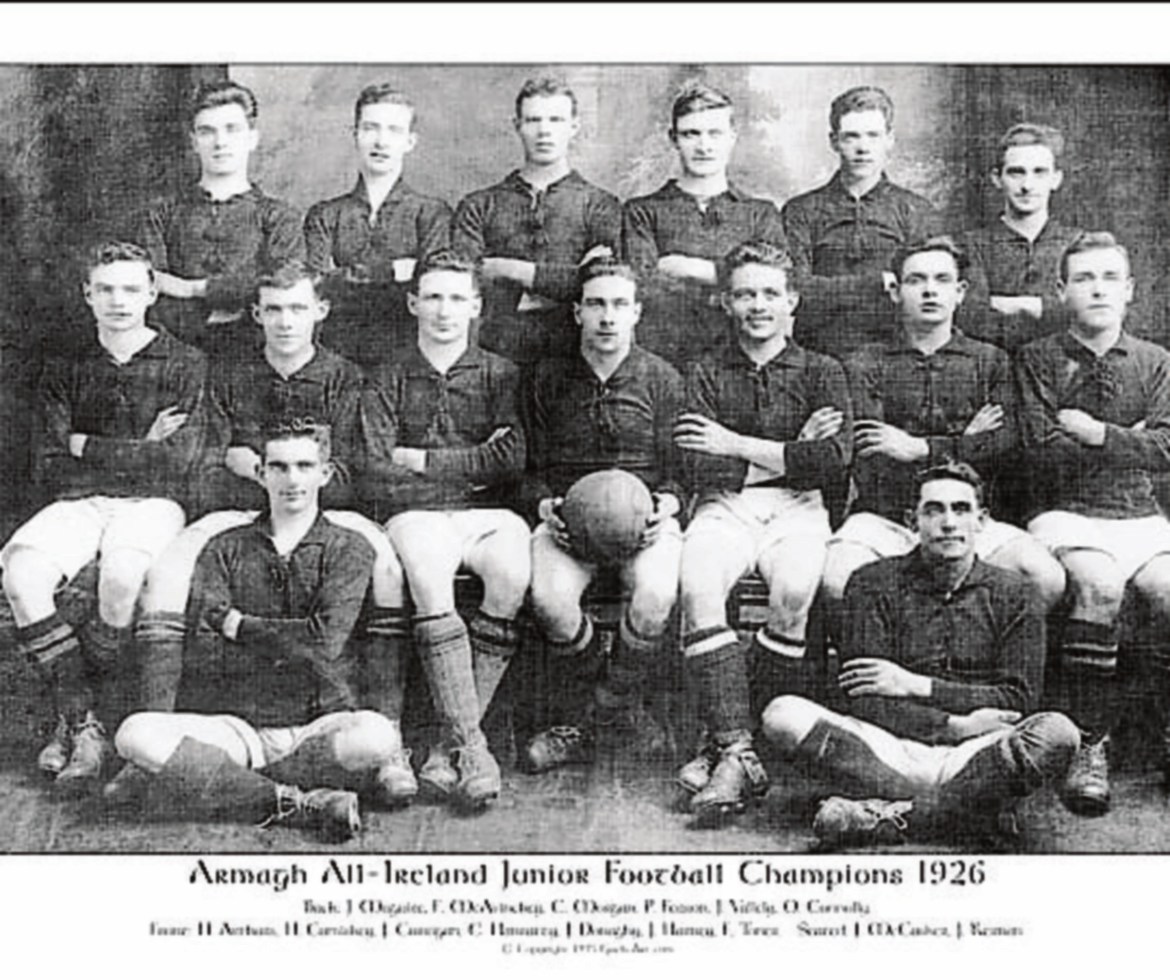
They won the All-Ireland Junior title way back in 1926. That year was also the first time the orange jersey ever appeared, and it’s also 100 years since the Athletic Grounds opened.
The Ulster Junior final, which Armagh won, was hosted by the Athletic Grounds that season while 1926 also marked the county’s first appearance at Croke Park.
Brendan McCann, a local GAA fanatic and historian, from the Tír na nÓg club in Portadown, has worked tirelessly through the years to recover all the happenings of that famous year, etched in Armagh’s long history.
“Armagh were starting to form a junior team at that time,” McCann explained, reflecting on the remarkable milestone season.
“With the War of Independence, counties had been devastated internally and the GAA as a whole had been majorly impacted. Armagh being a border county suffered quite a bit as well.
“1925 was Armagh’s first venture into the Junior Championship. The National League began in 1926, tournaments like the McKenna Cup began to form around that time.
“Armagh actually began 1926 by playing Louth that January in the (1925) All-Ireland Junior semi-final but they lost by 1-1 to 0-1. That was the basis for a good stab at things whenever the 1926 Ulster Championship came round.”
There were many key steps and important figures along the way. The nuns who created the first set of orange jerseys, the County Board who were determined that Armagh would be prepared for a proper shot at an All-Ireland title, even at junior level.
Then there was John Donaghy. No one on the pitch played a bigger role in getting the Orchard men over the line than he did.
How many players could claim to have scored consecutive hat-tricks in the All-Ireland semi-final and final? The Crossmaglen man has that record beside his name.
“He scored 3-1 against Sligo in the All-Ireland semi-final, but the best of it is that he scored 3-1 again in the final so that was quite a feat,” McCann added.
“He was obviously Armagh’s leading scorer throughout the campaign and I’m not sure if that has ever happened again, for someone to score a hat-trick in an All-Ireland semi-final and then again in an All-Ireland final.”
Before thoughts turned to bright lights of Dublin or All-Ireland finals, the provincial competition was the first hurdle to jump, and Antrim stood in Armagh’s way at both senior and junior level in 1926.
Played at ‘The Marshes’ in Newry (Páirc Esler), the Saffrons gained the upper hand at senior level but Armagh came good in the junior meeting.
“It’s funny because there were 10 boys on the senior team that day that ended up playing in the junior team at the later stages of the competition,” McCann explained.
“Things were a bit looser then and basically if the team was out of the Senior Championship, that allowed you to bring players into the junior setup. As many as 52 players played their part in the All-Ireland glory.
“The Antrim game was ultimately decided in the second half, Armagh played against the wind and the first score of the second half was a goal by John McCusker from Crossmaglen and Francis Doherty from Keady put the icing on the cake late on with another goal.”
Monaghan awaited in the semi-final and again Armagh came out on top, with the minimum of margins separating the sides.
“You need a bit of luck to win championships and that was definitely the case against Monaghan. They had beat Cavan in the first round and Monaghan were a much bigger team, but Armagh were small and nippy.
“Monaghan were 2-1 up in the first half and got a penalty, it was saved by Henry Lyness, but the penalty had to be retaken. This time the ball went wide so that bit of luck stood by Armagh.
“Edward Toner scored a goal shortly after and it was a low-scoring second half, but John Donaghy got an important score, and his name became better known by the end of their adventure that year.”
That left an Ulster decider with old foes Tyrone the next day out. “It’s also 100 years since the Athletic Grounds opened and in its first year, it held the Ulster Junior final between Armagh and Tyrone,” McCann continued.
“It was low scoring, but Armagh won 3-2. Tyrone were actually ahead 1-0 at half time but Armagh came back in the second half to earn a narrow victory.
“Armagh were wearing Mullaghbawn colours (green and gold) that day, the team seemed to have a lot of management meetings around the Mullaghbawn area.
“The senior team would have worn Crossmaglen jerseys, as the defending county champions at that time and the rule wouldn’t have been as stiff for the likes of the junior team.”
With the All-Ireland series upcoming, Armagh took the competition very seriously. Training funds were raised, and the idea of a new jersey was also discussed ahead of the semi-final.
“With Armagh going to Croke Park, the County Board wanted to ‘focus on sending to Dublin a team thoroughly trained and equipped to champion the interest of the Armagh County and all of Ulster’, that was their ambition.
“It was Armagh’s first venture to Croke Park when they played Sligo on the 17th of October 1926. It was the same day that Kildare played Kerry in a senior All-Ireland final replay, so there was a great crowd and a great Armagh crowd.
“The game was also broadcast live on the radio, and it wouldn’t have been that often that a junior game was on the radio back then.
“For the first time, Armagh came out in orange. This was at a time when counties were beginning to change from wearing club colours, so Armagh jumped on that bandwagon when they got the nuns in Newry to make the jersey.”
The sides ended up finishing level, 0-4 to 1-1, so a replay was required to decide who would advance to the showpiece. The rematch was set for Breffni Park, Cavan, and Armagh made no mistake this time around.
“Armagh won by 12-points and the wind played a major factor in the game,” McCann described. “There was a provincial game on that same day between Ulster and Munster and Ulster failed to score against the wind and Sligo also failed to score against the wind.
“Sligo got a few consolation scores in the second half, but Armagh were never going to lose that game, and it ended up winning 4-5 to 0-5.”
With Armagh into the final, hopes were high that they could land an All-Ireland title, but their ambitions were put on hold until the following July.
“The Kerry and Dublin semi-final was due to be played at the end of November but John Joe Sheehy, who had played for Kerry that same day that Armagh drew with Sligo, he captained Kerry to the All-Ireland that day and he was arrested down in Castleisland Garda Station.
“It was part of the political scene at that time and Kerry decided that they weren’t going to play the game because they felt it was unjust that he was being held captive.
“It went on for months and Dublin weren’t too keen to go ahead and just take the victory so eventually, after a change of heart, the game was refixed in July ’27 and Dublin came through by four points.”
A full nine months later, Armagh finally got their shot at the All-Ireland crown and another Donaghy hattrick helped them see off the Dubs, 4-11 to 0-4.
Cavan were the first Ulster team to win a senior All-Ireland, while Down brought the Sam Maguire across the border for the first time in 1960, but it was Armagh who actually achieved both those feats first way back in 1926.
“It was a first All-Ireland title for any Ulster County at any grade and the first across the border and that was the first footsteps of the men in orange.”
Related posts:
Receive quality journalism wherever you are, on any device. Keep up to date from the comfort of your own home with a digital subscription.
Any time | Any place | Anywhere
Get the app for the best Gaelic Life experience