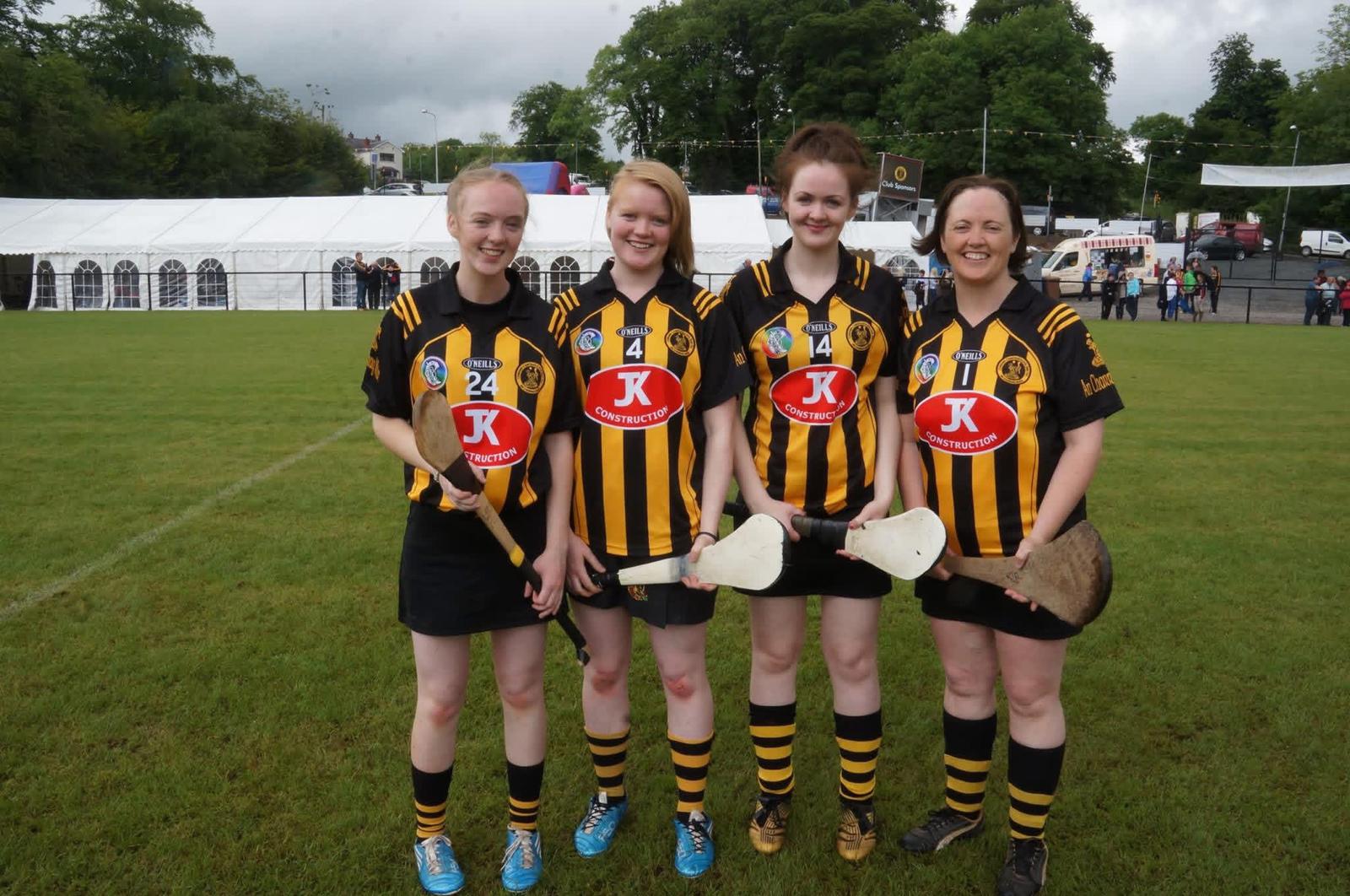


The camogs of Brídíní Óga and Éire Óg embark on two different All-Ireland crusades on Saturday afternoon. For one family, there will be an even deeper interest. Michael McMullan writes…
IF traffic is kind, it’s a 15-minute drive to the GAA’s National Games Development Centre in Abbotstown from Ashbourne.
A mere 75 minutes separates the throw-ins for Éire Óg, Carrickmore’s All-Ireland Junior B final with St Kevin’s and the Junior clash of Brídíní Óga, Glenravel and St Dominic’s.
The numbers don’t stack up for Brídíní Óga secretary Séamas McAleenan and his sister Bríd Uí Dhonnghaile, Éire Óg’s cultural officer and part of the senior management.
Thankfully for Séamas and Bríd, and their 94-year-old mother Mary, who rarely misses any of her extended family’s involvement, there is YouTube and the live stream.
The McAleenans are from Down stock, from Liatroim, a club picking from a handful of townlands and relying on those who move to within a manageable driving distance to stay involved.
Séamas is the oldest of 10. Bríd is seventh. Máirín, the first ever camogie All-Star winner from Ulster, is the second youngest.
Former Down player Brian hurled for Liatroim beyond his 50th birthday. His daughter Saorlaith was goalkeeper on St Malachy’s, Castlewellan’s recent Sciath Bhríde winning team.
Ciarán, the youngest, won championship medals with Liatroim. Eamon, Brendan, Patrick, John and Oliver all played at underage. Their father Eddie passed away in 2013.
Mary McAleenan was the first-ever female club secretary in County Down. Current county chairperson Maureen O’Higgins was in the chair with Anne Cunningham in as treasurer.
“That was revolutionary in the late ‘90s; for four or five years, the three main posts were filled by women,” Séamas points out. “The camogie club operated separate from that but they were always part of the GAA club.”
Liatroim camogie began in 1972 and within five years they were senior champions. It was the beginning of a golden era with sisters Bríd and Máirín to the fore.
Bríd, a teacher at Gaelscoil Uí Néill, outside Coalisland, moved to Belfast for a few years where she won a junior title with Deirdre. Married to Ballinascreen man Cathal, the couple would then move to Tyrone. First to Cappagh before settling in Carrickmore.
Teaching took Séamas to St Patrick’s, Maghera where he initially relocated. He trained with Lavey at the time before colleague Jim B Bradley asked him to come on board with Swatragh who were starting up hurling.
He moved to teach in Our Lady of Lourdes in Ballymoney and later Garron Tower.
Married to Claire, with family coming along and building a house in Glenravel, trekking up and down to play for Liatroim, beyond their intermediate success, became unsustainable. Following a transfer to the Con Magee’s, he saw out his playing days fielding in their two Antrim Junior Championship winning teams.
Like Bríd’s move to Carrickmore, it wasn’t the end of the Gaelic games’ road. It was just a crossroads that took them both on the All-Ireland trail on Saturday.
Two adopted clubs in two different counties, 16 kilometres apart on the outskirts of Dublin’s urban sprawl. There is a common denominator – a combination of camogie and family.
*****
There was camogie in Carrickmore in the late 1970s, lasting for a decade before the pressure of numbers reached for the pause button.
That’s how it remained for 15 years, until Bríd and Cathal explored an avenue for their three daughters to have a chance to play.
“We have six children and the older girls were probably about 10 and 11 at that time, in 2004,” Bríd began.
“The boys were starting to get interested in going to hurling training in Carrickmore, but there was nothing for girls.
“We were also involved in Irish medium education, so we knew the Kerr family in Carrickmore, and, through them, we initially got involved in the club.”
Mickey Kerr, grandfather of four players on the current Éire Óg panel, passed away in 2004. When Bríd went home from the wake, Cathal sat up for the night.
“Himself and Peter Kerr got talking and next thing we had started the club,” she said of the beginning of Éire Óg’s camogie path.
They made a start the next available Saturday with a group that formed their first team in 2005, in the u-12.5 post primary grade.
Every two years, as one team moved up, another one began until they had a fully stocked club, all the way to senior. From then until now, Bríd has been the constant. Others came and went to lend a hand, but she drove camogie.
“It was small beginnings,” she recalls. “We just borrowed hurls and helmets; we didn’t really have much equipment.”
How times have changed with the camogs and hurlers challenging for All-Irelands over the next two weekends.
Back then, it was a determination to have camogie for her daughters and the girls in the parish that drove Bríd on. A love of camogie and winning an Ulster Club before leaving Liatroim helped too.
“It was very strong in Liatroim when I was playing and whenever I left home,” she said. “It was just to give my own children initially a chance at things.”
Between giving birth to their third and fourth child, Bríd took up camogie again with Eglish.
In the years that followed, Éire Óg seniors began but numbers weren’t always plentiful.
“I started to play again in goals, because I wasn’t fit to play anywhere else,” she said. Four junior championships followed. Camogie in Éire Óg was there to stay.
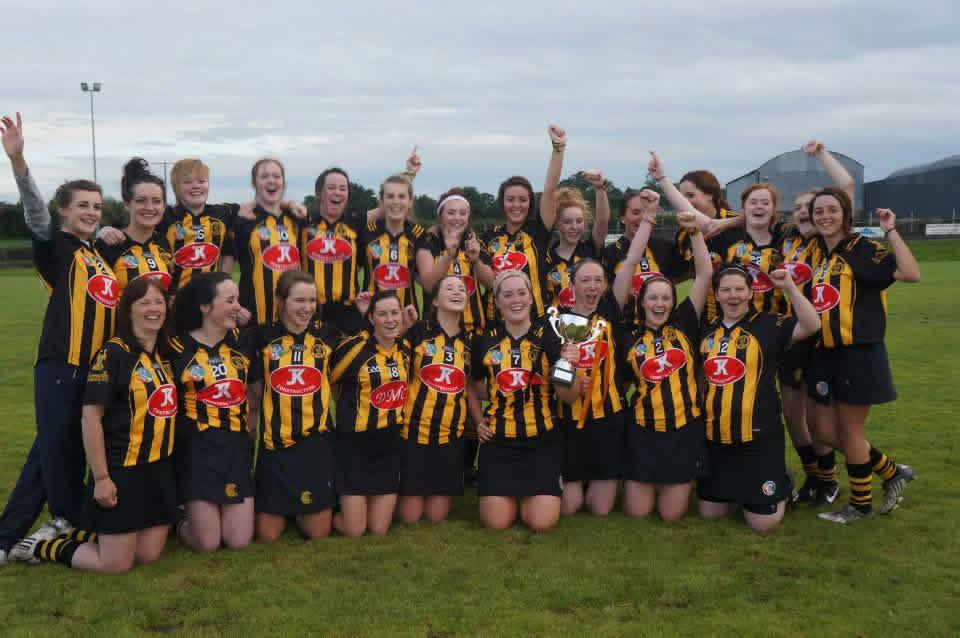
CHAMPIONS…Éire Óg camogs celebrating their Tyrone Junior Championship success in 2012
When the club opened Páirc Éire Óg in 2016, a base allowed the wheels to turn much quicker.
“We attracted more families and we had our own identity,” Bríd said of when the momentum really began. “Things then just grew and we had more players coming out.”
It culminated in this season. Remarkable is the word. Aside from a minor league, played at the height of summer with many players on holidays, and a post primary championship final defeat, they’ve won every other competition they entered.
Included is an All-Ireland Féile success, and St Kevin’s of Louth now stand between them and finishing the season in the best way possible in Abbotstown.
The hurling side of the club is much the same. Their minors will contest the Ulster Shield final this weekend in Ballinascreen, looking to get their passport stamped for the cup semi-final later in the month.
The seniors have an All-Ireland semi-final against Tuairín to get their teeth into.
Bríd has coached the Féile and u-16 camogs while also working away in the background with the seniors to make sure everything ticks along.
“The atmosphere is brilliant at the minute now, it’s just unreal and it’s hard to take it all in, things have gone that well,” she said.
“We recently had our (All-Ireland semi-final) match on Saturday and we had a youth presentation, which had already been arranged that night,” she said.
“Then the hurlers were playing on the Sunday, so it was just unbelievable. Everybody was out in numbers and it was great.”
Now there’s one more step. The biggest one. They’ll certainly give it a go.
While her two oldest daughters, Loinnir and Séimhín, are recently married and have begun raising their own family, Néamhann – named on the recent Gaelic Life team of the week – is part of the Éire Óg senior bid on Saturday.
“The girls that are involved are enjoying it especially in the past couple of years,” Bríd said of the team’s success.
Enjoyment and sticking at it have been the cornerstones of getting Éire Óg from nowhere in camogie to 60 minutes from a national title.
“The bond in the senior team has been very good. You can just see the friendships growing and everybody’s there for each other. It’s a good atmosphere to be involved in.”
It’s been a perfect mix so far. They’ll hope it’s not finished yet.
*****
Séamas had a similar experience in Glenravel where camogie had also faded out in the 1990s, until, with the help of others, they’d bring it back.
Interest was low. Numbers were lower. Underage was absent. Everything that leaves fielding teams an impossibility.
“They had a junior team which had three or four players with Ashbourne Cup medals,” he points out of the earlier years.
“Catriona Scott, for example, she had played on teams that won junior championships here but it just petered out because there was nobody looking after the young ones.”
During their u-10 and u-12 years, Séamas took his three daughters, Caoimhe, Eimhear and Úna, the 20-mile round trip to play with Loughgiel.
At the time, Seamus Elliott had organised an indoor North Antrim League, played at three different venues on Saturday mornings.
“So, from that, we decided we’d run a camogie tournament,” Séamas McAleenan said.
“You only need five or six players to do it. Cloughmills Primary School entered one as well.”
The two teams were the basis for forming an u-12 camogie team between the clubs in 2002. From that, Brídíní Óga, Glenravel was formed.
“The next year, somebody decided that they would have a senior team then,” Séamas added.
“The senior team was really like what they have now for mothers and others.
“It was players that had maybe played years ago and some of them that hadn’t played at all.”
While it wasn’t part of the initial plan of growing a team from u-12, like in Carrickmore, a Brídíní Óga senior team was entered in Division Three.
It progressed better than expected but the club then suffered a blow when a handful of the club’s players moved away to join other surrounding senior clubs.
“I think it was six players from the u-14 team and four of them had made the county team,” Séamas said of their loss.
“That was a bit of a setback. We were playing in the A grade at that stage and we were getting through to the county semi-finals; we were finishing third or fourth in the league.”
Like with Éire Óg in Carrickmore, persistence became an important word. After a first senior team, it took a full decade before they’d win a game in the junior championship. One day in particular sits above the rest.
“We were meant to play Gort na Mona on the last Monday of August,” Séamas begins.
“Of course, that’s the day of the Lammas Fair in Ballycastle. I had only 12 players but we fielded; you go through dark days like that.”
When Rodney Kerr came in and took the seniors, it was a boost and gave Séamas and others a chance to fully concentrate on underage. There are only so many hours and he was spreading himself too thin.
“Eimhear was 19 at the time, so that must have been 2011 or 2012,” he added.
“That was the first time she had been trained by anybody that wasn’t me.”
The underage began to flourish with the players also getting camogie with St Louis, Ballymena and in Garron Tower.
It drove the club to the 2016 Antrim Junior Championship with success coming in Ulster through the Bridie McMenamin Shield.
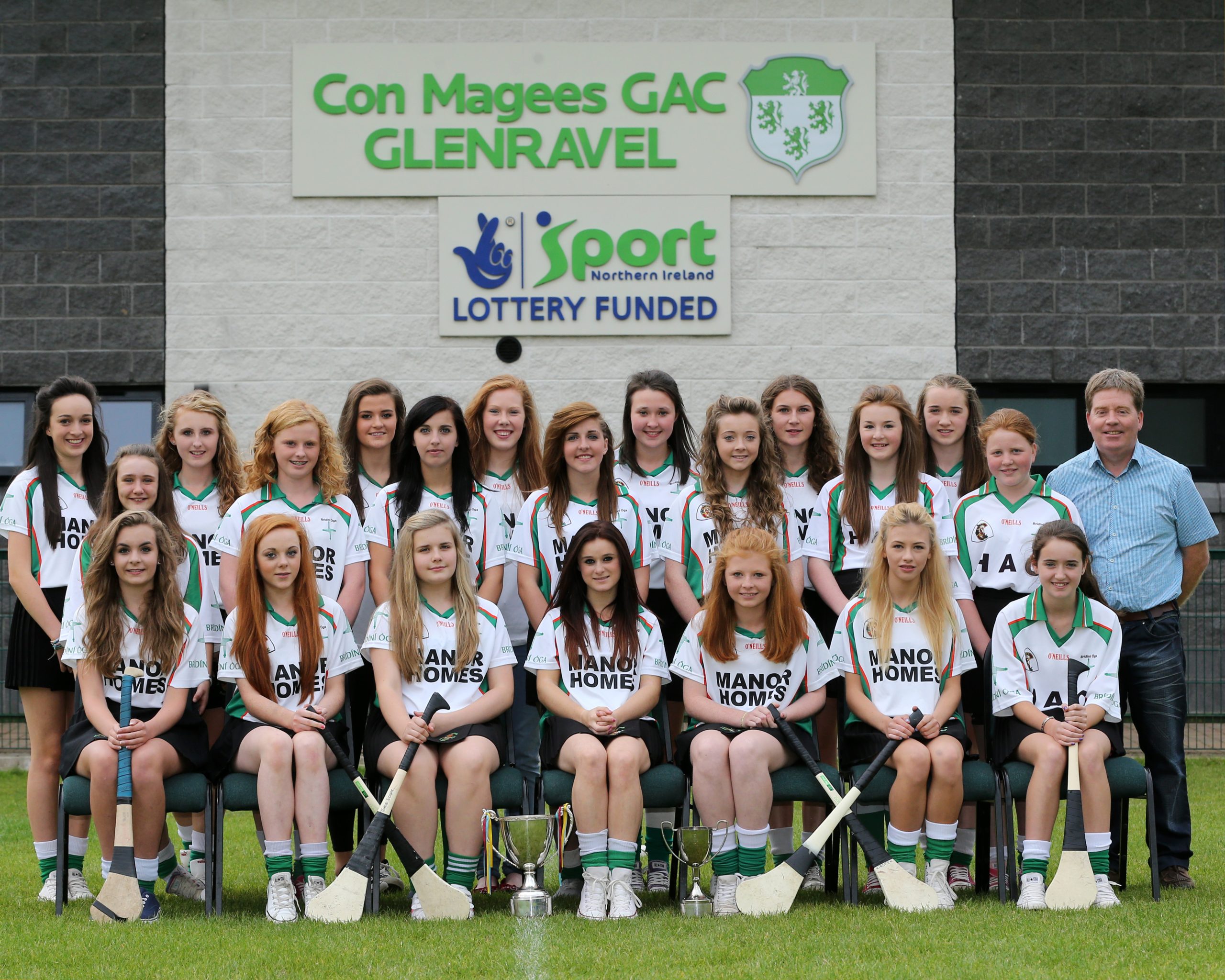
PRODUCTION LINE…2013 u-16 Antrim winning team, managed by Séamas McAleenan (back right). Photo:John McIlwaine
The following year, they progressed to the intermediate final, losing to Loughgiel’s second team.
At the time, second teams weren’t allowed to play outside of their county. Brídíní Óga represented Antrim but were pipped by Crosserlough of Cavan in the Ulster Junior final.
The ruling changed back and Loughgiel seconds would then advance into Ulster. Brídíní Óga lost out to them in a couple of finals followed by a 2021 first round defeat to Cargin.
Rodney Kerr came back on board as manager to help change the fortunes again.
“In 2022, everything came right. At one stage we were going to pull the plug on it because just there wasn’t enough turnout at training,” Séamas points out.
“We went on and won an All-Ireland from that. The potential was always there but it was just about maximising it.
Brídíní Óga came back as intermediate champions again. They had played their league camogie in Division One without county seniors Erin Coulter and Sarah Fyfe.
Maeve Mulholland’s football county training clashed with camogie games. All things combined, playing the big guns is an unforgiving experience.
The margins of defeat in some cases were far from inspiring, but, like they did before, they kept putting one foot in front of the other.
“It can be pretty bleak whenever you look at some of the scorelines coming home after getting a trouncing,” Séamas outlines, “and you’re looking ahead to preparing for the championship.”
Anything worthwhile never comes easy. Brídíní Óga emerged from Antrim and Éire Óg achieved their goal of topping intermediate in Tyrone after twice fallen at the final hurdle.
They had to absorb two players from last year’s Bridie McMenamin winning team going travelling while captain Alicia Coyle sustained an ACL injury.
Like in Liatroim and in Glenravel, the persistence word crops up in Carrickmore.
Others have put their shoulder to the wheel, but Bríd and Séamas have been the consistent cogs.
They also were also able to call on their sister Máirín at different times to make presentations at youth events or come in to take a coaching session here and there.
On Saturday, Mary McAleenan will be at home in Liatroim. She will be perched in front of YouTube. Proud as punch.
A mother, granny and great granny, she watched on as Eimhear hit the net in Brídíní Óga’s Ulster final win over Dungiven.
Fingers will be crossed the family WhatsApp group is buzzing all evening with photos of Éire Óg and Brídíní Óga and of silverware.
She’ll not have to worry about the cold and how challenging the traffic will be from the M2 to Abbotstown.
Related posts:
Receive quality journalism wherever you are, on any device. Keep up to date from the comfort of your own home with a digital subscription.
Any time | Any place | Anywhere
Get the app for the best Gaelic Life experience