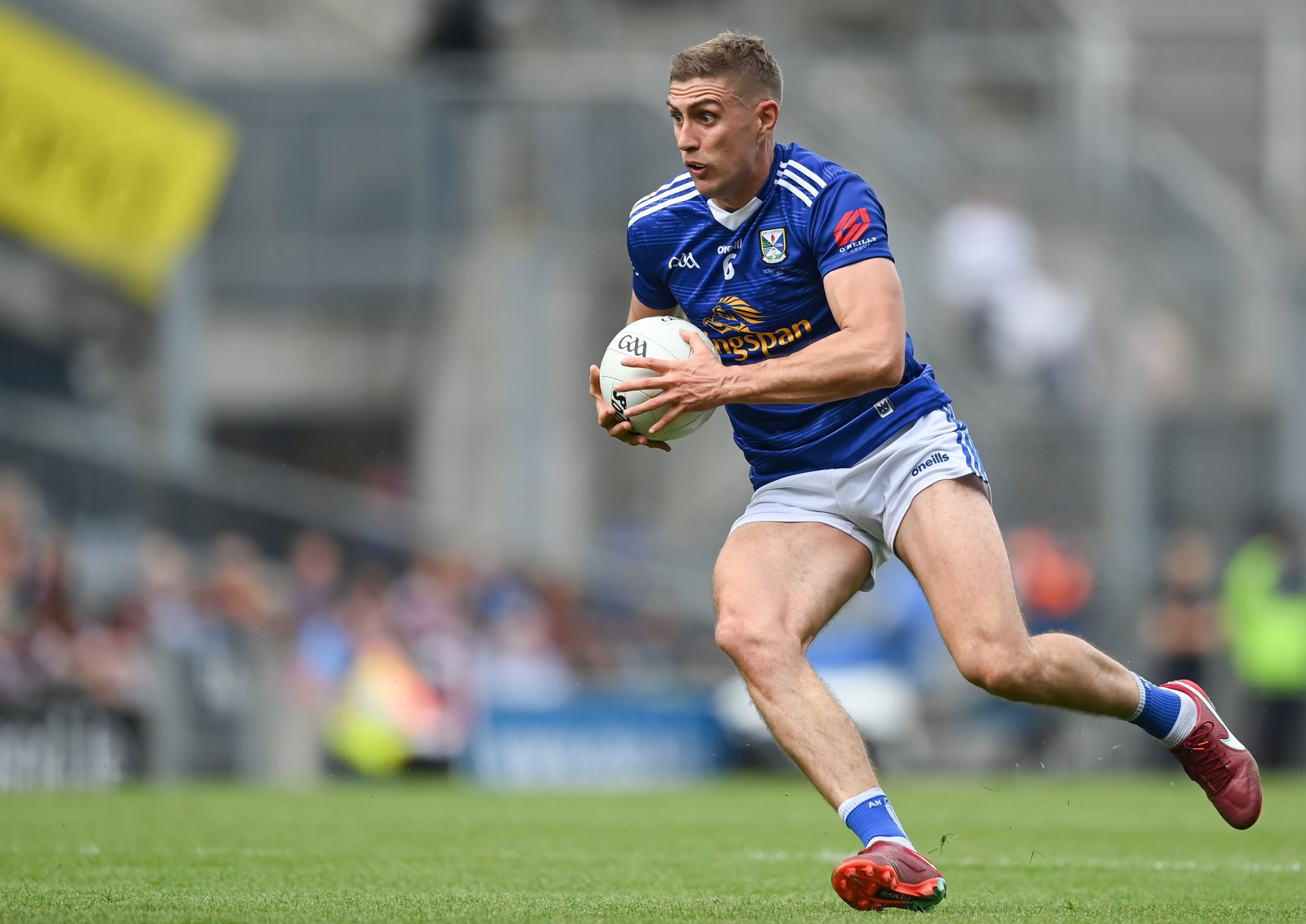


Killian Clarke retired from inter-county action at the end of last season after a career that yielded Ulster medals at all levels in the Breffni blue. He spoke with Michael McMullan.
WHEN someone plays 134 times for their county, there will always be more under the bonnet than we can ever see. Welcome to a conversation with Killian Clarke.
Given how his words are enveloped with both detail and enthusiasm, it’s no surprise he has won Ulster medals at minor, u-21 and senior level.
He’s in the same company as Michael Argue, Gerry Smith, Dara McVeety and Ciarán ‘Holla’ Brady. The persistence club, pondering if the Anglo Celt Cup would ever come home.
Every week now, Clarke joins Damien Donohoe and Paul Fitzpatrick, as an analyst on the We Are Cavan podcast. They pick through the bones of Cavan’s 2026 model.
Having being on the inside for over a decade, he knows better than most how the engine ticks. More importantly, he knows how to get there, the joy and what to consider at any crossroads.
As a footballer, Clarke has been the jack of all trades. He was full-forward on the Shercock team that won the 2011 junior title under the management of his uncle Jody. Killian’s father Sean was a selector. Another uncle, Raymond, was part of the winning group too.
Also, that year, as part of O’Raghallaigh Gaels, a merger with Kingscourt, Clarke wore the number 14 jersey as they won a minor championship.
Padraig Faulkner and Brian Sankey were in the half-back line. Joe Dillon and James Farrelly were the midfield duo.
It was Clarke’s second minor medal, having being part of Killann Gaels two years earlier, a combination with Bailieborough. Back then, Clarke and Sankey were the corner-backs.
Football was everywhere. After National School, despite the rest of his class moving to Bailieborough to continue their studies, Clarke opted for the short spin over the county border into Monaghan.
In his first year, Clarke was an athletic goal machine in the late manager Eamonn Dunne’s middle third with Patrician Carrickmacross as they landed a Corn Colmchille title, a passport into Grade A Ulster Schools football.
“My father was chairman of the club, he was also manager and I would have been going to training sessions with him,” Clarke recalls of the early sporting memories.
His older brother Lee has since relocated to Toronto having played under current Down manager Conor Laverty in his days as a student in Dublin’s Trinity College.
Back then, Lee and Killian would spend their nights as youngsters gathering balls from behind the goals, kicking them back into the training sessions.
A friend Dean O’Reilly’s father, Paddy ‘Chicken’, looked after the stewarding in Kingspan Breffni at the time.
“He got us roped into stewarding in Clones for Ulster finals and Ulster semi-finals,” Clarke recalls of his impressionable teenage years.
“I was pitch-side for a lot of those games in my early years and that was probably my first experience of inter-county football.”
The path to the Breffni blue jersey was a winding one. Football wasn’t only sport in those earlier years.
He was a middle-distance runner with the local athletics club in Shercock. He tried his hand at basketball and badminton.
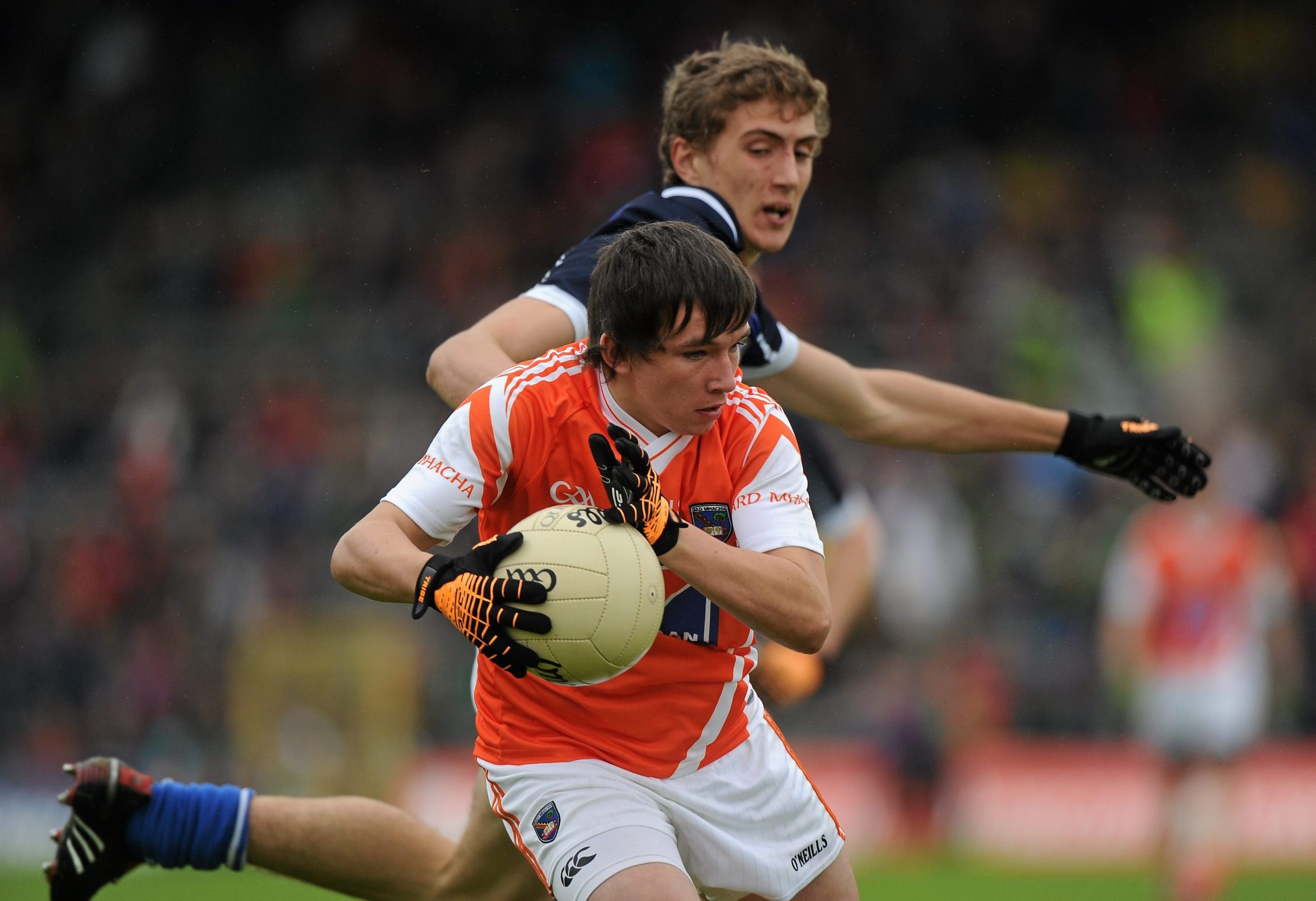
Killian Clarke in Ulster final action against Armagh in 2011
There was also a youth soccer stint that saw Sean and Mary trek their sons Lee and Killian the well-travelled N3 to St Patrick’s Athletic Club in Dublin.
When it came time to choose football for Cavan or soccer, Clarke knew it would take an all or nothing approach to progress at either.
As a central midfielder, by his own admission, while he had the physique, his first touch wasn’t deft enough level to cut the mustard at top level soccer.
And, there was only one jersey he was wanted to wear – the Breffni blue. It was time to go all in.
“I probably have quite an addictive personality, in that when I say I’m doing something, I’m probably doing it to the letter of the law,” Clarke said, lifting the lid on an inner desire.
“I’d be trying my best to get the most out of myself or I’d just be wasting my own time.”
With Cavan he knocked every door. Marking in the last line of defence. Going box to box as a midfielder. He’d chip in with the organising. He’d be probing others to improve.
Those days stewarding Clones left an impression. It was same from watching heroes like Dermot McCabe, Peter and Larry Reilly.
Once in the minor team, he looked towards trying to emulate David Givney and Gearóid McKiernan who had led the charge in the 2010 and 2011 u-21 finals.
“I wanted to be that high fielding midfielder,” he added. “I probably had a notion myself that it was the forward, but I was probably the furthest thing from a forward.”
Before anything could materialise, Clarke’s first quality was his thirst for knowledge. He wanted to improve. If a door didn’t open for him, he wanted to know why.
*****
Clarke’s Cavan career was nearly over before it started. After winning a minor championship, as an u-16 with Killann Gaels, he was a one of the hopefuls setting out to make the 2010 Cavan minor team.
He didn’t make the cut but wanted to know what was missing from his game, deciding to sound out manager Mickey Graham.
The absent ingredient was the raw pace to play in the full-back line at county level.
“That was the position I was going for,” Clarke recalls. “I was playing club football at midfield, centre-forward or centre-back a lot of the time.”
Rather than accept defeat, he pursued sprint training with Irish sprinter Craig Lynch, a fellow native of Shercock, who has since died in a tragic accident.
“He would have been a big help to me when I was younger, he was a role model as well,” added Clarke, who wanted to focus on the sharp burst needed to twist and turn in the full-back line.
The 200 and 400-metre running he took part in at the Community Games was the foundation for life in the middle third. This was different. That’s where Lynch came in.
“It was alien to me,” Clarke said of looking into a different type of mechanics.
“With Craig, he did a bit of work too on the strength and conditioning side, what sort of exercises you’re looking to do when you’re wanting to increase your speed.”
The running mechanics were broken down. Raising up the knee, chest out and chin up. Firm foot connection with the ground to generate power. Craig’s nuggets were golden.
“The top speed didn’t come naturally to me, but it’s probably something I learned,” he said.
“I was never that good at the five to 10 yards element of it, but I was probably fairly strong at the 30 to 40 metre bracket, when I’d be opening out the legs.”
By the following summer, Cavan were parading around Clones with the Fr Murray Cup as Ulster minor champions for the first time in 37 years.
A newly defined Clarke had thrown his lot in at the trials and manager Dermot McCabe liked what saw, plonking him in at full-back, beside Sankey, like the good days in their Shercock teams.
“I didn’t really have any expectation,” Clarke recalls of his early season thoughts.
“I was just getting in and doing my job. I was quite competitive in the air for a full-back, from being a midfielder by trade.”
Teams were playing with a physical inside forward Clarke would pick up. The two slighter attackers matched up elsewhere.
Cavan had also won the first of four-in-a-row u-21 titles in 2011. Clarke slotted into the team the following year, going on to pick up another three Ulster medals.
Up against Patrick McBrearty in the 2014 Ulster u-21 final
Terry Hyland was manager of the u-21 and senior teams. Cavan were light on cover for a challenge game against Leitrim and Clarke was drafted in to boost numbers.
“I ended up getting the call to play in the full-back line,” he points out of the start.
“I just kept my head down for a year, getting a bit of an appetite for competing at that level.
“After that first year of the u-21s, I probably had a good enough idea of where I was at in comparison to what was in Cavan and then also what was in other counties.”
College took him to Athlone where mixing with players from all over the midlands gave him an idea he could compete with the best young players elsewhere.
Back in Cavan, with the u-21s, there was a culture of leaders and of preparing to win. Standards were being driven by all four corners of the dressing room.
“The management team had us really well coached from a psychological point of view as well,” Clarke added.
“I would have felt we were quite strong on that element and the style of football we played probably suited the time of year we were playing.”
With the weather asking questions of both desire and their basic skills, Cavan hung tough and hit teams on the break.
Willie Gillespie’s flicked effort gave Donegal a glimmer of hope in the 2013 decider but it was the only goal Cavan conceded in four Ulster finals, twice each against Donegal and Tyrone.
“It was a great experience for me because it teed me up, from a culture point of view, really well going forward,” Clarke said.
“It let me see what standards I needed to set for myself and for my teammates around me.”
Hyland was manager for the first two successes, stepping in as senior manager when Val Andrews opted out during the 2012 season. Peter Reilly then took over for the 2013 and 2014 u-21 wins.
“Peter and Terry were quite pally,” Clarke explained. “Joe McCarthy would have had a massive impact and Joe has passed away since as well due to cancer.
“He was a stockbroker in London for 10 or 15 years and ended up getting early retirement from his work.
“He was very much heavily focused on the stats and the type of approach we should look to take.
“With the time he had on the hands, there wasn’t too many games he missed be it Sigerson or school, whatever it might be, you’d have saw Joe’s head perking up.”
Cavan escaped relegation from Division Three on the final day of the 2012 season. Despite shipping four goals at home to Antrim, Tipperary’s win over Offaly saved Cavan from the possibility of relegation on head-to-head, having lost earlier in the campaign to the Faithful County.
Hyland took over as manager ahead of the championship and handed Clarke his debut against Ulster champions Donegal, having never played a minute of league football.
Cavan lost by six on home soil before three goals helped them to an away Qualifier win over neighbours Fermanagh.
They limped out of the All-Ireland at the hands of a Kildare in the next round on the day Seanie Johnston came off the bench on a bizarre day at Kingspan Breffni when he made his Lilywhite debut for the visitors.
Cavan’s fortunes turned the following year when Hyland steered them through the Qualifiers and into an All-Ireland quarter-final defeat to Kerry.
In Ulster, they had been pipped by Monaghan in the semi-final, by a point, who downed Donegal in the decider.
“We probably should have won that day,” Clarke feels. “Conor McManus was the difference; he kicked a couple of worldies like he’s done on numerous occasions throughout the years.”
By the end of the year, his first full season as a county player, Clarke was among three Cavan players nominated for an All-Star, having not made the minor panel three years earlier. Craig Lynch’s pointers and his willingness to follow them up took him to the top table of defenders.
Over the next five years, Cavan bobbed up and down in the leagues, promoted twice to Division One before trickling back to the third tier.
When Covid forced the GAA into four-team leagues in 2024, Cavan bottomed out to Division Four before easing back up two levels to where they current sit.
It was a spell that saw Clarke captain Cavan and also take a brief stint away from the squad before stepping back into help the charge towards the 2020 Ulster title.
*****
The five championship years after dancing with Kerry in Croke Park were disappointing. In a rare home championship game, they accounted for Armagh but it was their only win in Ulster.
There was a draw against Tyrone before they lost in the replay. Twice Roscommon put them out of the All-Ireland. They were on the wrong end Tipperary’s 2017 story.
“There were always the same bogey teams, Roscommon, Tyrone and Monaghan,” Clarke said. “We just seemed to fail to get over the line against them.”
Cavan did reach the Ulster final in 2019 after beating Armagh in a semi-final replay but Donegal retained their title in the decider.
Then came 2020, the story that may never have been written when Covid stopped the world and sport in its tracks.
“Donegal was definitely the superior team that day against us,” Clarke said of the 2019 decider.
“Then we got our own back after a run that was probably a bit of a shock to everyone with the comebacks that we made,” he said of the following year.
Once again, the fixture computer dealt Cavan an away day – Monaghan in Clones.
The visitors hit the last six points of normal time but breathed a heavy sigh of relief when Conor McManus was off target late on.
There was plenty of drama in extra-time before goalkeeper Raymond Galligan won the game with a late, late free.
“I think that point started at about 50 yards out but Raymie has told people it was 80 yards out by this stage,” Clarke said with a laugh.
“There’s a famous clip of him and putting his two fingers up running backwards back into his goal after kicking the monster.”
Clarke himself was among the scorers in a four-point over Antrim before Cavan were back in the depths of drama against Down in the semi-final.
Down led by 10 points but the impact of substitute Conor Madden and with Thomas Galligan pushed into the forward line, the pattern changed.
Madden set up Clarke for a late score that proved vital as the Breffni side edged back to the final with just a point to spare. The days when uncle Jody handed him the Shercock number 14 jersey now more than justified.
Donegal were on for three-in-a-row and after Cavan’s bright start, hit a 0-7 to 0-1 purple patch to put them in a winning position.
A tight corner for Cavan? No problem. It had been the story of their autumn championship odyssey. They twice poked their nose out in front before Madden’s insurance goal, after Shaun Patton punched a McKiernan delivery into his path.
Despite being played in front of a skeleton attendance in Armagh with the coronavirus restrictions, the emotion was palpable. Manager Graham and captain Galligan broke down in tears in their post-game interviews.
“Mickey was involved in the ‘97 team, same with Dermot (McCabe),” Clarke said. “As I grew up, and the teammates around me, we probably had an expectation that we would get there at some stage.
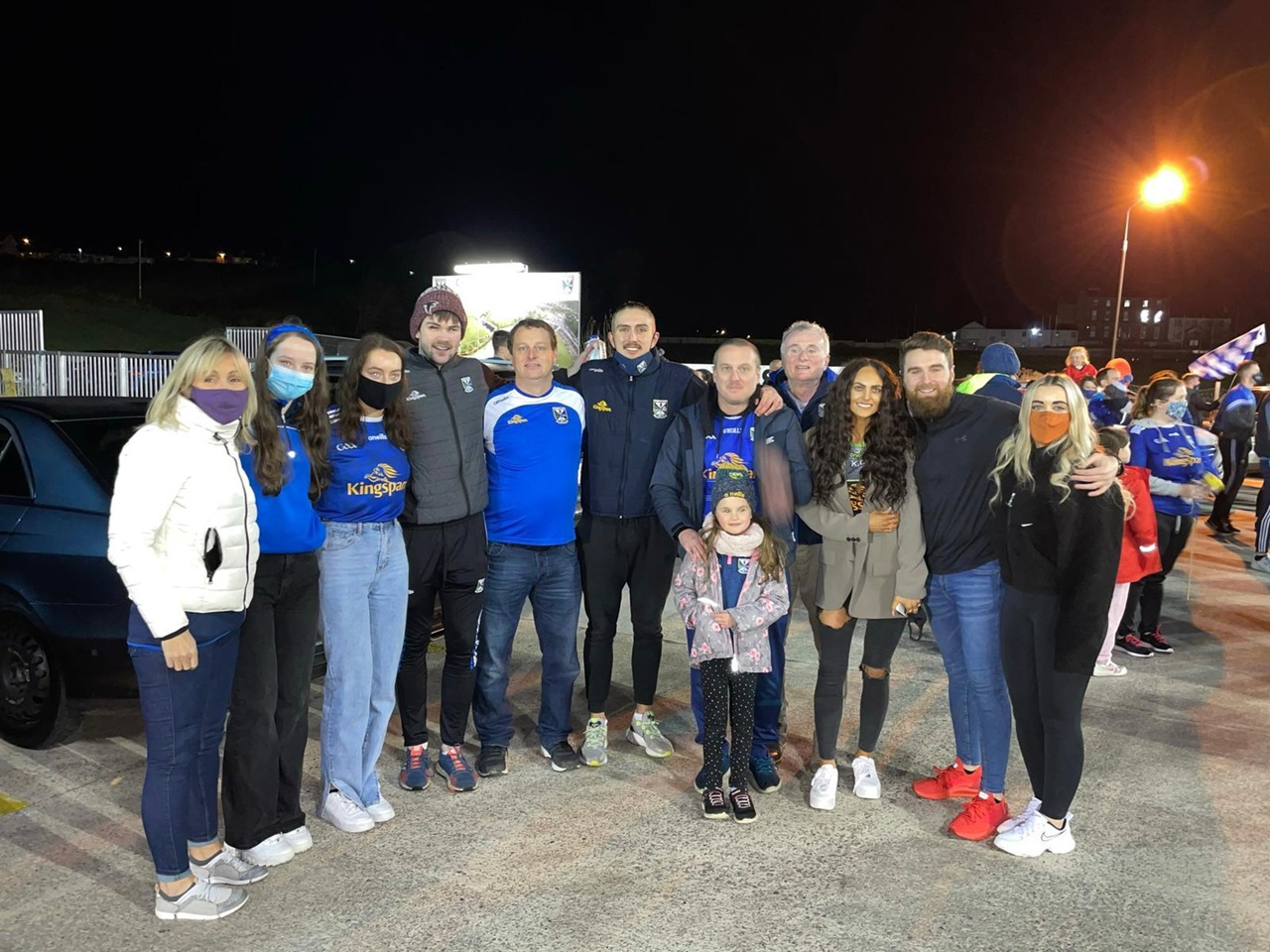
HOMEHOME HEROES…The Clarke family welcome Killian Clarke, a teammate Thomas Galligan, after Cavan’s Ulster final win over Donegal in 2020
“With the players we had and the pedigree that those players had as well from their underage success, it’s something that you’re chasing,” he continued, pinpointing the level of persistence that eventually broke down the door.
“For eight years of my life, putting stuff on hold for the purpose of winning an Ulster Championship with Cavan, Mickey likewise and Raymie as well.
“He was a centre forward in his early days and then was converted to a goalkeeper later on.
“The level of application he would have had to become a goalie and the hours he would have put in. That’s what it meant to his family and friends and the people around us.”
Many success stories are painted around a team bus edging out of a venue with a cup gleaming on the dashboard of the bus.
Cavan’s 2020 homecoming was different. Totally, totally different. In a summer of fears for no sport, players trained in pods and travelled to games in their own group.
On that drive home from Armagh, as an Ulster senior champion, Clarke travelled alone.
“There must have been eight bonfires on the side of the road the whole way home,” he explained of the roads through Armagh, then Monaghan and eventually back over the border.
“It was a big convoy on the way home, with the beeping of horns and all of that.
“I was thinking this is mental. I was ringing my father, ringing my partner (Louise), ringing my mother, my brother and just thinking this is crazy.”
Clarke contrasts their win to Dublin winning Leinster. Up the steps. Lift the cup. A word or two. A few thanks. No emotion. Winning is just an expectation. Back in Cavan, it was mental. Men of all ages crying. They’d never cried before.
“Their wives and daughters were nearly slagging them and like,” Clarke joked.
“We knew what it meant to everyone around us and what it meant to everyone personally as well.”
It was all built on that culture of success in the u-21s. A dream. A thought. A hope. A willingness to keep on chasing.
“It’s difficult to carry through the level of commitment because the u-21 is a competition that runs for three months of the year,” Clarke explained.
“Your senior competition runs for nine months of the year, realistically. It’s hard to sustain that level of commitment throughout a full season.
“We would have carried a lot of that culture into the senior team and set those standards for ourselves, missing those holidays, those events with family and those weddings.”
The goals were two-fold – leaving the Cavan jersey in a better place than when it was handed down and bringing home the Anglo Celt Cup.
“We landed back in Breffni, down in the back car park with a lorry set up. There was a drive-by welcome organised, so anyone that wanted, could jump in the cars and drive by us on the back of the lorry.”
The queue snaked all the way out the driveway, up onto the Dublin Road with the last car driving back home in the wee small hours.
Is there a regret the success arrived in the middle of the pandemic when the thronged streets of Cavan, welcoming them home, just wasn’t an option?
Clarke just accepts it for what it was. The old saying ‘controlling the controllables’ is there for a reason.
“It was meant to be that way,” he added. “It’s something I won’t forget at any time soon. It’s not something I look back on, saying ‘oh, I wish, I wish’, it’s something I’m very happy with and content.”
One of the photos Clarke has locked away forever more is the image of his family standing at the back of the stand in Breffni on that night.
The level of support to play at inter-county level is insane. Only those in the inside really know.
“I was very lucky, I had a father that would drive the country for me, to bring me to any game I ever wanted to go to or that I was playing in,” he said.
There was a night game for Ulster University on the day he jetted back into Dublin after being on an All-Star tour.
After telling his father he’d give the game a miss, he wasn’t hearing it and drove his son all the way to Derry where the game was.
“Paul Rouse and Tommy Joe (Farrell), were very happy to see me,” Clarke pointed out.
“It was just a good summary of how my father went about his business, and how he pushed me, to get the best out of me.”
“It was like the soccer, my mother and father, drove us to St Patrick’s Athletic in Dublin, probably a two-hour drive from my house in Shercock.
“My brother was on the team and they used to drive the two of us up, three times a week.
“Your family definitely put their life on pause and I was very fortunate that I had a family that knew the commitment I had to my football.”
Things like making it to Ireland International Rules training on the day of his aunt’s wedding, showing up later on, after the grub, for the night’s craic.
“In my head, it was something I needed to do, and my auntie was very understanding of it,” he added.
It’s the same with his now fiancée Louise. She’d love to have gone travelling the world or heading away on a holiday at the drop of a hat.
Coming from a footballing family herself in Mullahoran, sister of Cavan ladies’ star Aisling Sheridan, she knew the importance of the blue jersey and the commitment.
“I needed to give everything I could to put myself in the best position to play,” he added.
“She put her life on pause for a while as well, to allow me to achieve my goals and my dreams over a number of years.”
There is another part of the family now, their 11-month-old son Oscar. With retirement thoughts looming, it’s an extra level of perspective.
There is a value of going on to be a Cavan with 150 appearances versus living those important family moments with Louise and Oscar. Football is important but you can never wind the clock back.
It wasn’t the only factor in retirement. The aches and pains from a lifetime of hammering into tackles and breaking balls also found their voice too. They’ve been louder in recent years.
“I was struggling for game time then because my fitness wasn’t where it needed to be,” he said.
“I probably was disappointed with how last year finished. It’s not something I went into last year thinking to myself, ‘oh, this is my last year’. It was probably just the way things worked out.”
A clot in his lung limited his time with Shercock last year in the intermediate championship. The high-intensity training load of a lifetime wasn’t an option.
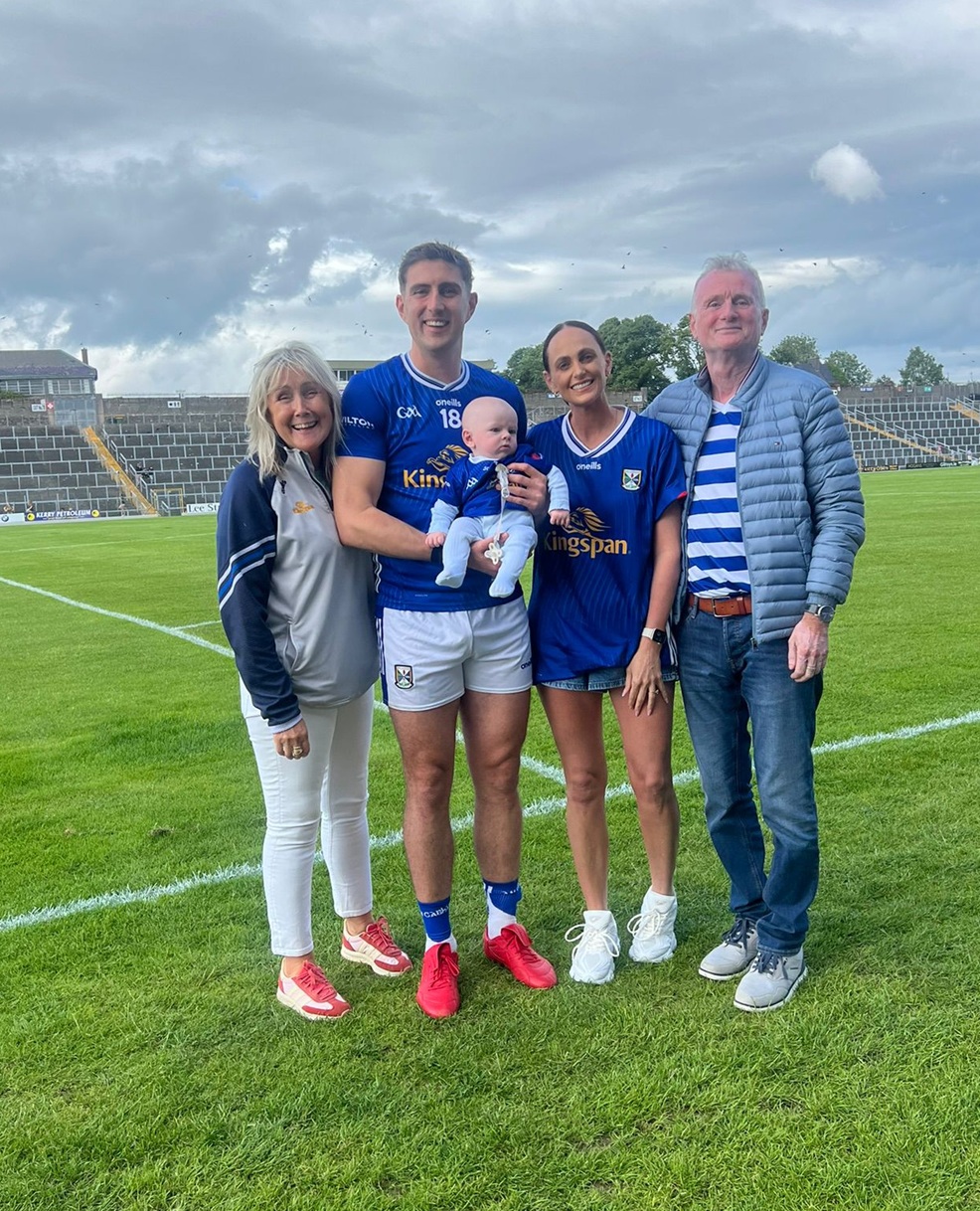
BREFFNI SEND OFF…Killian Clarke pictured with his parents, Sean and Mary, his fiancée Louise and their son Oscar after his last day in a Cavan jersey, against Kerry in Killarney in 2025
It was hard to see where the inter-county minutes would come from in 2026.
For now, he isn’t missing football. Shercock will keep him ticking over and there is now more time for family.
“I don’t know how I had the time to do what I’d done as well,” he joked. “There’s more than enough in the club football for me at the minute to keep me going.”
The media involvement keeps his finger on the county pulse too. There is satisfaction that comes from his career too.
Ulster medals at all levels, playing in both the Railway Cup and the International Rules were other times he got to show his worth.
His first season with Ireland was on the extended panel for a home series but he played in 2017 campaign down under.
“I ended up rooming with Niall Grimley for the majority of that trip and you wouldn’t meet a bigger gent,” Clarke said. “I would say that comfortably, even last year, we were texting each other, just checking in.”
The other value of the trip was gauging himself against the top players from across Ireland and the Australian professionals.
“It was interesting to be exposed to the top level of preparation, training and analysis.
“It gave me the realisation as well that Cavan was not that far off where we needed to be.”
He dipped his toe into coaching last year with the club u-20s and he is helping Liam Brady out with the Cavan u-15s.
“It’s definitely something I’ll be looking at more whenever the legs give way or the appetite for playing is gone,” he said.
“I’m going to try and play as long as I can because that day will be taken away from me regardless of what way I cut it up.”
After 134 appearances for Cavan, Clarke’s legacy is simplistic. He hopes he left the jersey in a better place than when Hyland gave it to him on that night in Breffni in 2012.
“I think I developed a lot of relationships with all the players, not just the starting 15 but anyone that was involved with the panel,” he added.
“I always tried to touch base with them, give them that shoulder to see if it could help them out in any shape or form.
“I obviously tried to get the best out of myself but wanted to make sure that everyone had been looked after and heard.
“The likes of Mark McKeever and Ronan Flanagan, when I came in first, they put their arm around me, telling me if there was anything I needed, I just had to ask.
“I tried to treat people as I like to be treated myself. I thought that was a really nice touch from some of the older stock that I came into.
“I tried to portray that as well with the players that I was dealing with, to set those standards high and set the demands high so the next generation can follow.”
If the young players can learn one thing from Clarke it is to meet the word ‘no’ with the word ‘why’.
As a first-year minor, he didn’t have the pace to play in the full-back like. A lesser man would’ve thrown the toys out of the pram.
Winners find a way. Clarke asked Craig Lynch how to get faster and was an Ulster minor and u-21 winning defender within two years and on his way to an All-Star nomination.
Another word is persistence. When many thought the Anglo Celt Cup might never return, Clarke merged no with why and got why not.
Lesser men give up but it’s a box Killian Clarke doesn’t tick.
Related posts:
Receive quality journalism wherever you are, on any device. Keep up to date from the comfort of your own home with a digital subscription.
Any time | Any place | Anywhere
Get the app for the best Gaelic Life experience