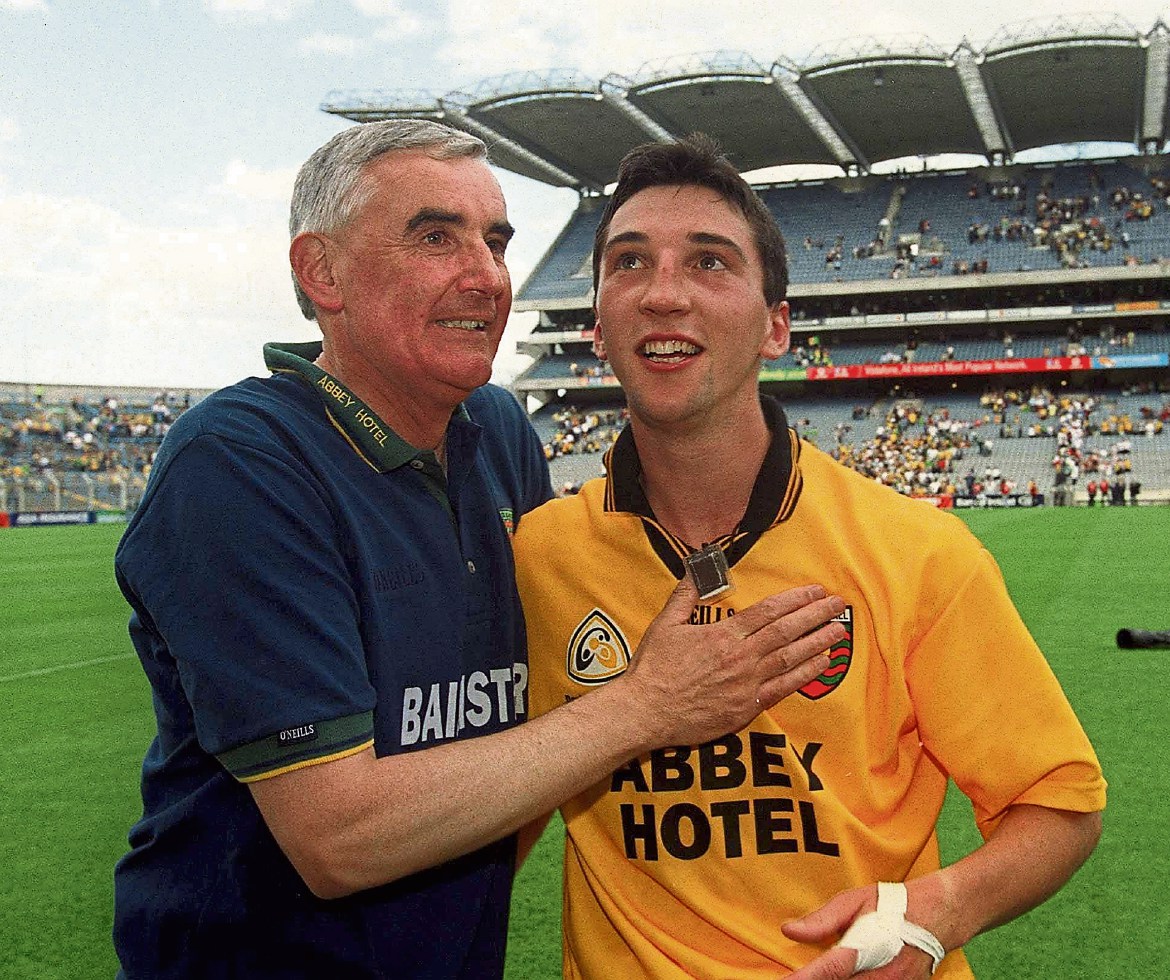


IN 2001, Mickey Moran took over Donegal alongside coach and friend, the late John Morrison. In that first season, Donegal lost their preliminary round championship match to Fermanagh, but in an odd twist, the first round of the new Qualifiers they met Fermanagh again and won. However, Kildare beat them in round two.
The tactics in those days were simpler than they are now, but more advanced than the catch-and-kick style of many years before.
Michael Hegarty, who was captain in 2002, explained:
“The way things were, tactics weren’t the number one the way things are now.
“At the time we had good enough footballers. In club football there was the trend of taking a corner-forward and maybe using him around the middle. That was the trend carried on into intercounty football.
“When Mickey Moran was in charge, the thing Mickey worked on was everyone being good on the ball and being comfortable on the ball. When he came on board everything was about the ball.
“We went out and we tried to keep the defence tight, and that meant keeping it closed in.
“Then we would try to keep it wide up front. It sounds simple but that was the way we played the game. We felt that we had good enough footballers.”
Hegarty said that the freedom to express themselves, and the need to for players to be confident, was developed.
“Some players might not have been comfortable on the ball, but we just did a lot of work with the ball. As the year went on players grew in stature and they expressed themselves more. That grew into the way he wanted the game played. That year in particular the team played terrible well.”
That year was 2002, when they went on a fantastic run all the way to the Ulster final, beating Cavan, Down and Derry along the way. Then in the final they couldn’t get past Armagh.
“If you look back at that game they got a goal that was a dreadful goal to concede. We missed a lot of chances. I think there were 13 or 14 wides. We weren’t found wanting as far as playing football, and we were able to compete. We were able to play open football. I think the players loved that. They were good, open matches. They were helter-skelter, and great championship football.”
The loss to Armagh sent them into the Qualifiers where they beat Meath in round four, and then they were headed for a clash with Dublin.
Hegarty said in those days there was no laborious studying of the opponents, or analysing who should pick up whom.
“Our corner-back just picked up their corner-forward. That was it. At that time we felt that any player we had was good enough to pick up any individual. Nowadays the whole team is nearly locked in to pick up three or four players. That’s the way it was. I think that was the way football was played in those days.”
Darren Magee marked Hegarty in that game. Magee didn’t start the match, he had went on as a sub after 10 minutes to replace Paul Casey. Hegarty played centre half-forward that day.
“It was 15 on 15, throw in the ball and away you go. Tactics might have been just telling us who you were marking. Nowadays you would get told what foot your marker kicks with, and how he passes the ball. It is so detailed now.”
The Donegal team went out against Dublin feeling that they were good enough to win, and they had the freedom to make the decisions for themselves.
“We had a lot of players who were able to compete against anyone and that first game showed that. We probably should have won the game.”
The game was a battle from the off and Dublin tried to bully Donegal with physical play. Brendan Devenney and Adrian Sweeney were the two attackers and they combined well to get the better of their markers Paddy Christie and Coman Goggins.
However, Dublin got in for a goal from Ray Cosgrove after 16 minutes. Yet their chances were few and far between, and Donegal should have been further ahead but for a missed goal from Devenney. John Gildea had a fine game and provided a great platform for attack, while Damien Diver came on to replace Barry Monaghan and his experience settled Donegal. At half time they trailed 1-4 to 0-6.
Jim McGuinness came into the game well in the second half and Donegal edged three ahead, but Dublin hit back with Cosgrove’s second goal.
In the 42nd minute Stephen Cluxton made a great save to deny Brendan Devenney a goal. Adrian Sweeney showed great heart to score the equaliser and Donegal hung on for a deserved draw.
“It was the goals that kept Dublin in the game, and we should have won the game. We had them outplayed. We hung on to get the equaliser at the end.”
With regards tactics, while Hegarty said that there wasn’t a lot, there was still an element of understanding there.
“I knew how the two boys inside (Sweeney and Devenney) worked.”
Hegarty’s reflection on the match was one of dismay.
“We definitely should have won the first match. I was watching TG4 and they showed the Dublin Armagh semi-final and Dublin probably felt that they should have won that semi-final. It is interesting the way football went. We always felt we found it hard to beat Armagh and we should have beat Dublin. But that is knockout football and it made it exciting.”
As it was, Dublin regrouped for the replay and were convincing winners 1-14 to 0-7.
But the lesson according to Hegarty is that the Donegal team that season were confident on the ball and believed in themselves –they just missed a few chances that would have made the difference.
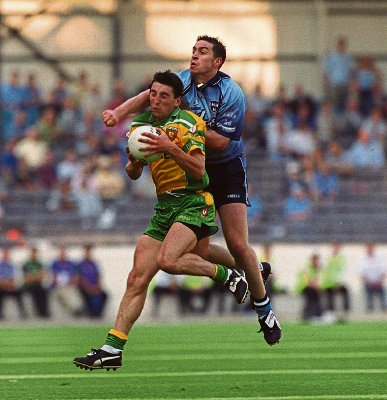
BETTER… Michael Hegarty says Donegal were the better team against Dublin
BALL WORK… Mickey Moran encouraged players to be confident on the ball
Receive quality journalism wherever you are, on any device. Keep up to date from the comfort of your own home with a digital subscription.
Any time | Any place | Anywhere
Get the app for the best Gaelic Life experience