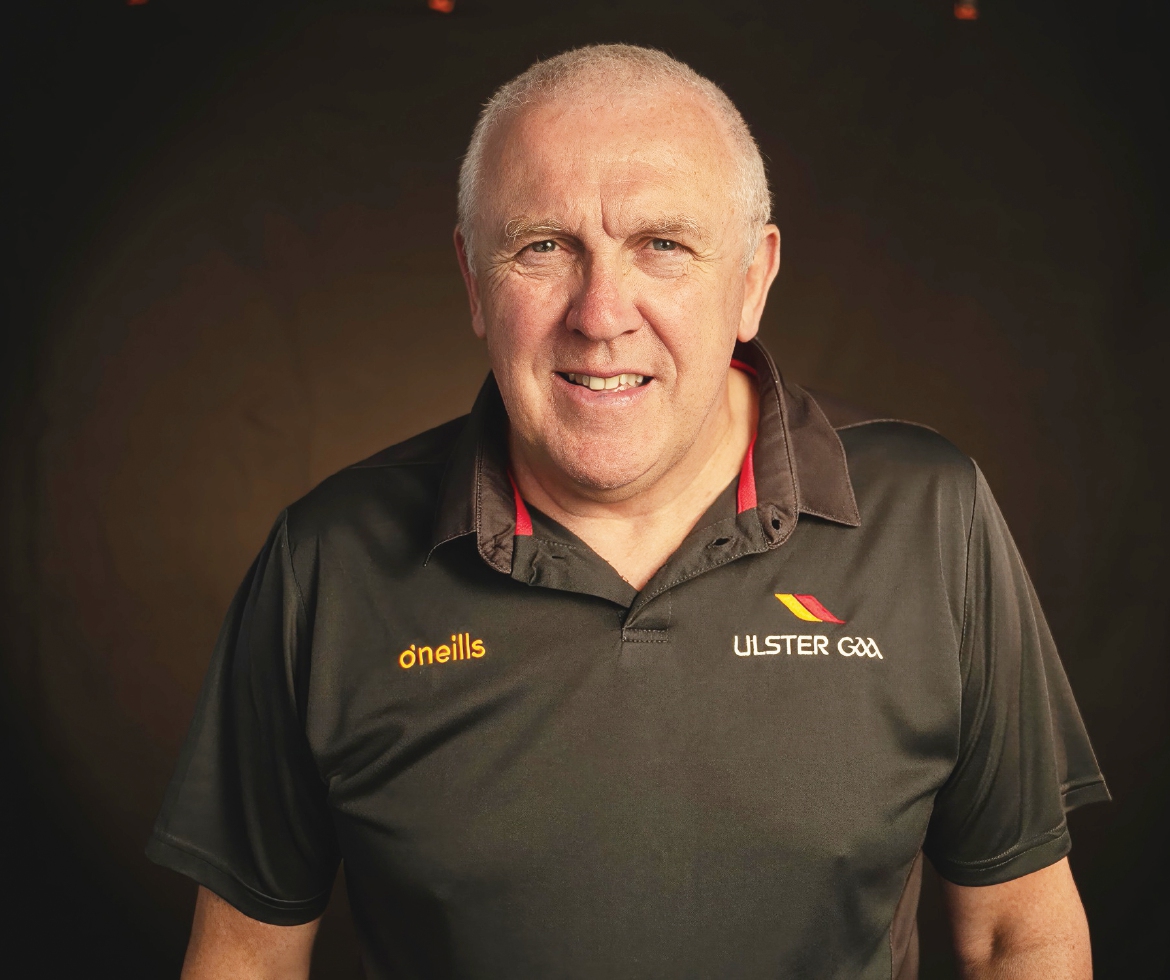


Eugene Young recently retired from Ulster GAA last month after 25 years. He was the director of coaching and games development. He sat down with Michael McMullan…
ON the face of it nothing has changed in Eugene Young’s world. Sitting in Magherafelt’s Terrace Hotel, on the second Friday in January, sport, and GAA in particular, envelop every sentence.
He is nine days into retirement but sport is everywhere. It’s all he has ever known. An interview on these pages a few years ago says it all.
A club career in Moneymore has taken him full circle and he is back coaching his grandson’s u-6 group. Another generation of sport.
An education in St Patrick’s, Armagh took him to a couple of MacRory semi-finals and a Corn na nÓg title.
The school’s basketball team was the passport to another world. The Ireland u-15 team gave him a taste of life across the Atlantic.
Basketball took him to Dungannon and, during his university days in Jordanstown, to St Gall’s and a decade in the National League.
He went on to represent both Ulster and Ireland in basketball. Sport was everywhere. Playing alongside Gerry McElhinney with Derry, there was a brief soccer stint with him in Distillery before basketball pulled harder at whatever time outside of GAA he had.
Before the days when Patrick McBrearty and Benny Coulter did it, Young played minor and senior on the same day for Derry.
He came into the Derry team after their back-to-back Ulster winning teams of the mid-seventies, his last season coming in 1990, a championship season when he played against Fermanagh at the reopening of Celtic Park.
He played on the Derry team that beat Kerry and Cork on the way to the Century Cup semi-final in 1984.
Sean O’Neill saw enough of him, as a 20-year-old, to call him into the Ulster Railway Cup team and he bagged two goals in the final.
He remains one of a few, if any, to have played for Ulster in both basketball and football.
Growing up, Young modelled himself on the great Sean O’Connell, as an inside forward or at midfield. Frankie O’Loan was another inspiration.
Young would go and fetch the balls when O’Loan was kicking frees at practice sessions back in the day.
On the education front, he graduated as a PE teacher before moving into lecturing in sport at UUJ.
For the last 25 years, he has been employed by Ulster GAA, signing off as the director of coaching games development at the turn of the year.
It began with a three-year stint as high performance director with the Sports Institute, based in UUJ, looking after the GAA academy, a model that has morphed into the development squads ran by counties across Ulster.
“As part of that programme then, we had a squad of 20 players in the Institute,” Young recalls of a squad picked from the minor panels across Ulster.
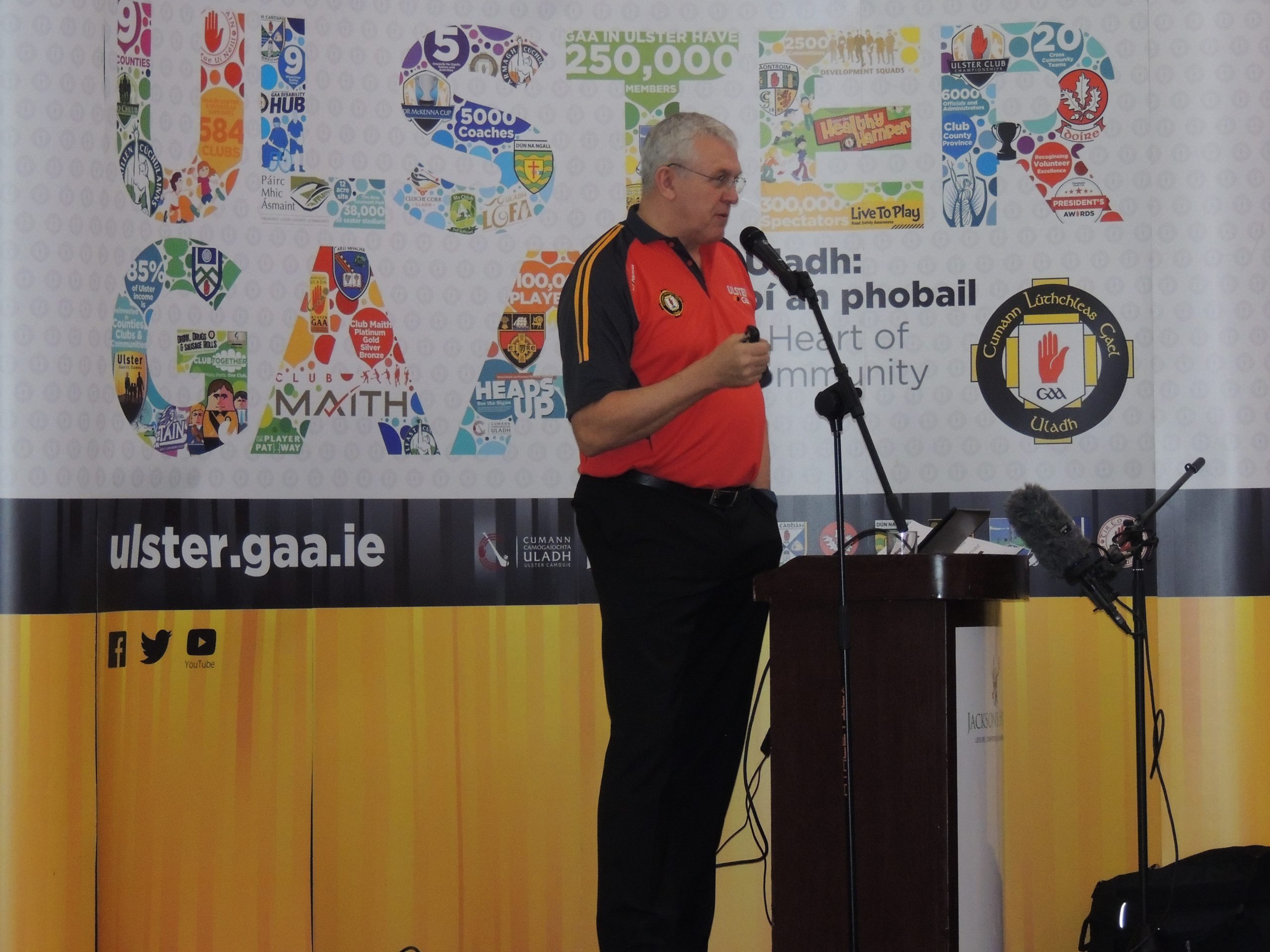
SPREADING THE WORD…Eugene Young delivers his talk at the Ulster GAA Coaching Conference in 2017. Photo: Ulster GAA
“We had the likes of Gerard O’Kane and Karl Lacey. There was Dermot Carlin from Tyrone and Kevin McGuigan from Down.”
They were all students at the time apart from Derry’s Patsy Bradley who’d be in Jordanstown for six o’clock in the morning for a weights session on the way to work in the family streetlighting business.
“The purpose was to try and generate an interest in high performance sport,” Young explained of his remit at the time.
“It was so these lads would go back into their counties and be the ambassadors for it.
“We wrote the first strategy in 2002. The vision was to have nine sports institutes, in each county and nine development programmes.”
When Down complete their base at Ballykinler, all nine Ulster counties will have their own dedicated base.
“The reason we wanted to go with that plan was it meant that all the counties would be treated on a similar basis,” he added.
Some counties were beginning to get their house in order but Young was dispatched to Australia with a three-week brief of digging into their sporting spine – AFL and rugby.
“The model I saw that worked best was in Melbourne with the soccer team,” he explained.
“The players were scattered, a bit like our players would be scattered over the nine counties.
“The coach there brought them in twice a month on weekends.”
All the boxes were ticked. Nutrition, strength, conditioning, tactical work, video analysis and pointers on technique.
“All of these players then went back into their own environment and then came back,” Young added.
“I thought, right, maybe this model will work for us. If we bring boys in, try it out, give them all the services.
“We’d try and encourage them to go back into their counties and tell them what’s going on.”
The word spread. Back in Sleacht Néill, Bradley’s story of early morning gym sessions added to his growing reputation.
Further down the line, Lacey is now running the academy in his native Donegal.
The other element was a delivery of coach education workshops.
Young recalls Denise Martin holding a session in Cookstown’s Loughrey College. Peter Quinlivan worked at the college.
“Peter sat in on it and is actually related to Mickey Harte,” Young pointed out.
“He saw the software and all that was going on. All of a sudden, he was on Mickey’s backroom team doing the video analysis.”
McGuigan now leads up the sports science and sports medicine in Swim Ireland, where he played a part in Olympic glory for Daniel Wiffen and Mona McSharry.
*****
With Young’s secondment approaching an end, Danny Murphy insisted he return to Ulster GAA in their new base in Armagh.
He can still remember Murphy’s pitch. Modernisation. Integration. Coach development. Cross community. The lot.
The remit was significant and long-term. Young ticked all the boxes they needed and accepted. He was in.
Many people have helped lift the load, but the results are there, support structures to help counties stand on their own two feet.
Alongside that, there is an Ulster academy that comes together every summer with the most promising youngsters across the province. They get all the advice they need.
Gone are the days when Ulster was the forgotten land. Back in the day, Ulster and Connacht teams used to love drawing each other in the All-Ireland semi-finals.
In the day of Kerry and Dublin, Ulster were nowhere in the overall big picture. Not anymore. Kerry are once again the county to catch, but the building blocks are now there.
A reminder is only two years old when every All-Ireland football title, with the exception of the Division Three league, resided in Ulster. Club, school, college and county.
It didn’t happen overnight. The story is one of persistence. Young hails the mountains of heroes – the coaches.
“When I came in, the only thing available was an introductory coaching award,” he said, comparing it to the provisional driving licence.
“There was a level one (course) but there was no level two, and there was certainly no level three.”
The level two course was a major hit, with the residential element allowing a weekend of learning and networking.
The thirst for knowledge was only beginning and a level three course was added, accredited by OCN, Open College Network.
“Liam Dunne came up to that course from Wexford,” Young added.
“There was some craic at it, with the banter, the slagging and the challenging each other.”
Another string to the bow was the Ulster GAA coaching conference at the Glenavon Hotel that has stood the test of time. The latest edition takes place at the end of January.
“Even during Covid, we ran it online,” Young added.
“We ran our coach development program, through workshops.”
There were different elements to give coaches extra knowledge they could bring to their coaching session.
“There is developing the big man which Peter McGinnity and I took in Monaghan one night and Tony (Scullion) is out regularly,” he added.
It lifts the bar for some coaches. For others starting, not working in a PE environment, it arms them with the information to translate a love of the game into the confidence to run a coaching session.
In some cases, those in attendance videoed the sessions to share with fellow coaches across their county. That was the power of spreading the word.
“There was a fellow called Istvan Bali, he was a great friend of ours in Ulster GAA,” Young added of the international speaker on long-term athlete development.
“It was a very technical thing but we simplified it for Ulster GAA. We had this poster that we put out around the counties.”
Young found himself looking at it as he put the finishing touches to his plan for a session with Moneymore u-16s.
“As an experienced coach, it was a great tool, in terms of saying, I’m going to go at that tonight with these boys,” he added.
That’s what Danny Murphy’s long-term vision brought in spades and it began right at the grass roots.
Terence McWilliams swapped a career in the education sector to pull together a plan to teach primary school children the fundamental movement skills.
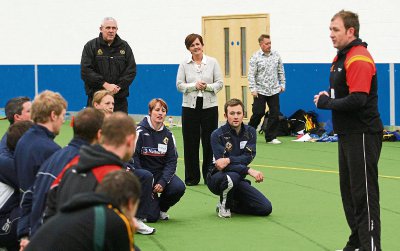
WORKING TOGETHER…Department of Education Minister Caitríona Ruane, centre, along with Dr Eugene Young, Ulster GAA council director of coaching and games, watch on during a GAA/IFA schools coaches training day back in 2008
“Caitríona Ruane, Minister for Education at the time, she got onside with it,” Young said of a venture run in conjunction with the IFA.
“She asked us for a meeting, and through that meeting we secured the funding for 30 coaches, to go into the primary schools.”
It was a programme directed at teachers and coaches of the youngest kids that lasted almost a decade and was recognised with a UK award.
Young can still envisage a video from one of the sessions that has been used at conference to demonstrate bilateral skills.
A kid at Glen Primary School, outside Maghera, standing on a bench with a hurl in hand.
“The boys were throwing balls at him and he was hitting them left and right,” Young said with a smile.
“It was bang, bang, bang, bang. Balance, coordination and hand-eye coordination.
“We created that, so Terence was a big driver for us and we transferred that into the clubs.”
Roadshows began around all nine counties with clubs invited. Young can still see one of the early ones in Maghera Leisure Centre, there with Scullion and McWilliams to get the wheels in motion.
Young laughs as he uses Scullion’s now famous ‘Maghera was bleck’ reference to Derry’s All-Ireland homecoming with Sam Maguire.
“There must have been 250 people out,” he explained. “We ran a series of stations, doing fundamental movement skills and took questions.
“It went down really well because I think our clubs were struggling. All of a sudden, it wasn’t just about u-12s, it was about u-8s, and u-6s.
“I’m in with the u-6s in Moneymore and believe me, I’m glad I know some of that because I would be lost otherwise.”
The success, for Young, over the last quarter of a century has been about the team of coaches at Ulster GAA, their experience, drive and passion.
“When you bring quality people in and they’re really interested in driving it on, you can make them inroads,” he said.
He can’t speak for the future but while there is room for areas to be refined, the structures that work must remain.
The links between teachers, coaches and volunteers are the basis of all things development.
So, two throwaway questions. Firstly, based on his basketball background, is there any common theme in coaching both sports?
While the size of the playing arena is different, Young references the switch pass. Play going from side to side on the basketball court, missing the player in middle.
He compares it to Armagh under Joe Kernan and their diagonal ball. Aidan O’Rourke or Kieran McGeeney’s diagonal ball to the opposite corner.
“The zone defences obviously are very much basketball-oriented as well,” he added.
“I was running a coaching session, a basketball session in the Greenvale (Leisure Centre) in Magherafelt,” he said of another example.
“We had a game called ‘wide man’ with a runner up and down the side, as extra players.”
There is also the cluster tackle, used famously by Tyrone to hunt down the Kingdom’s crown jewels on the way to lifting Sam in 2003.
“That’s a basketball thing,” he said. “Double team, triple team. So, there are some similarities I would say.”
The second question. In relation to Kerry, for all of Ulster progress, how can teams bring a sustained challenge to take on the game’s highest achievers?
“I thought we’d cracked that, it shouldn’t be about Kerry anymore,” Young said.
“It must be something to do with how they’re coaching and what they’re coaching down there.
“A lot of it comes down to passion as well. If you have a passion for it.”
Young references his native Derry’s recent push that brought back-to-back Ulster titles.
“There was a real passion in that squad and I think that was coming through,” he said in conclusion.
“You need to have a passion for it because technically, tactically, a lot of the teams, and physically, are very much on a par now.
“It comes down to resilience and belief and a passion for what you’re about.
“I’m looking forward to seeing our own county this year and seeing some of that back.
“Then all the other counties are doing it as well. You think of what’s coming through Tyrone at the minute, it’s amazing.”
As the minutes pass on a tranquil Friday afternoon in Magherafelt, Young has all the time in the world.
Retirement is a recent and totally new phenomenon. He’ll continue to watch sport, love it and talk about it.
Formally, Moneymore u-6s are his immediate focus. The more things change, the more they stay the same. Sport changes without ever going away.
Related posts:

Receive quality journalism wherever you are, on any device. Keep up to date from the comfort of your own home with a digital subscription.
Any time | Any place | Anywhere
Get the app for the best Gaelic Life experience