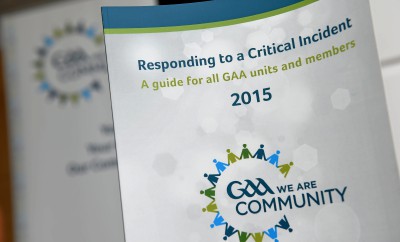


AN important programme within the community and health arm of the GAA is a club’s response during a time of crisis. We are all aware of the unique role our GAA clubs play in times of great need within our communities.
In order to best prepare for such circumstances, the GAA has developed the Critical Incident Response Plan.
Every GAA unit is asked to adopt their own critical incident plan; and all templates and resources needed to develop a plan can be found at: https://www.gaa.ie/my-gaa/community-and-health/community-personal-development/cirp-training.
What is a CIRP?
It is a template developed by experts in the field, which aims to equip clubs and counties with a pre-agreed response to critical incidents which may, unfortunately, occur in our clubs and communities. The Critical Incident Response Plan (CIRP), although developed by the Community and Health Department of the GAA, is a plan which the club executive are responsible for overseeing.
Unfortunately, there will be times when a club or community will be affected by a particularly challenging situation – what we call a ‘critical incident’.
A ‘critical incident’ is defined as a situation that overwhelms a person’s/club’s natural capacity to respond. Certain situations, due to their severity or complexity, can overwhelm a club or county’s natural capacity to respond.
The Critical Incident Response Plan (CIPR) has been developed to assist clubs to deal with these extreme situations.
We are all aware of the invaluable support which GAA clubs offer in times of loss. Clubs can quite easily rally in relation to arrangements for wakes and funerals; and more generally for the social network our clubs provide within communities. GAA clubs up and down the country will continue to provide this crucial support, as it is what we do best.
No guide or plan can account for every possible scenario, however, the CIRP aims to highlight some key principles, roles, duties, and support systems that will better enable a club make its way through the most difficult of times.
The resource will support our units in such times by reassuring them and offering a pre-planned response which will minimise the negative impact, and give the best support possible to those most in need.
The aim of the guide is to help GAA units at all levels to:
– Better understand what a critical incident is.
– Develop and maintain their own critical incident response plan.
– Follow recommended practices when supporting community responses to critical incidents to the best of their capacity.
– Ensure a consistency of care for all members following an incident regardless of the situation/location.
– Identify and access the range of national and local support services that are available to them in such circumstances.
Preparing a CIRP in advance will better prepare GAA units for the challenges such situations may present.
Although it is something no club wishes to have to use, it is worth taking the time to plan your response should the worst happen.
Feedback from clubs who have had to implement their CIRP have found it to be invaluable in dealing with the critical incident which their club faced. It is also important that the CIRP is reviewed immediately after a club AGM or county Convention so that it is updated to reflect new officers.
For more information on a club’s CIRP, contact Ulster GAA community and health manager Maura McMenamin on maura.mcmenamin.ulster@gaa.ie.
Receive quality journalism wherever you are, on any device. Keep up to date from the comfort of your own home with a digital subscription.
Any time | Any place | Anywhere
Get the app for the best Gaelic Life experience