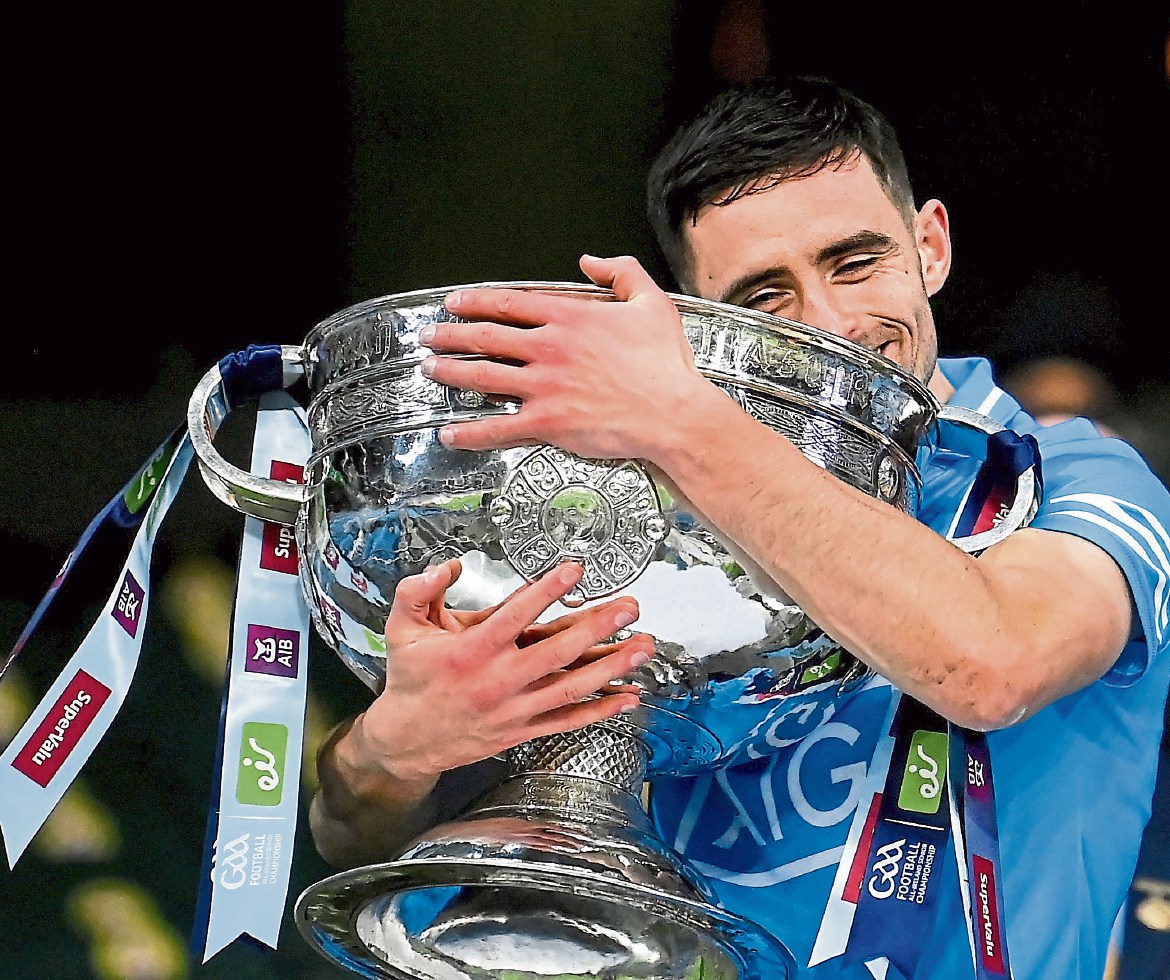


The week of the All-Ireland, Jim Gavin said to me that I might be overlooking an important factor.
“Jack O’Connor has never won back-to-back All-Irelands.”
“Is that important?” I said.
“Nothing could be more important. If Kerry win on Sunday, the two-in-a-row gives him an opportunity for three-in-a-row. So long as he knows how to do it.”
I should have learned by now that when Jim tells you something, you listen. A few days later, O’Connor duly blew it, again.
As Kerry manager, he has won five All-Irelands with various teams, spanning 2004 to the present, but he has never managed a back-to-back.
It was obvious that Kerry were all wrong against Mayo. After going 1-5 to 0-1 up, they believed it was over and switched off. It was as clear as the lights being turned off.
Jack eating the arses off them at half time was a purely rhetorical gesture. The final had been lost in the previous 12 months.
As Martin McKenna, the steward outside the Dublin dressing room during the time when they had more back-to-backs than Donald and Melania said to me, “I’ve never heard a voice raised before the game or at half-time. It’s the only dressing room where they just have a discussion. And I’ve never heard Jim Gavin’s voice.”
On that point, Jim told me once that pre match team talks or at half-time in the changing room are pointless. Typical of Jim, he had the evidence to back that up.
He told me that he used to give those talks. He then asked a psychiatry intern to do an evaluation of their usefulness.
“So, this guy spoke to the lads the evening after the games and he asked them what they could remember of the talks. He would ask Johnny Cooper what instructions I had given him.
“Johnny would say, “To be honest, I’m not too sure.” Michael Darragh would say, “Jaysus, I can’t remember.” and so on and so forth. So, I stopped doing them as they were pointless.”
Before Dublin won six-in-a-row, the last team to win back-to-back was Kerry in 2006-2007. Before that, it was Cork, 1989-90.
When we won in 1993, the legendary Kerry full-back John O’Keefe wrote in the Irish Times, “This Derry team looks set to dominate Gaelic football for a decade.” The following June, we were beaten in the first round by Down.
We had annihiliated them by 11 points in Newry in the first round in 1993. In the week leading up to that 1994 game, Eamonn Coleman stood up on the bench in the Celtic Park changing room and couldn’t stop laughing as he told us Down had booked their hotel for the All-Ireland final weekend.
Which we all had a good chuckle at. We weren’t laughing that Sunday when a last minute goal knocked us out. We had become distracted by the status, the adulation, the lack of humility.
There are many reasons why retaining an All-Ireland is so complex. The most important one is humility.
As Pat Gilroy put it to me recently, “the reason most teams cannot continue to win is lack of humility. The Kerry team in this year’s All-Ireland final for example thought they were bulletproof. They thought they knew it all. They thought sure it’s only Mayo. So, they were distracted. When this happens, humiliation is inevitable.”
Me: Go on
Pat: To do it again, the manager has to carefully figure out how his team can be beaten. He must work out what else they can bring. Essentially, they are playing against themselves. Winning changes the conditions that created the first success.
Me: Explain:
Pat: Players’ natural tendency is to protect their status, position on the team and reputation. The fear of losing takes hold and replaces the freedom that helped them win.
Champions start to overlook small declines in hunger, standards, recovery and connection with team mates. Last year’s habits are repeated automatically, even when opponents and circumstances have changed.
Me: Basically, success creates comfort?
Pat: Exactly. To overcome this, the team must find a new challenge without manufacturing pressure. The biggest change is expectation. The first championship win is freedom and energy. Defending it is expectation, control, tension. The trick is to recognise the outside pressure but not carry it. The group, under the manager’s constant guidance, must detach themselves from last year’s title, reputation and outcome. Then, they must accept this is a new team, a new season, a new challenge.
Me: Sounds good but how do you achieve this?
Pat: You celebrate and close the previous campaign. You rebuild trust and roles. You refresh tactics constantly as opponents will adapt. You give emerging players genuine responsibility. You judge players by daily behaviours, not what they were last year. You keep stretching the players – safely. You treat mistakes as information. You cannot defend last year’s championship. It is already won. The key is to become good enough to win the next one.
As Pat went through the checklist, it struck me that Jim Gavin ticked every box. Jim told me once that the Dublin team learned to play against themselves. I wrote it down. Here it is word for word:
“So, Joe, we had a metric for the group. Every possession is an attack. Let’s say our metric in a given year was 19-14-11 for each half: 19 attacks, 14 shots inside the scoring zone, 11 scores. That’s all I would talk about.
“Through constant repetition and getting the lads to talk about it, it gradually became our focus. At half-time, the lads would say we only got 12 shots off, two short. Or we only got nine scores. They were the ones discussing it. Eventually, it got to the stage where the opposition was irrelevant. The lads were genuinely playing against themselves.”
Which reminded me of something Colm Cooper said to me. I had asked him what it was like playing against that Dublin team. He said, “It’s as if you aren’t there. They just totally ignore you.”
This sort of far-sightedness and insight is virtually impossible to put into practice. You can have the blueprint. You can sit with Jim like the young Kung Fu sitting at the feet of Master Po, absorbing everything, but it won’t make any difference, unless you are Jim.
Which Jack O’Connor isn’t.
Related posts:


Receive quality journalism wherever you are, on any device. Keep up to date from the comfort of your own home with a digital subscription.
Any time | Any place | Anywhere
Get the app for the best Gaelic Life experience