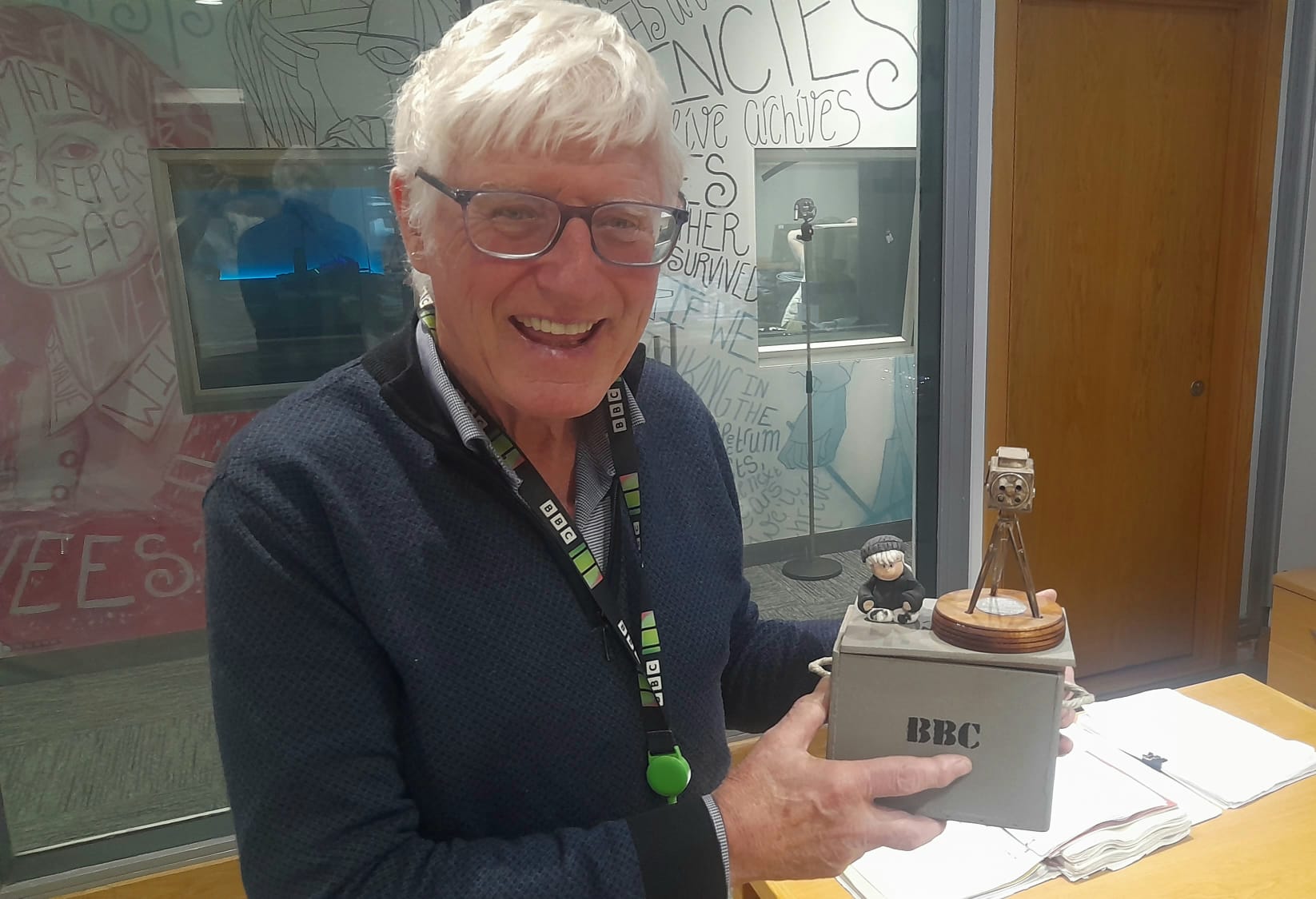


Cameraman John Otterson was the BBC’s longest serving member of staff when he retired last month. He signed off with a lifetime of memories. Michael McMullan went to meet him…
JOHN Otterson knew it was time. After 61 years behind the lens and with his 80th birthday on the horizon, his days at the coalface of the BBC coverage were stepping into the past.
Seated in his living room, he is content. His usual jovial self. A cup of tea in hand, he unpacks the memories.
And there are many. Nearly a couple of hours pass. It merely skims the surface.
Locally, ‘Otty’ is quite the character. Legend is often an overused word. Across the BBC, with his many colleagues, it’s a word that fits snugly.
To mark his career, they contributed to a video montage. Faces from TV, voices from the airwaves. It’s warm and funny, all at the same time.
It paints a career well spent. Professional but with plenty of personality to go with it.
“I just got up one morning and asked myself, am I going to be in this van for the rest of my life?” Otterson said of his decision to eventually pull down the shutters.
It wasn’t something planned. The job had evolved. He’d spent enough days out in the rain. It was time to give someone else a chance.
It was quite the innings. There were both tough and enjoyable days. He took all in his stride.
Interviewing Eamonn Coleman in the wee hours after Derry returned with Sam to Glen car park, metres from his front garden.
There were days waiting outside court for a judgement to be handed down to the Birmingham Six.
He rocked up to cover Daniel O’Donnell’s wedding. There was a trip to Oslo when David Trimble and John Hume were awarded the Nobel Peace prize. He was in Rome for a papal funeral.
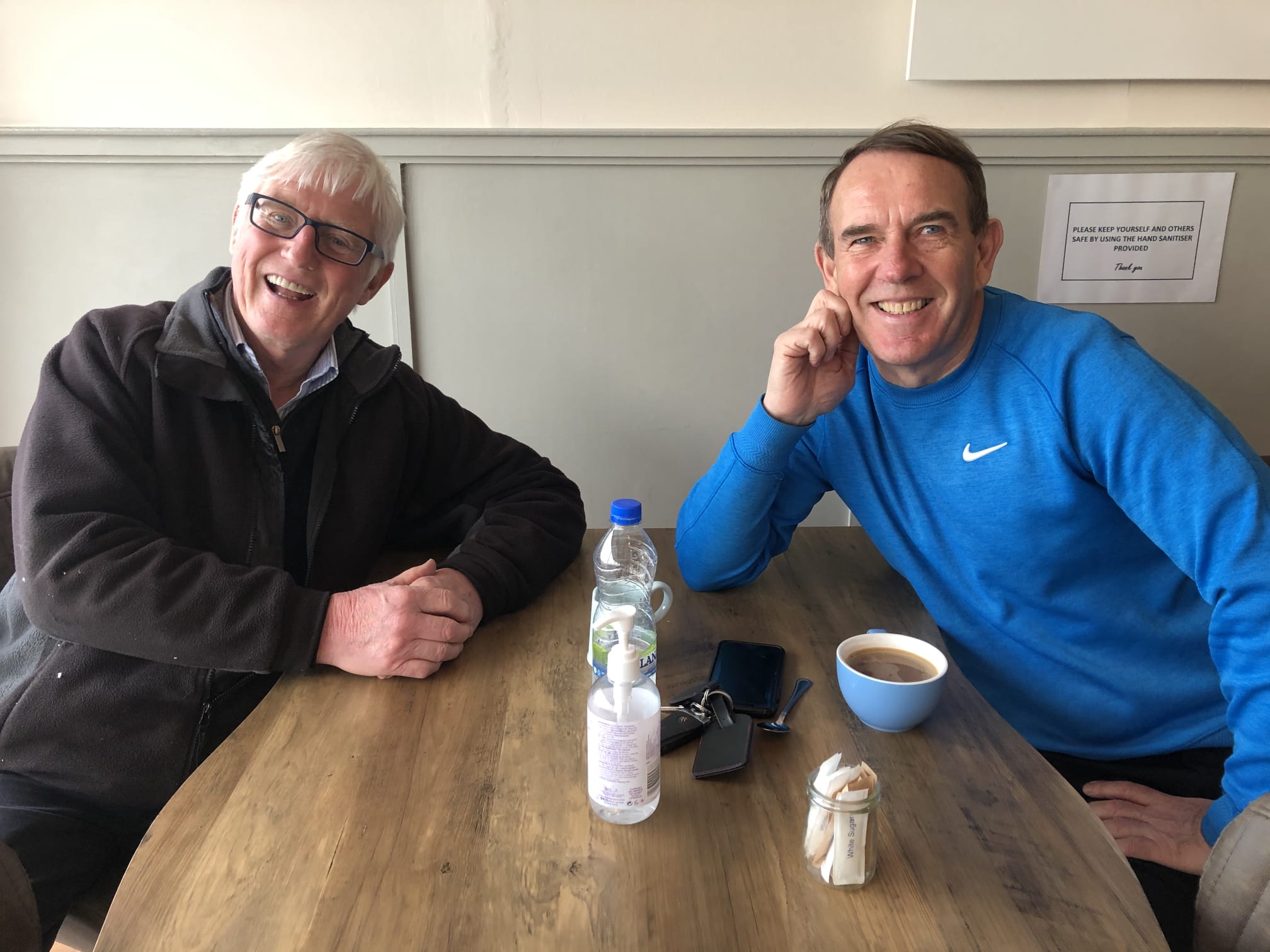
CHILL TIME…John Otterson and fellow Maghera man Kenny Shiels chatting over a cuppa
Waiting in Kilcoo to record a homecoming, the cavalcade coming up the lane with utter punctuality. His good friend Mickey Moran’s time keeping was always bang on.
There was a Monday spent at the final round of the 2010 Ryder Cup, waiting patiently on a Graham McDowell interview after news editors pulled the deadline forward.
Climbing down a crane, hanging onto the cables, after the driver had gone to tea in the middle of another golfing tournament.
Welcome to the moving world of working in the media. Not everything happens in a straight line.
It wasn’t always rosy either. There was tragedy. The ‘Troubles’ brought plenty of hurt.
After footage of a row between Bellaghy and Lavey made the news, Otterson’s camera wasn’t welcome at the county final weeks later. Even though it was his own patch in Watty Graham Park, Derry said no.
On Ulster final day, he was just one of the 42 people who brought the colour and magic from Clones to the front rooms across the globe.
Think John Otterson. A man behind a camera. A man with a van. A smile. A giggle. Always full of chat. Banter often his middle name.
****
The Ottersons lived in Maghera’s Hall Street. The late Danny was the oldest of four. Margaret was born two years later. Liam two years after that. John, the youngest, two years later, in 1946.
“I am the same age as Trump, Clinton and one of them Bushes, (George W), so it was a good year,” John said with a smile.
Their father Dan came from Cullion, on the slopes of Slieve Gallion, above Desertmartin. He married Margaret Logan, from the nearby Tobermore.
After attending Fairhill Primary School, the boys faced a fork in the road. Before the days of schools in every town and village, it was a choice between boarding school.
Margaret went to the nearby St Mary’s Magherafelt, with John following in the footsteps of Danny and Liam by boarding at Garron Tower.
“You did a three-hour study at night,” he recalls. “Imagine getting somebody to do three hours homework now, not a chance.”
While learning the phonetics in French didn’t appeal to him, geometry came naturally.
On the sporting front, Otterson represented Garron Tower in pole vaulting, coming up against Mike Bull who was representing St Malachy’s at the time. Bull went on to win Commonwealth gold and compete at the Olympics in 1968 and ‘72.
In football, pupils were divided into teams named after mountains. Slemish had Otterson as their goalkeeper.
“I was a good man at saving penalties,” he recalls. “I became the reserve goalkeeper for the MacRory team. The other man was about six feet three or something like that, so he was getting the gig.”
They were playing one of the Belfast schools at Casement Park and Seamus McCamphill forgot his jersey.
“We walking down the tunnel and he was coming behind me, he just reached into my duffel bag and he took my shirt. I ended up with a very woolly jumper on me because Seamus took my shirt,” Otterson added with a smile, “and I never forgave him for it.”
He left hurling to the hurlers of the era, players coming in from the Glens. Natural stick men.
“I can remember me and ‘Sidey’ (Mark Sidebottom) going down 50 years later, when they were trying to win it (Mageean Cup) again,” he added of two past pupils returning to their alma mater.
While he spent most of his time boarding on Antrim’s north coast, his name was still a regular fixture on Glen teams.
“Barney ‘Jinx’ Devlin knew my date of birth because I was a year older, we were both the 18th of the 10th,” Otterson said.
“When I was at Garron Tower, I played a lot of matches at home,” he joked about players lining out under his name.
“There were a lot of boys called John Otterson who played for Glen schoolboys at that time, all courtesy of ‘Jinxy’.”
That was how it was back in the day, often with an entire team packed into Paddy Joe Conway’s Vauxhall Wyvern. Memories to last a lifetime.
Away from sport, Otterson was always interested in photography. He’d often borrow Gerry McGuckin’s Voigtländer camera.
“There was another man, Louis Campbell, in the army in Cyprus,” Otterson added.
“He had a great camera that he got through duty free. I borrowed it and did the colour slides at Louis’ wedding.”
This was during his school years in Garron Tower. There was a photographic exhibition every year. While others were taking photos of people, Otterson was snapping alternative images.
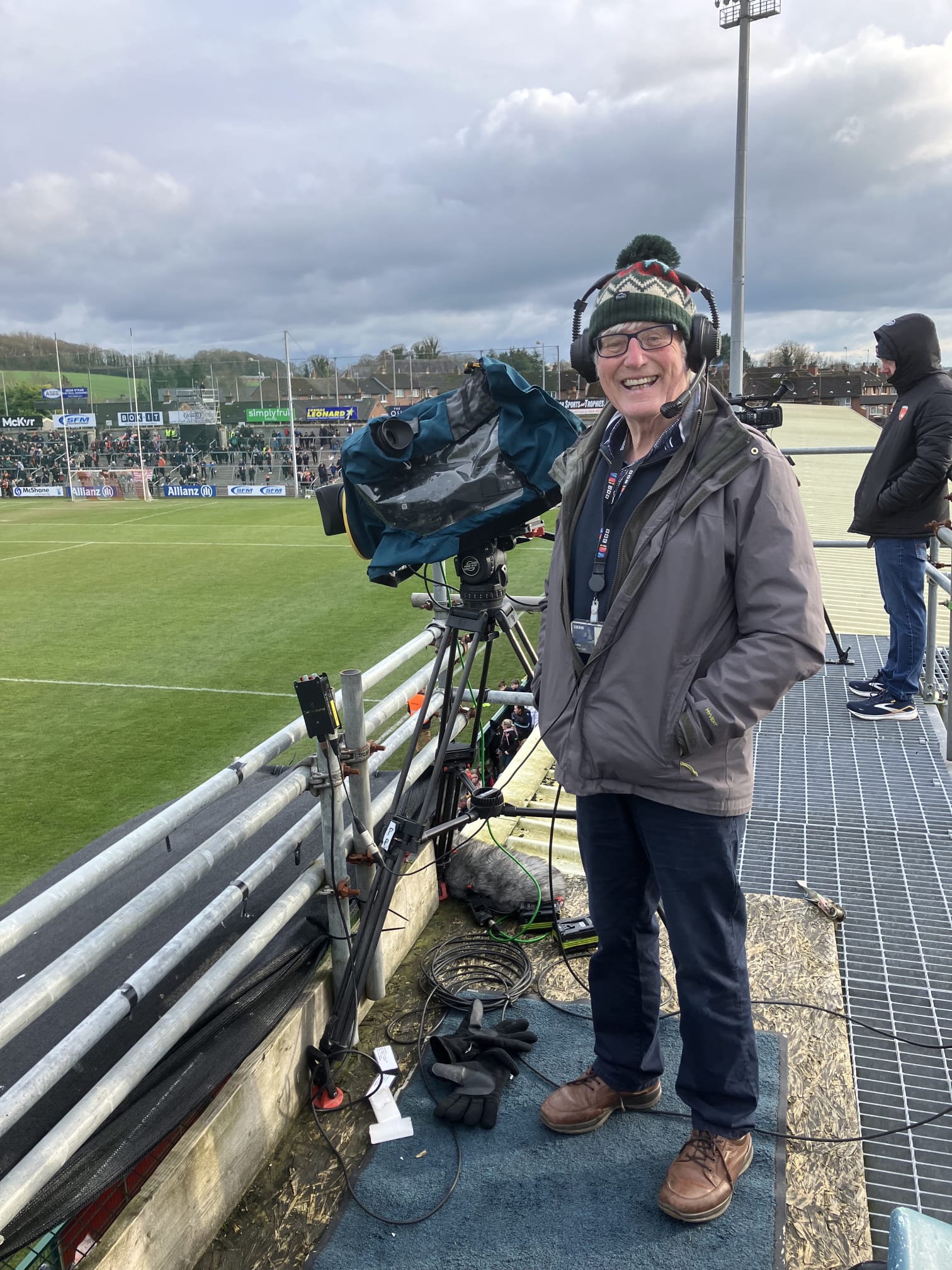
HAPPY AT WORK…John Otterson worked as a BBC camerman for 61 years
“I was doing all sorts of things and always fancied it,” he added, hinting at the start of a career looking down the lens.
There was no real desire to follow the university route. Otterson penned letters to both BBC and UTV, enquiring of any openings for a cameraman.
The ‘Beeb’ came back, offering an interview at Broadcasting House in Belfast. UTV have yet to respond.
“I remember the guy gave me a formula and I started working it out,” Otterson recalls, his grá for maths now kicking in when it mattered.
“They gave us 10 bob for expenses,” he added. “Danny took me up in his minivan. That got us a sausage supper in Carlisle Circus and petrol for the van, I remember it well.”
It was worth it. The interview was a success. He landed the job and was soon on his way to Evesham for nine weeks of training. Those were the early steps into a lifetime looking through a lens on a range of landmark days. Events that mattered to people.
“I always fancied being a cameraman,” he pointed out. “You’d take photographs, but you had to wait until you used up the 36.
“Then you had to send the film away to get printed and you didn’t see your results for weeks.
“If you were a TV cameraman, you could see the results on the spot, through a five-inch viewfinder.”
TV brought intrigue. Whether it was watching Panorama every Monday night in Garron Tower or sitting down to the Saturday night movie night.
After leaving school, he relocated to digs in Belfast where £3.10 covered the week’s food. Breakfast, lunch and dinner, topped off with tea and toast for supper.
The early days in the BBC were spent in the studio. It involved editing audio before eventually getting into television. First it was black and white. Then it was colour, moving into the world of the outside broadcast.
“We’d have done matches then, mostly covering GAA matches and rugby matches,” Otterson said.
“We weren’t covering much GAA until Jim Neilly started The Championship.”
Neilly was Head of Sport at the time and Otterson recalls being dispatched with Neilly to Castleblayney to cover a game.
“Jim said to me, ‘this is the business, we need to be covering this’.” Otterson recalls.
“Jim was a rugby man and we were there with just a single camera to get a piece for news.”
On this return, Neilly touched base with Donegal man Pat Loughrey, a former Head of Languages in St Colm’s Draperstown, who moved into broadcasting.
“Pat went on to be Controller for BBC Northern Ireland and Jim told him we needed to be covering GAA. The rest is history.”
The first game episode of The Championship was aired on Sunday, May 13, 1990. It was a highlights’ show covering Monaghan’s victory over Antrim, ironically in Castleblayney.
Jimmy Smyth and Peter McGinnity were on commentary. Mark Robson hosted the show with Sean McCague as analyst. There was also footage from the minor game and a competition for a football yielding hundreds of postcard entries.
Antrim’s Lenny Harbinson’s point was the first score televised on the show with Gerard McGurk hitting the first goal on a day Ray McCarron scored seven points. The BBC’s imprint on Gaelic Games had begun.
“At the start, we were welcomed with open arms when we went down to a match,” Otterson recalls.
“It’s the same nowadays but the closer you get to a final, the tighter it is for accreditation.”
****
It’s May 1994. The sun is splitting the trees. Celtic Park is packed. Derry are All-Ireland champions.
Down are in town, having been chinned by the Oakleafers in the previous two seasons. Once narrowly in a Casement classic, under the sun. The other was a hammering in Newry, in the rain.
The heavyweights are seconds away from a game billed as another clash of the giants.
Referee Tommy Sugrue has made it all the way from Blennerville, on the outskirts of Tralee. The most neutral of men in a championship cauldron.
He has the ball in hand, soon to be surrounded by four midfield giants. Sugrue is the man in charge. But not just yet.
The BBC floor manager has yet to signal when the size five can be tossed into the air. Live TV is different. Scheduling calls the shots.
“Everybody was ready,” Otterson recalls, “but there was a delay of a couple of minutes.
“That was one of the big secrets, they had to wait for the EastEnders Omnibus to finish.
“The ref would be getting a nod from the floor manager, someone along the sideline in headphones.
“It was a needle match. It was maybe only a two-minute delay but that’s an eternity and the crowd were just getting anxious.”
Otterson has covered sporting events the world over. GAA. Soccer. Rugby. Boxing. Cricket. You’d need a week in his company for a proper deep dig.
“I did the Ryder Cup, whenever they all jumped onto the duck pond at the end of the Sunday,” he said of 2010 when Monday was needed to decide the winner.
Just before four o’clock, Graeme McDowell stood over the defining shot. The world held its breath.
“He putted from about 23 feet,” Otterson recalls. “We had to wait to interview him, me and Stephen Watson.
“We had to edit three minutes but they decided that instead of that going out at 10 to seven, that would have to go out at half six, so there was another 20 minutes cut off our editing time.”
Welcome to TV and historic moments. Detail is everything but minutes matter.
In a sport like golf, with a small ball travelling so fast, even the cameramen need practice.
There are other logistics. Any potential hole in one needs a dedicated camera.
Otterson recalls Seve Ballesteros driving a shot into the trees but he was unable to follow the spaniard trudging towards a recovery shot. The next man was ready to tee off and the camera needed to be rolling on the green. Seconds matter.
There was another day Otterson recalls filming golf from high in the sky, between the 12th tee and the seventh green. A sweet spot, with as much scope as possible.
“I was up a Simon hoist and couldn’t get back down for lunchtime because the guy who would have had to start the lorry was away for his lunch,” he recalls.
“We couldn’t get the lorry started, so I climbed down the camera cable, which in those days was two inches thick.
“When I climbed down, I tapped the lorry man on the shoulder. He looked up and the bucket was still up there. He still talks about it.”
The BBC boxing coverage included following Barry McGuigan for his fights in the Ulster and Kings’ Hall.
At the time, Otterson was the Entertainment Manager when the Glen GAA club – a decent kick of a ball from his front door – was thronged every weekend.
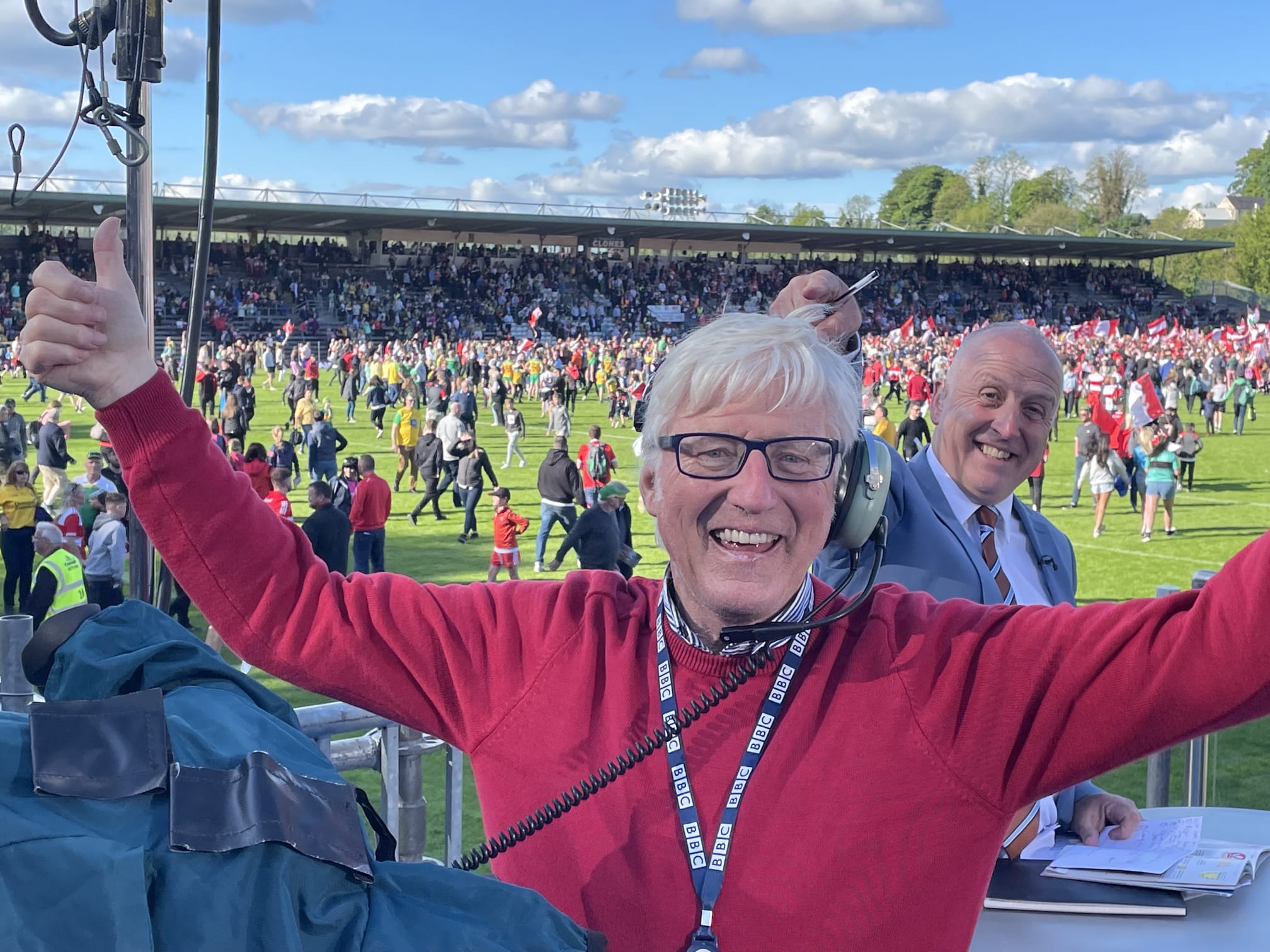
RED IS THE COLOUR…John Otterson and another past pupil of Garron Tower, Mark Sidebottom, on duty at Clones on Ulster final day 2022
McGuigan’s father, Pat McGeehan, took part in Eurovision and Otterson knew him from the music circuit.
“You’d be in the ring for an interview after a fight and Pat would be asking for a copy of the tape,” Otterson said.
Glen club was packed and it was Otterson who was booking the bands.
“I had Christy Moore in the 70s for £250 and he stayed here in our house,” he added.
“I had Hugo Duncan doing the opening and closing with his eight-piece band. It was £185 and I enjoy reminding Hugo about that.”
Glen club also ran quizzes on a Tuesday night and the Queen’s team would use it to sharpen up for University Challenge.
There was controversy one night when it went down to the last question. The local Glen team beat them, with the answer disputed.
The view from Otterson’s living room, across to the club, takes you across the car park that has been thronged with many a homecoming.
In more recent times, Connor Carville has carried the John McLaughlin, Seamus McFerran and Andy Merrigan Cups up onto the back of a lorry there. The special moments of bringing home the bacon.
The Anglo Celt Cup made a return in 2022 after Derry ended a 24-year famine. All-Ireland minor successes have been toasted.
To coin Tony Scullion’s phrase, Maghera has never been as ‘bleck’ as the early hours of Tuesday, September 21, 1993, when Sam Maguire made his only visit to the county.
“We interviewed Eamonn Coleman at about a quarter to five in the morning,” Otterson recalls of a magical day on the job. “I was on the team bus the whole way up until about Carrickdale.”
He recalls seeing the throngs of people as the crowds began to ebb into Maghera. There was even someone dressed up as Santa.
It was buzzing but the crowds presented a problem. There was a detour needed around Maghera, via Sleacht Néill, to get back to the top of the town to video for Sam being carried off the open top bus.
When you are a cameraman, capturing the moment is everything. It takes planning. There is an element of luck and of knowing the right people.
Two days earlier, as Derry were going toe to toe with Cork in the All-Ireland final, a BBC producer ensured Otterson was granted permission to the Derry dressing room after the team had taken the field for the second half.
If they were to create history, having the camera ready to roll in the dressing room would chart history forever.
“I remember when Anthony Tohill came in,” he said. “I remember it well but you wouldn’t get near the changing rooms now.”
One of the moments of the day was when Eamonn Coleman stopped with Jerome Quinn for an interview as the teams headed for the dressing rooms at half-time.
Otterson was there. Camera rolling and ready to shoot. Luck kicked in and the Derry manager stopped.
One of the main talking points was Niall Cahalane staying on the pitch after striking Enda Gormley while Tony Davis was harshly dismissed for a lunge towards Dermot Heaney.
“Cahalane should’ve gone first, he struck first,” Coleman said in 15 seconds of gold. “When you strike in this game, it says you must go and he didn’t go.”
“Jerome nodded Coleman to come across but he might have just walked on,” Otterson recalls.
Watching the 2019 Ulster Club final from the comfort of his living room, Otterson knew Kilcoo or Naomh Conaill would be a first-time winner. History beckoned.
When Kilcoo won, he punched Mickey Moran’s number into his phone.
“Mickey said they’d be back in Kilcoo at ten past seven,” Otterson recalls.
“I was there at half six and there wasn’t a being in the place. By seven o’clock, everybody was there and at ten past seven Mickey came round the corner.”
In another club chapter, he had his way trip to Ruislip paid to record a Lavey All-Ireland quarter-final against Tir Chonaill Gaels.
“I was sponsored by a Lavey pub,” Otterson said, “They were always busting to get the tape for the Monday Night in the pub, so they paid for my flight.
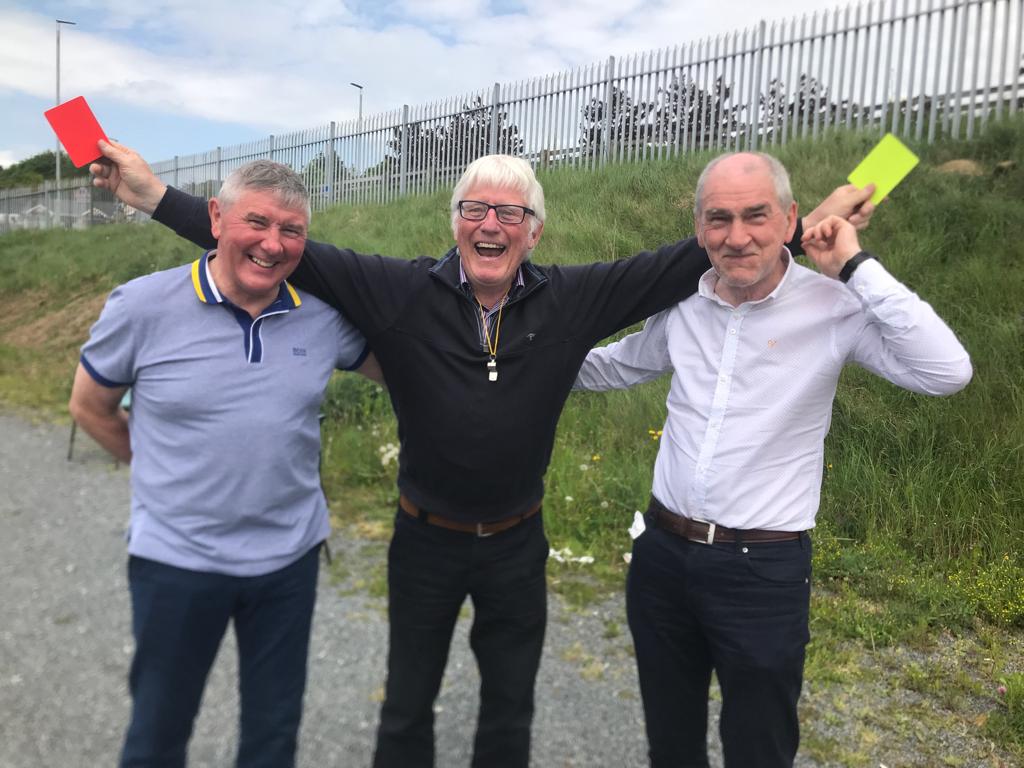
HOUSE OF CARDS…John Otterson shows cards to Martin McHugh and Mickey Harte
“Johnny McGurk got his teeth put through the side of his cheek. It was real brutal stuff and was over to film it.”
Decades later, when Otterson made the journey to cover Sleacht Néill’s game against St Kiernan’s, he bumped into the man who had the run in with McGurk.
“He’s a photographer now,” Otterson said with a smile. “That was 25 years ago and they were having a big night so I sent him the tape of the match.”
While Otterson is a vital part of Ulster final day, he is just on of a BBC crew that stretches to 42 people.
From commentators, to analysts, to producers, sound engineers, presenters, those in make-up – the lot. It’s a far cry from a 50-minute show when the BBC set the ball rolling that day in Castleblayney 36 years ago.
“We’d be there on a Saturday,” Otterson said, looking into a weekend in the life of a cameraman.
“If we were the host, we’d be the cameras at the pitch. We would have what we’d call a bolt-on, which would be the presentation studio.
“RTÉ might be covering the match live as well and they’d be doing a bolt-on.
“Early in the day, I’d go down to town and get the vox pops. We’d do the same when the match would be over.
“Sometimes that would be easy and sometimes it would be very difficult, depending on how well they played. Everybody could be in a hurry out.”
If on match camera duty, half-time is a break when the studio camera kicks into action.
“There could be 16 cameras in all,” Otterson continues. “A camera that covers the match wide and there’s another camera that covers the match tight to just head and feet.”
The viewer will see the finished product, jumping between them all. There will be a camera covering a player that does something, like scoring a goal. There are behind the goal cameras and the super slow-motion coverage.
“The next thing is the kick-outs,” Otterson adds. “They’re so fast and it’s very hard to get any replays in and everybody wants to see the kick-out now.”
With the new rule enhancements, keeping an eye on the breach is a new development with a camera just dedicated to film that on its own, there to be delved in on request.
Even from the throw in, it’s important to keep an eye on the player who now begins at the sideline, with teams having ploys to get them on the ball, like Dublin did with Con O’Callaghan last season.
“At the start, producers were asking why we were filming someone out on the sideline,” Otterson added.
The other side is the half-time analysis. Now retired Producer Margaret O’Hare would’ve been central to making it tick along.
Key incidents were clipped, tagged and named ahead of a tight schedule when the talking points needed highlighting.
“There’s also a floor manager just calling out the subs, the scores and the cards,” Otterson added.
It could be something as simple as floating a question to the fourth official about the reasoning behind a card issued. An answer may or may not come, but it all feeds back into the coverage.
With one more week of league action, the Ulster Championship is just around the corner and the show will be on the road again.
If Otterson is on the line this season, it will be part of some freelance shift to keep his hand in but his days of full immersion are gone.
It was fitting that before he signed off, he was awarded a BBC Lifetime Achievement award. He knew he was nominated and set off for the awards, as the only person who didn’t know he was getting it.
“All of Belfast knew, even the dogs in the street,” he said with another heart laugh.
“They went through all the trophies and got to the last one. I got out my phone and I was just about to text “well maybe next year”, but then I looked up. Everybody around me said “it’s you, it’s you” and the rest is history.
“Everybody in the whole of the BBC NI knew I was getting it and I would usually be the sort of boy who would know what was going on.”
It was a fitting layer of icing on a career that spanned seven decades and saw ‘Otty’ at the forefront
of some of the most iconic of moments.
For once, he was on the other side, celebrating a career of looking through the other side. It was more than that. There was always a smile.
Related posts:

Receive quality journalism wherever you are, on any device. Keep up to date from the comfort of your own home with a digital subscription.
Any time | Any place | Anywhere
Get the app for the best Gaelic Life experience