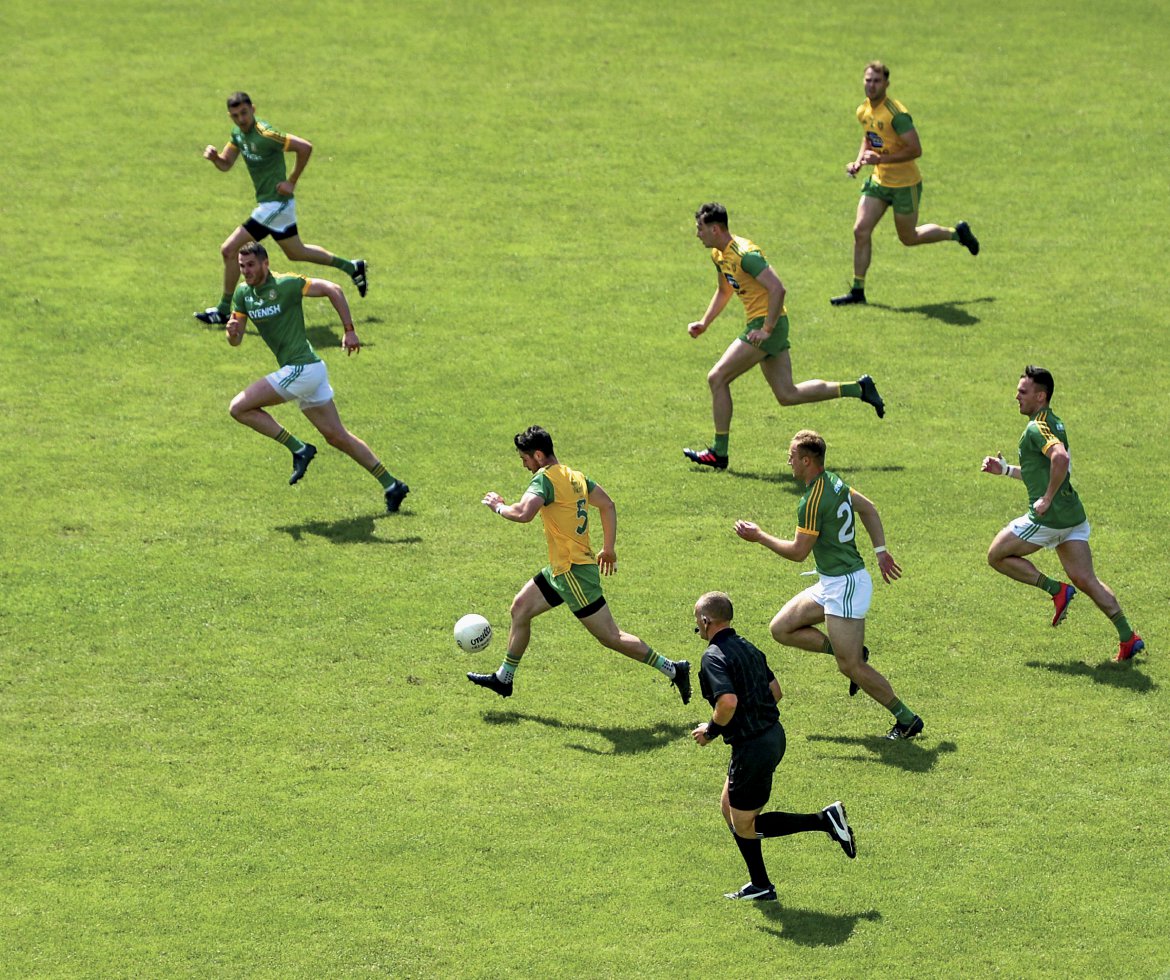


PROBABLY one of the most important factors we need to coach in the modern game is our transition play. It’s so underrated from a coaching perspective.
Transition play has a major role to play in Gaelic football. How a side adapts and adjusts and reacts to a change in possession is absolutely pivotal and can really affect the flow but, more importantly, the outcome of a game.
When coaching a training session, it is an area of play that is probably nowhere near looked at as often as it should be.
The top teams will engross themselves in transition games and a great importance will be placed on that transition between attacking play and defensive play and vice versa. The common mistake most coaches make is an over coaching of defensive play or attacking play and not enough emphasis on that urgency and opportunity of a quick transition. It can be coached through a multiple variety of transition games and drills.
There are two aspects of transition play which are critical when coaching in the modern game of Gaelic football.
1.Counter-attack
The instant your team gains possession of the ball from the opposition, whether that is from repelling an attack or a simple turnover ball, it presents a key opportunity for you to counter-attack.
With the opposition on the front foot, their defensive structure is probably frail with players reacting from the attacking transition and are out of position.
Two things have to happen in the counter-attack, first you must anticipate the change in possession and take a risk. For example, if you were a half-back on the opposite side of the field you could drift into the opponent’s scoring zone in anticipation of the counter.
Secondly, once in possession players must collectively react quickly and move into an attacking position. A fast breaking team will always pass forward and the top transitioning teams when they turn the ball over will usually hit you within 15 seconds for a score.
Conor McKenna’s goal in last year’s All-Ireland semi-final between Tyrone and Kerry was a prime example of a punishing counter-attack.
Also when teams counter-attacks, if the first pass is with the hand in comparison to the boot, teams will have a 20 per cent greater chance of ending with a score.
2.Counter-defence
This is where most teams make the mistake in transition play. When the team counter-attacks, they get cavalier and throw bodies forward in numbers and in lay man’s terms ‘abandon ship’, ultimately leaving them extremely vulnerable to a counter counter-attack.
The key here is to maintain a good defensive structure. I know some top coaches who coach their sides to always have four back as a minimum, or a plus one (overload of one defender). It’s a simple but effective measures to prepare for a loss of possession in your own counter-attack.
With over 60 per cent of scores in Gaelic football coming as a result of turnovers, it’s amazing how many teams don’t have a counter defensive structure in place for the expected turnover ball.
Pep Guardiola had Sergio Busquets at Barcelona as his counter defensive commander in chief and always left a block of four players in a position to repel any sudden counter-attack. The same can certainly happen in Gaelic football. The really well organised teams at the highest level will be supremely well coached, have an ability to press the opposition at its source while also having the safety net of cover in behind.
No matter what structure you plan for your counter-attack or counter-defence, it can all be coached through small-sided and conditioned games on the training field.
Coaching transition play won’t just happen overnight, it takes patience, hard work, perseverance and, also, a very understanding group of players. These are the constant challenges you are faced with as a coach and these are challenges you should embrace.
Receive quality journalism wherever you are, on any device. Keep up to date from the comfort of your own home with a digital subscription.
Any time | Any place | Anywhere
Get the app for the best Gaelic Life experience