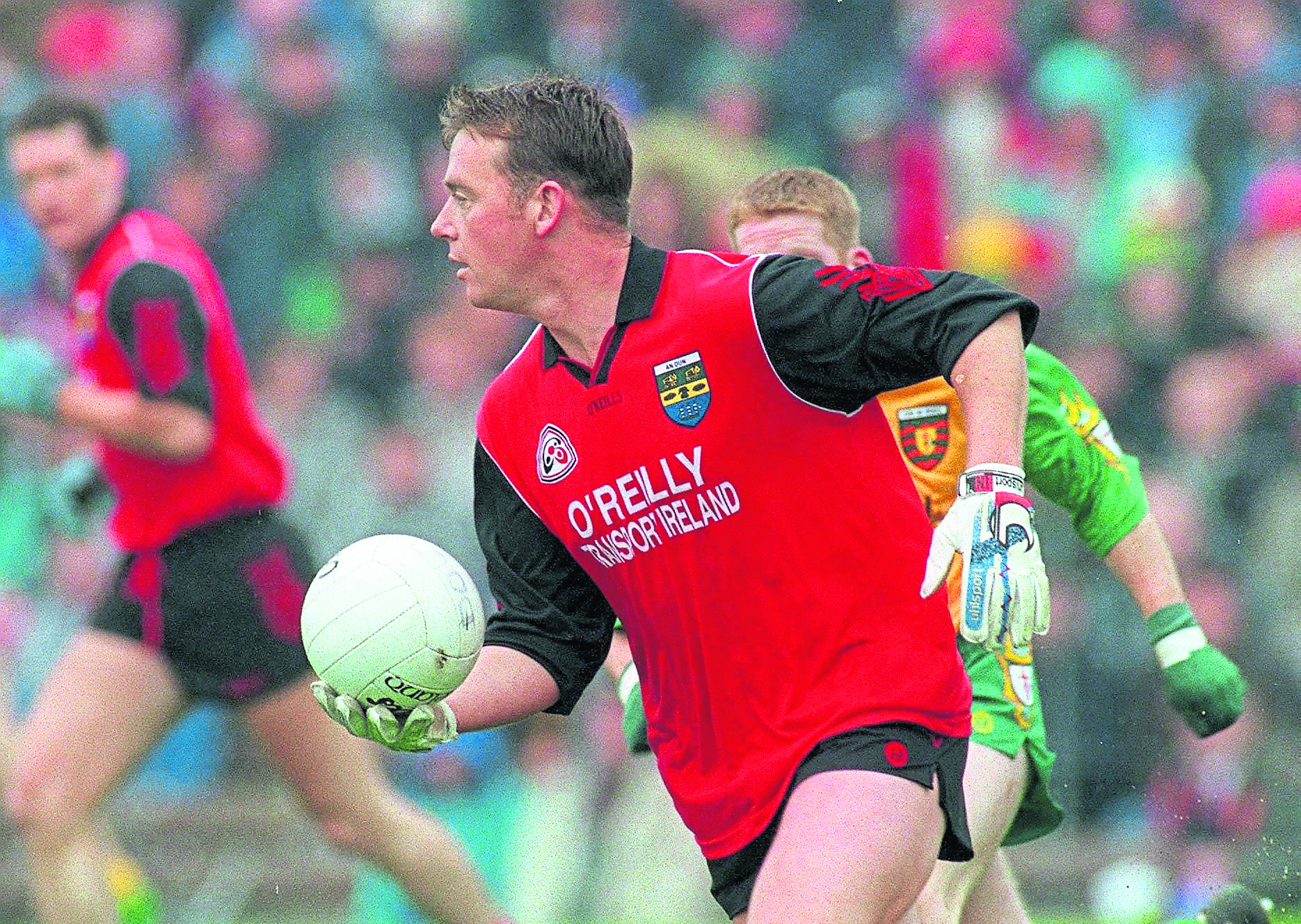


Former Down defender Paul Higgins charts his journey to the 1991 and 1994 All Ireland titles. Niall Gartland writes…
The Mourne Mountains to the north, the Irish Sea to the south. Future Down star Paul Higgins grew up in Ballymartin, a scenic part of the world located on the main route between Kilkeel and Newcastle. It’s where he remains today.
In an understated sort of way, it was a sporting metropolis. Football, tennis, even cricket. Those were the post-school festivities. There were six GAA clubs in the vicinity so it was an ample breeding ground but for Higgins, there was no bigger picture. It was all about the craic and a healthy bit of one-upmanship.
There were the schools days with classmates from Longstone and the surrounding areas.
“The banter would’ve started at underage, playing against them and then going back to school with them,” Higgins said.
“Everybody tried to beat each other for a bit of bragging rights. Top dog one week, next you could be the bottom dog. It’s not like now. A lot of the young ones now, I find it’s hard to get them out to football. There are so many other distractions – Xboxes, PlayStations.
“We just went out every day. Home from school, straight out of the house to kick a bit of ball. If Wimbledon was on, you were out with tennis rackets, there were times you went out with cricket bats. You were always doing something.”
One of Higgins’ greatest influences was the legendary Ambrose Rogers, a Longstone man who died long before his time in 1999.
“Me and Ambrose grew up on the same road. Two estates, the bottom ring and top ring – no more than a kick of the ball between the two places.
“Ambrose was seven or eight years older. He was the only county player from around the Mournes. Everybody looked up to him, even if they were from a different club.
“He was a great lad and great craic. He took football deadly serious though.”
Born in the late sixties, Paul was too young to fully appreciate the exploits of the legendary Down team of the same era. Football was in the DNA though; his father Tom was a devoted servant of Ballymartin and won a Down Senior Football Championship medal with the club in 1955, when they beat neighbours Longstone.
He had plenty of potential and all it took was a bit of encouragement from a school-teacher to send him on the right path.
“The first time I saw any Down team playing was when they won the Ulster Minor Championship in 1978. I remember watching that on TV, probably because Ambrose was on the team.
“My brother played for Down minors a year or so later as well. That’s when Down first came on my radar, I didn’t really think of the team of the sixties in those days.
“I was playing a lot of football in those days. I went to school at St Columban’s, Kilkeel and that became a turning point.
“Raymond Carvill was our PE coach, a lovely man. He’d have told me, ‘you have a lot of potential, boy, so just get at it.’
“I got more into it and eventually I joined the minors. Myself and Barry Breen were the two youngest. That was the early ’80s. I progressed through that onto the seniors.”
Away from the football, Higgins, mostly through circumstance, became a plasterer by profession. These days he goes nowhere near a trowel, and he’s grateful for that.
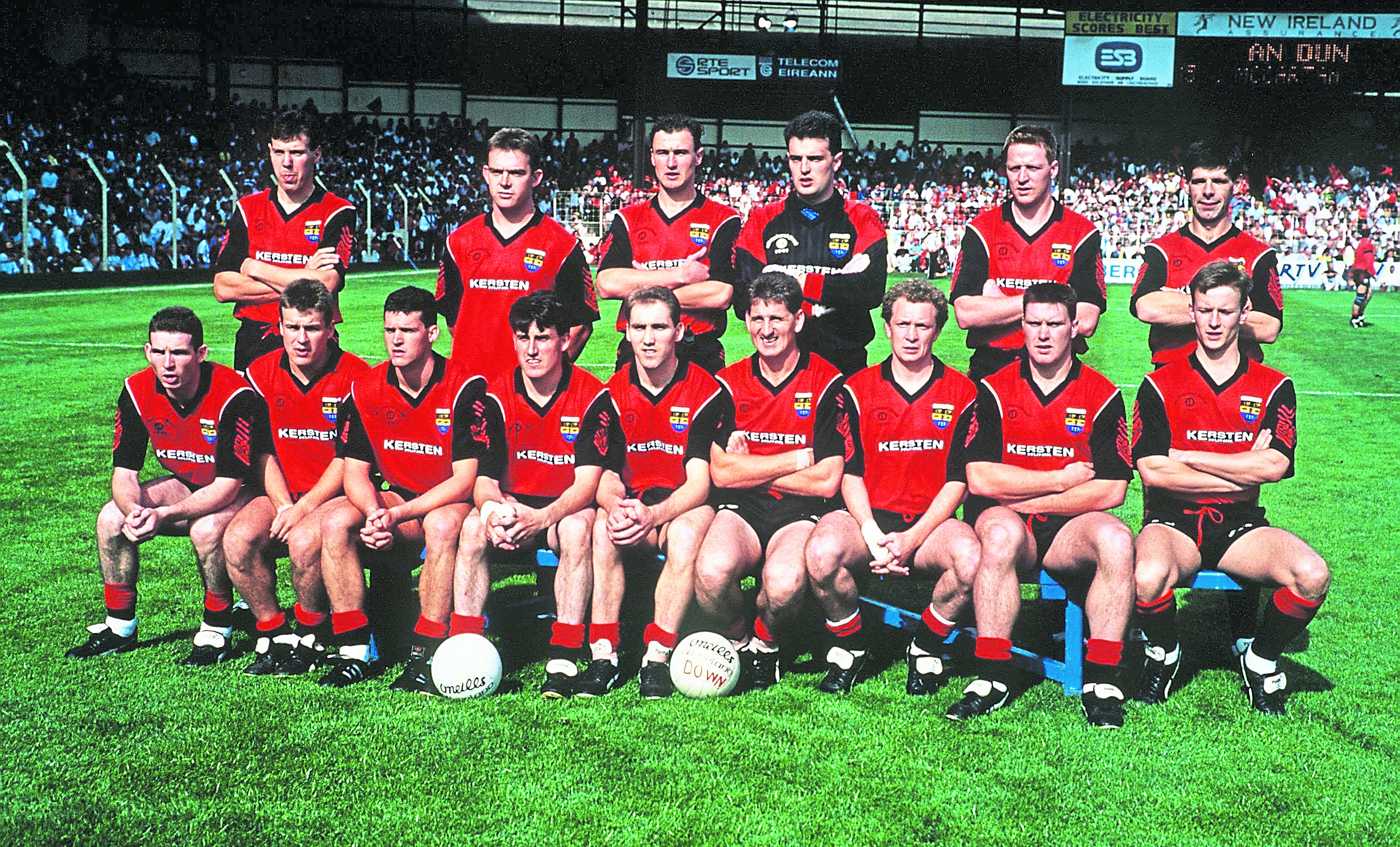
TRAILBLAZERS…Paul, back row, second from left, with the Down team that won the 1991 All-Ireland SFC
“I was going to be a stonemason, but I broke the ankle playing for the Down minors. By the time I got back, the work had dried up, so I went for a trade – and it was the worst decision I ever made!
“I did plastering on and off through the years, but it’s a tough job – a real tough job.
“I managed the local Ballymartin Inn for a while. Our football club owns it. I think we were the first GAA club ever to own a public bar. Some people say it’s a great investment; other people say, ‘hold on a minute! There’s too many of the boys in it!’ I managed that for a while. What I’m at now, I’m a store manager for Copius Technology. They supply engineering parts into the aviation industry. I enjoy it, it’s a bit of computer work, a bit of purchasing. I’ve branched out a bit, and I’m enjoying it.
“We’re based in Kilkeel, down in the harbour. I leave the house and 10 minutes later I’m at work, so it’s very good that way. They’re a great bunch of lads, all into their golf so we get plenty of outings.”
Higgins had to bide his time on the Down senior set-up. He was brought into the panel in 1986, but had to wait three years for his championship debut. He spent much of the hour keeping tabs on the legendary ‘Nudie’ Hughes.
“My debut was Monaghan in the Ulster Championship. That was ’89, in Blayney. They were reigning champions and we knocked them out, and then Tyrone put us out in the semi-final.
“It was uncompromising back then. There were no second chances. You were fighting for your life every game back then.
“I ended up marking ‘Nudie’ Hughes in the second half because they pushed him up into the forward line. The only thing I remember, God rest him, is that he never shut up the whole game.
“’Do you know who I am?’ and all this here. I just gave it back to him. I’d have been chatty enough too on the field! It was harmless stuff.”
Higgins operated as a specialist corner-back for virtually all of his senior intercounty career. It wouldn’t have been his first choice, put it that way, and in a sense, he was a victim of his own success.
“I played in the forward line and midfield at underage. With Down All of my club football was at midfield and forward – I never played defence with my club, ever.
“Then I ended up getting lumped into corner-back. I detested that position. I really did, but you thought, well, it’s better than not playing. I complained the odd time.
“To be fair, I played a couple of National League games up front. I remember playing Derry and I was playing full-forward. I think Tony Scullion was marking me.
“The first half was going great. At half-time, Pete [McGrath] pulls me over and says, “’you’re going to have to be full-back,’ because I think one of the boys was struggling.
“It didn’t bother me where I played, but I definitely would’ve preferred half-back or half-forward. Corner-back is very restrictive. You were basically told to go out and nullify your man first and foremost.
“That’s why, every chance I got, I was way up the field!”
It was a barren spell for Ulster teams on the All-Ireland stage. Tyrone made the final in 1986 but their challenge eventually unravelled. Elsewhere, there wasn’t much to shout about.
Down did, however, take hope from a near-miss against Meath in the National Football League final in 1990, losing out by 2-7 to 0-11. This was a team that had won two All-Ireland titles, so the Mournemen knew they couldn’t be that far away.
“The year before 1991, we got to the National Final, and the National League final was bigger than it is now. Maybe it’s more used as a training run-out now, but back then it was important enough.
“Meath were one of the top two or three teams in the country, and it was a close game. So we knew we were close, and everybody knew we had really good players on the panel. It just needed something to gel us together.
“I remember in 1991, we were so happy to win an Ulster title. You don’t actively think, ‘We’re going to go and win an All-Ireland title,’ but you knew at that stage we were good enough to do it.”
On the hard yards off the pitch, Higgins said it wasn’t exactly scientific. There’s no doubt they were fit as fiddles though.
“You could close your eyes and rinse and repeat every session. You did maybe a five- or 10-minute run around the field, a bit of kicking about, then stretching, then into sprints or whatever.
“There wasn’t much variation in it. We were doing basically what every other team was doing.
“Coming up to the championship, it would’ve been all based on stamina. You wouldn’t have seen a ball. The legs were run off you.
“It was tough-going. We were fit. I know people say the teams now are really, really fit, but we were a fit team.”
Down did the business against an aging Kerry team in the All-Ireland semi-final. It marked the final game of Pat Spillane’s career, while Jack O’Shea was also on his last legs. They weren’t all old men though with Maurice Fitzgerald the obvious stand-out. Higgins was tasked with marking Pa Dennehy, a tricky forward, and he was determined to make amends for his own personal horrow-show against the same man earlier in the year.
“I marked the same fella in the National League that February. Our club went down to watch. We asked Pete would he let us travel down with the club instead of the county. He said, “Yeah, but promise not to take any drink.”
“I said, ‘we’ll take no drink’, but to cut a long story short, we did take a lot of drink on the Friday and the Saturday.
“I went out to mark the wee lad and, I swear to God, if ever there was a game I did not even want to go on the field for, that was it. I was doing my best even to stand up.
“He had a field day. Scored two goals. I couldn’t see him.
“It was unprofessional of me, but I was a young fella at the same time.
“Six months later, it was the same boy I was marking in the semi-final. I remember running out and saying to him, ‘remember that fella in February? This is a different fella today!’ I played well and had a good game, to be fair. I didn’t want to be roasted twice!
“When I crossed the white line, I was deadly serious. But before and after the games, I was easy-going.”
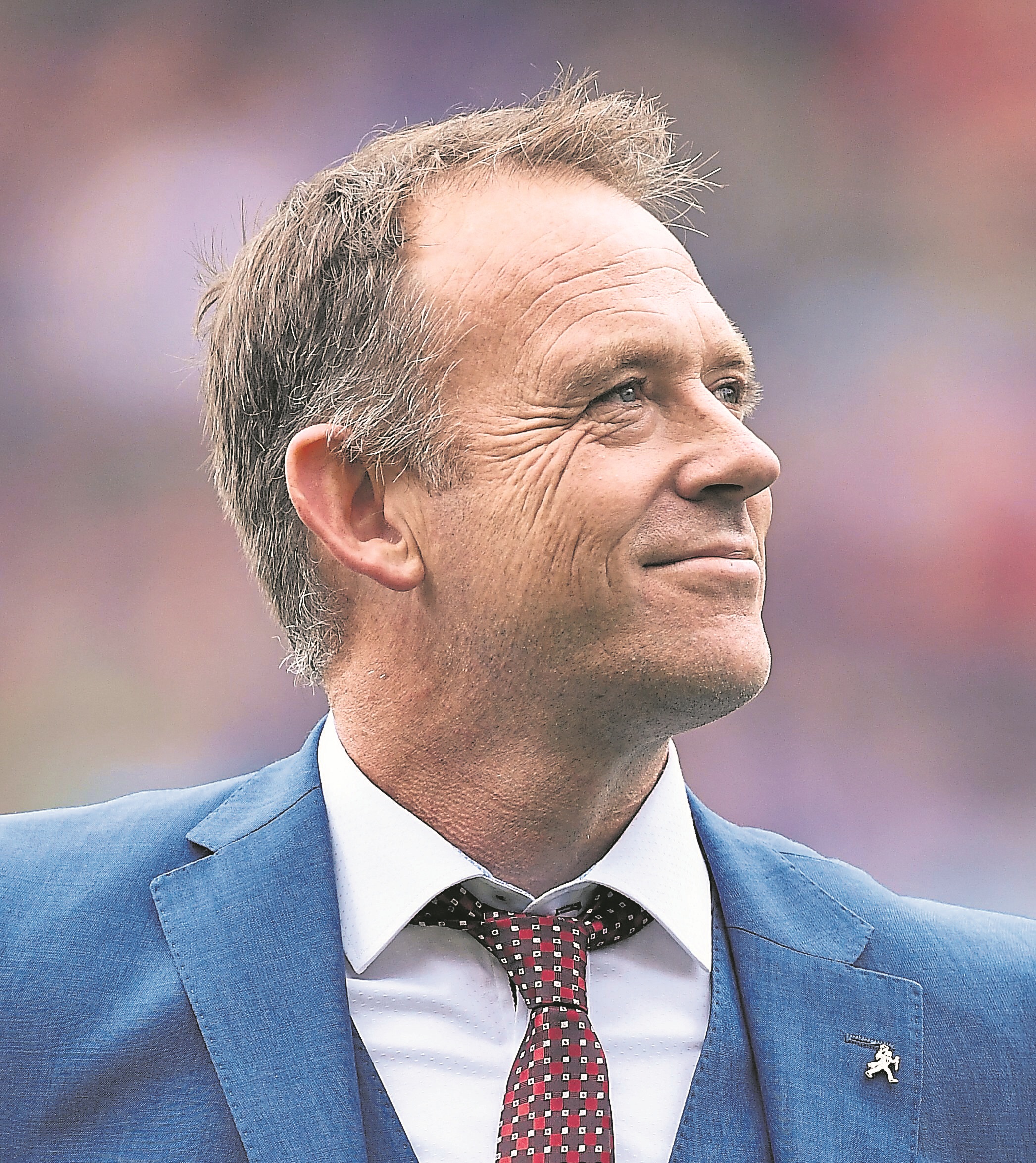
25 YEARS ON…Paul and the rest of the 1991 team were honoured at Croke Park before the 2016 All-Ireland final
Down were underdogs for their All-Ireland final date with a Meath side that had emerged victorious from a famous four-game saga with Dublin earlier in their campaign. The game didn’t exactly go to script. Down surged into a commanding lead, but the Royals summoned a late charge, making for an extremely nervy finale. When the final whistle went, it was sheer and utter elation. Nobody gave us a chance, especially after that epic Meath-Dublin summer, where they looked dead and buried but came back all the time, so it was as if they were unbeatable.
“The only regret is that we switched off with 10 minutes to go. At one stage we were 11 points up. I think we were one or two scores away from giving them a really good hammering.
“We were hanging on at the end, without doubt. The minute the game was over, I don’t even know if I shook my man’s hand. I just fell to my knees, and before you know it you’re surrounded by spectators.
“It was unbelievable. You sit back and you close your eyes and you half laugh.”
“I always look back and think it must’ve been great to have followed the Down team then, to have that success, because they’d been starved of it for so long.”
Down’s All-Ireland triumph seemed to spark their provincial counterparts into life. Higgins certainly didn’t begrudge Derry and Donegal their days in the sun, but there was an important itch to be scratched. They didn’t want to be ‘one-hit wonders’.
“You sort of had a wee bit of pride in them too. You’d always support the Ulster teams. At that stage, we were the only team from the north to win it. It spurred those fellas on. They probably looked at us and thought, “if they could do it, so could we.” We’re not taking credit for it, and fair play to them for doing it, but it probably did show them the way. And, to be fair, they still had to go out and do it.
“1994 was probably more player-driven. We didn’t want to be a flash in the pan, basically.
“It was redemption in a way. We wanted to show we’re not just this one-hit-wonder team. We knew we were a good team, and we wanted to go out and prove it.”
Their 1994 Ulster Championship semi-final victory over Derry at Celtic Park is widely recognised as one of the greatest games of all time. On a personal level, Higgins’ memories are more complicated. He was actually dropped for that game, though he came on early and certainly made his point.
“I didn’t start that game, which was a bit of a sore point with me at the time.
“Pat O’Hare came into training that year and freshened everything up. New ideas. We went away for a weekend before every game, and I remember him taking us to Antrim and it was basically a prison.
“There was nothing to do, no TVs or anything.
“He let us out for a couple of beers one night. and they came to pick us up at 10 o’clock and I said, ‘for God’s sake, give us another hour!’
“There was a bit of chatter and the end result was I didn’t get starting the next week.
“I was sort of pissed off about it. They brought me on about 10 or 15 minutes into the game to mark Joe Brolly.
“John Kelly had been on him, and to be fair, he wouldn’t be a corner-back. He was thrown into the corner and probably got it tough, they did target a lot of balls into Joe. When I came on, I was in that bad a mood, that it wasn’t even about having a point to prove, but I did keep Joe quiet.
He added: “We were a confident team as it was, but I suppose that victory did pave the way for our second All-Ireland. We knew if we could go into the lion’s den and get a result, especially given the standard of that game, that there was nothing to fear elsewhere.”
Cork stood in their way of a place in the final. Or as Pete McGrath put it, Colin Corkery stood in their way of a place in the final. Higgins was sent out to put the clampers on the Cork man-mountain.
“I think it was the Thursday night before. Pete basically said, “if you can mark Colin Corkery, we can win the game.” And I said, ‘no pressure, Pete!’
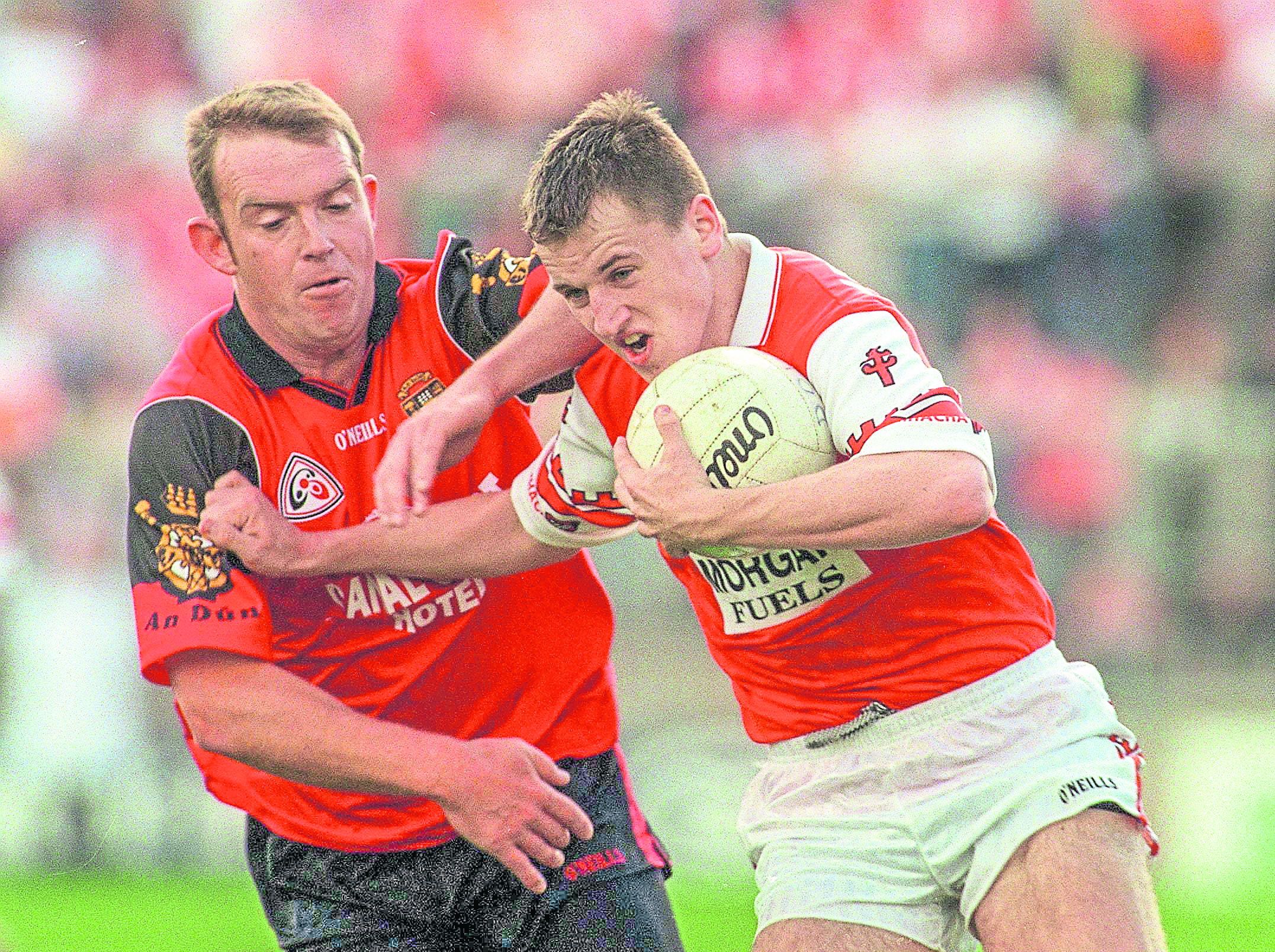
CONFLICTED…Paul says he never liked the corner-back role
“He was massive. He’d definitely be 6’4″ or 6’5″, and an absolute brute. And quick, you know. He’d everything about him.
“I’m running out and standing side-by-side and thinking, w’hat am I going to do with this boy here? He’s an absolute bear’.”
Higgins delivered in spades, though he recalls one moment late in proceedings where he didn’t exactly cover himself in glory.
“I always say, when you play corner-back, you don’t want your man to score from play, and you don’t want to give any easy free kicks away. Those were the two things you held yourself to.
“The game was near enough over and he hadn’t scored from play. I hadn’t given any easy free kicks away.
“And I had a brainwave, I was going to try and outscore him. I just ran. He probably thought, ‘what’s this boy at?’
“The game was basically over. To cut a long story short, I tried to go for a point. It was that bad, it looked like a pass to Gary Mason.
“The ball broke, Colin Corkery got the ball and tapped it over for his first point. And I was at least 70 or 80 yards away from him.”
Down went on to defeat Dublin in the final, cementing their status as a legendary team. If anything it means more to Higgins that the 1991 victory.
“They both have their better points. But personally, I think ’94 was particularly sweet for the players. This was us backing up what we were.
“Even though ’91 came at you with a whirlwind, ’94 was like, ‘we’re backing this up. We are a good team.'”
Higgins eventually signed off with Down in 2000. The latter years were fairly forgettable, but by that stage, there wasn’t much left to prove anyway.
“I played on until 2000. I’d a thing in my head where I wanted to play three decades, so I had that in my mind.
“I was still fit enough. I think I was 33 or 34 when I quit. I was still okay to play, so I thought to myself, when I got to 2000, no matter what, I’d retire. I was captain that year. I played club football up until I was 40.”
These days he takes it fairly handy as far as the GAA is concerned. He’s done his bit for Ballymartin and has no interest whatsoever in managing elsewhere. In that sense, home is very much where the heart is.
“I managed the seniors about 10 years or so, we got to the Intermediate final. Warrenpoint hammered us, they were a good team. I enjoyed it but it’s worse than playing because you can’t turn around and say ‘I can’t be at training.’ You have to set an example. They’re the only club I’d ever manage, I’m a one-club man. I’ve been asked a couple of times to manage different clubs and I’ve just said no.”
Receive quality journalism wherever you are, on any device. Keep up to date from the comfort of your own home with a digital subscription.
Any time | Any place | Anywhere
Get the app for the best Gaelic Life experience