

By Michael McMullan
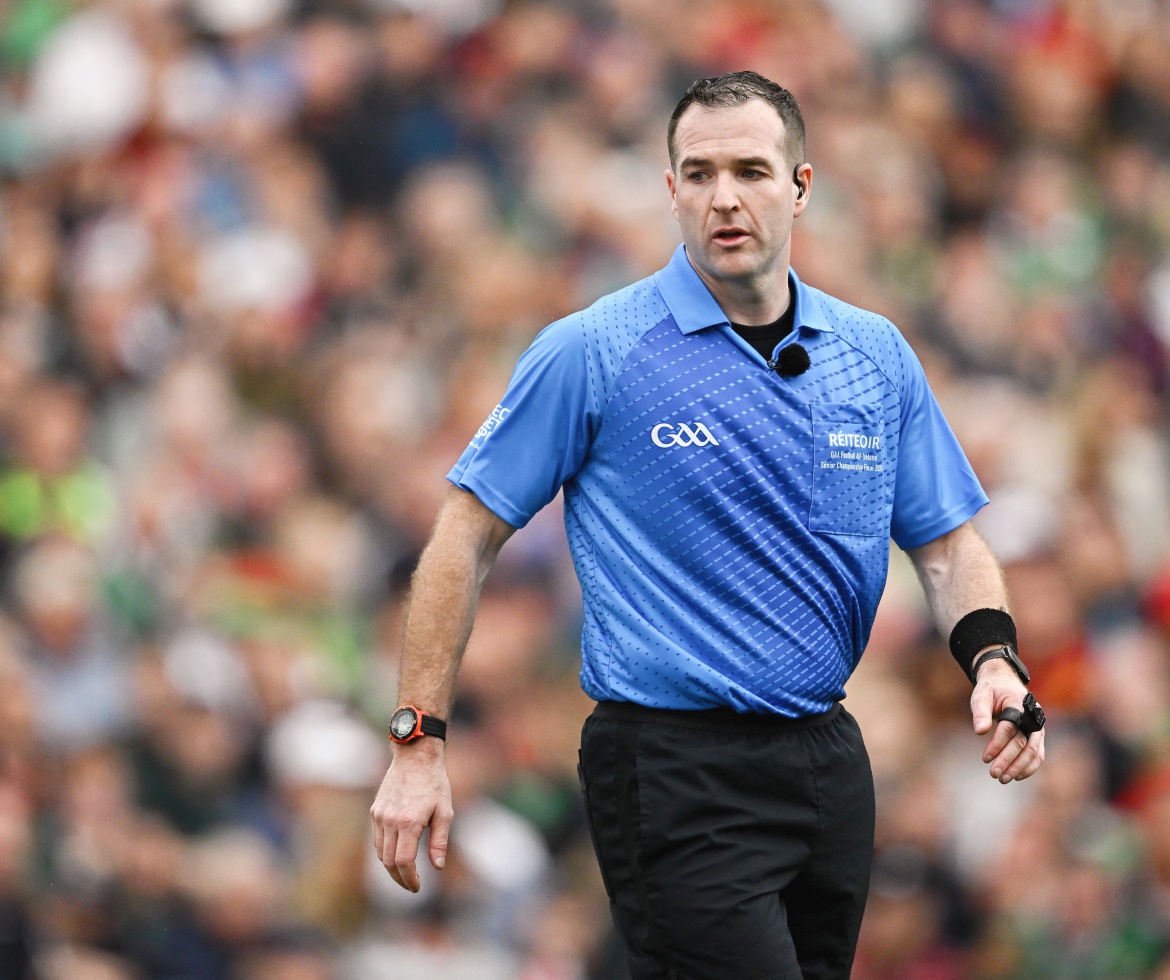
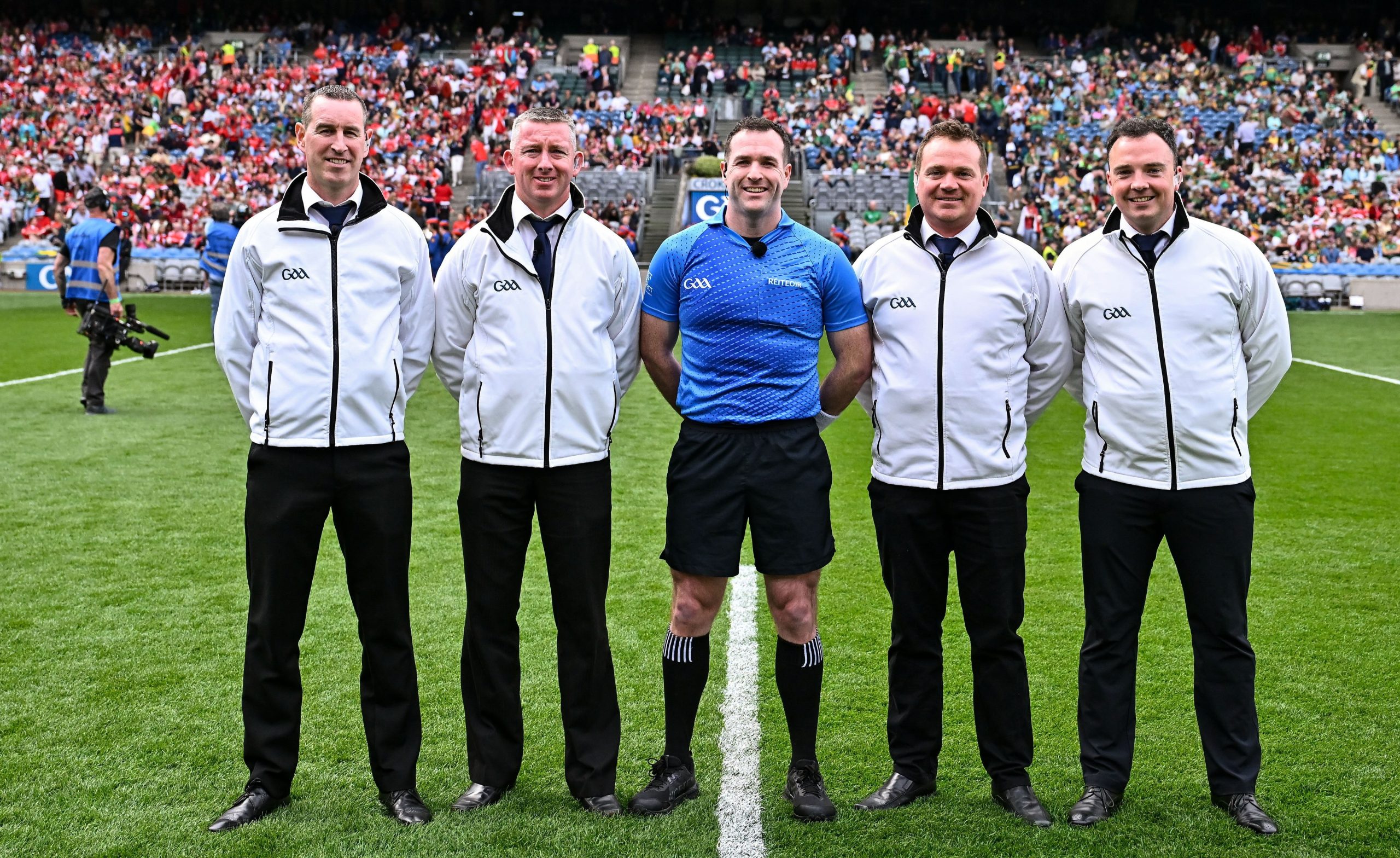
MARTIN McNally refereed his first All-Ireland senior football final on Sunday alongside four Corduff clubmates on umpire duty. A privilege, according to McNally.
Speaking to Gaelic Life on Tuesday morning, McNally hadn’t yet watched it back. He will in time. As with every other game, evaluation matters.
All the same, a referee not in the spotlight is often a sign they’ve performed well and Sunday’s game which saw Mayo win their first All-Ireland in 75 years passed off without controversy.
For McNally it’s all about trust in the team of officials and clear communication with everyone on the pitch.
“The north star for us is to get in and get out without any drama,” he said, also highlighting the team of officials’ remit to help “facilitate” the game.
“If the players lead you down a different path, well then obviously you have to intervene.
“All we want to do is facilitate a game of football and the new rules definitely have gone a big way in doing that.”
McNally picked up an injury during his own playing career back in 2011 and was coaxed into taking up the whistle.
By 2014, he was on the national referees’ panel and was added to the championship roster four years later.
Since the FRC’s new rule enhancements, including the solo and go option, the pace of the game has sped up.
Coupled with the heightened level of discipline needed from players, McNally feels the game is now easier to referee.
“The game is constantly moving,” he said.
“Players don't have time to stop, think and engage in anything that they shouldn't be doing.
“We want to have as little involvement in the actual impact of anything in the game as possible.”
Former Meath goalkeeper Donal Smyth is the GAA’s National Referees’ Manager.
On the Tuesday after the semi-final weekend, his name lit up on McNally’s phone.
While it’s not set in stone, the final referees are more often than not selected from those who officiated the quarter-finals.
Strong performances indicate there is a chance of getting a final but nothing is certain until the call actually comes.
“You're thinking, ‘right, okay, this could be for anything, a linesman, it could be fourth official, it could be referee’.
“Thankfully for me it was referee. It's hard to explain the feeling, but I suppose it's an incredibly exciting few moments after you get the call.”
The years of work had been worth it. After a ring around his umpires and family, it was time to begin the prep. Training needs to be tapered. Days, hours and minutes matter.
“There's a lot that goes on behind the scenes that people don't see,” McNally added.
“We would have analysed the two teams' kick-outs, so that we know what our positioning needs to be.”
Having refereed Mayo’s quarter-final win over Cork, they were aware that Andy Moran’s side pressed up high on opposition defences.
They also looked at Kerry’s use of David Clifford in the ‘number 13’ corner, his goal threat and his tendency to fist over from the narrow side.
“We were speaking to each other as officials in the first 15 minutes of the game,” McNally said of the communication with his team early on in the final.
“We do look at those patterns in play and all that does is just give us a better indication of where our positioning needs to be, for both myself and my umpires.”
Another important aspect is kick-outs and where teams tend to station overloads. Linesmen Sean Hurson and Thomas Murphy positioned themselves accordingly for the key decisions.
It’s the same for umpires on square ball and penalty calls if a tackle is deemed to be cynical.
“For me, last Sunday was about my team of umpires representing every umpire in the country,” he stressed.
“There has been a narrative out there about umpires. I think that umpires do a really brilliant job at club level and inter-county level.”
There’s a huge number of decisions made every weekend across a volume of games,but officials get the majority right.
“Yes, I know that when a mistake happens, it brings everything into focus,” McNally said.
“I would be slow to go with a knee-jerk reaction because of one incident.”
After the controversial square ball decision in Kerry’s semi-final victory over Dublin, there was a fresh appeal for all four umpires to be actual referees, as opposed to a trusted quartet the man in the middle is familiar with.
“It’s massively important that you have people that you trust,” McNally insisted.
“Jack O’Connor and Andy Moran both have people that they trust in the backroom team and I’m no different.
“I have Ben Woods, Niall Reilly, Mark Gilsenan, Anthony Marron and Pat McNally.
“The lads have a very high football IQ.
“Some of them are still playing, some have just recently finished playing and are now involved in coaching.”
Hold to account
Then there’s the additional bond that comes from spending time on round-trips when officiating over the country.
That’s also the time when performances are dissected with referee and umpires holding each other to account. It was the same last Sunday.
“The majority of the time you’re going to get most things right,” McNally said of his general take on every game.
“You have to be comfortable with the fact that you are going to
make mistakes.”
The important part is owning it, accepting it before learning for the next outing.
“I’ve made a lot of mistakes in my refereeing career but the important thing is that myself and the lads would have a look at what that mistake is,” he added.
“We’re no different to a team. We do our video analysis, we look back on our performances and we can see what the marginal gains are.”
The goal is iron out any creases and ensure they are prepared to the highest possible level on any given day.
While trust is important, McNally’s second vital cog for anyone moving through their referee journey is communication with players, managers and their own team of officials.
“Players and managers don’t always know everything,” he added. “If you give a decision, they always want to know why.
“I think if you communicate the reason that you’ve given decision; I think that will garner respect.
“They may not agree with your decision. You may not have got it right but at least when you explain your rationale behind decisions, as part of your communication. That’s the bit that will keep everybody on side.”
For now, McNally’s focus is on the Monaghan Senior Championship with teams always wanting – and entitled to – a top performance from the referee.
Like players and managers, every day is a new day.
There will always be a decision to make.
Welcome to the world of the man in the middle.
• For the full interview with Martin check out our Gaelic Lives pod on Spotify and YouTube
Receive quality journalism wherever you are, on any device. Keep up to date from the comfort of your own home with a digital subscription.
Any time | Any place | Anywhere
Get the app for the best Gaelic Life experience