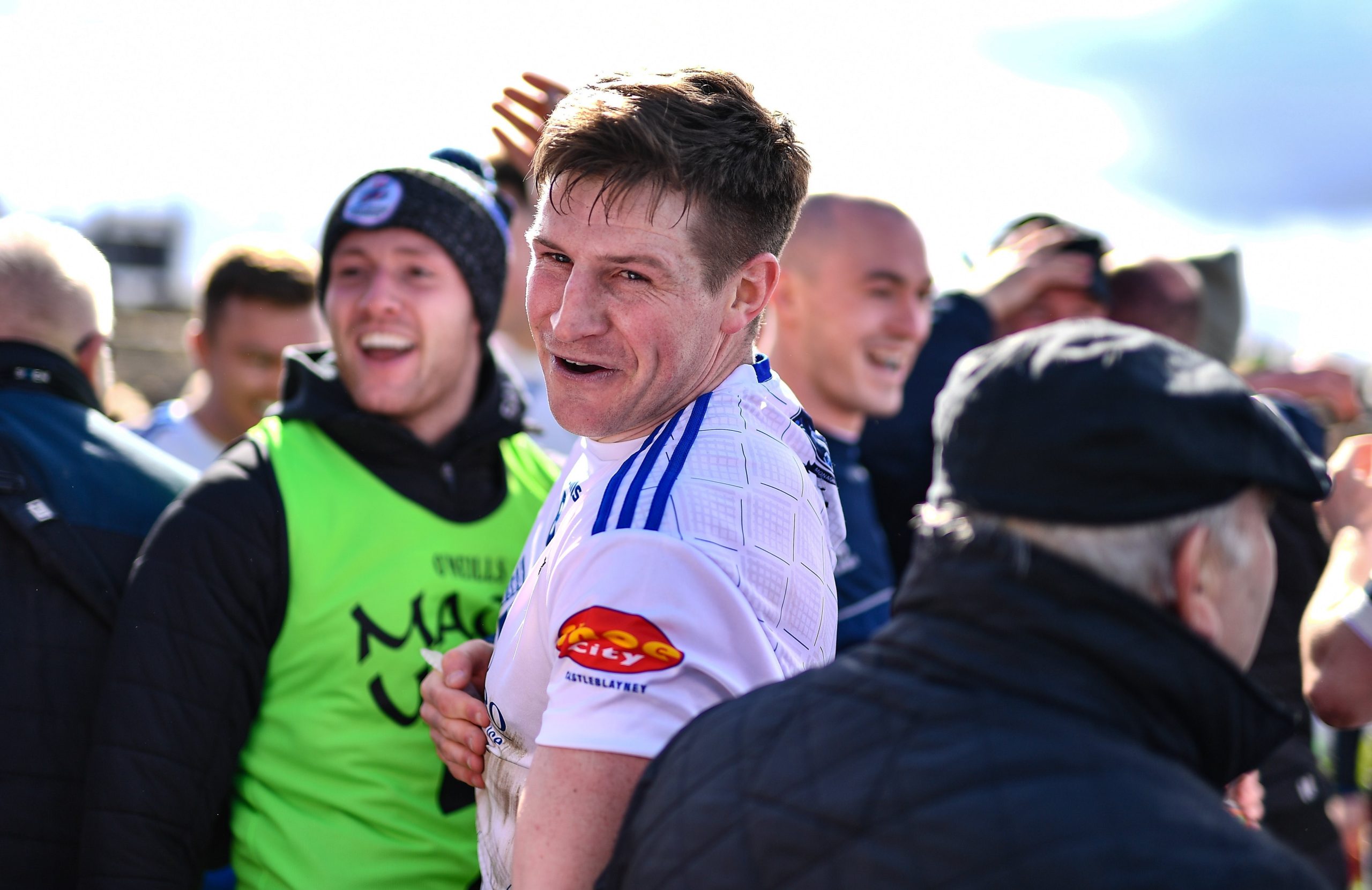


Darren Hughes has called time on his Monaghan career after two decades and over 200 senior appearances. He’ll go down as one of the county’s all-time greats. He spoke with Michael McMullan
THE Croke Park dressing room and the days afterwards is no window for rash decisions. With June’s defeat to Donegal still in the nostrils, Darren Hughes and Gabriel Bannigan spoke. They’d catch up again.
Hughes knew the timing was right to step outside the Monaghan bubble. It more about when to set it on stone.
A serious injury against Cavan last year made him ponder retirement until losing his herd of cattle to TB left him with the free time to roll the dice one last time.
“I suppose there was a wee bit of strategy in it,” Hughes said. Leaving the decks clear to focus on a search for a tenth county medal was important.
Within hours of victory over Truagh, the word was out. With a bye the following week, Hughes saw space between his retirement story hitting the ether and the Scotstown dressing room needing to focus on a title defence.
He counts himself lucky to have been part of a Monaghan team on the ascent towards the 2013 and 2015 Ulster titles.
Peter Canavan and Graham Geraghty were players he looked up to. Especially Geraghty. The blonde hair and flashy boots.
“He’d have been someone that you’d have been aspiring that you could play like because he was going from wing-back to full-forward in different years,” Hughes said.
The irony of it all, with Hughes being Monaghan’s utility man, having been handed virtually every jersey number from the bag. Including number one.
Growing up, his grandfather Packie Hughes, who owned the ground where Emyvale put their pitch, would take him around the grounds of Ulster.
Monaghan’s emphatic 1995 Ulster Championship win over Donegal in Ballybofey was his first memory.
His parents, Francie and Patricia, didn’t overly push football but there would always be a lift over to Scotstown.
Between the u-7s and primary school football, Hughes was on his way. The groups both above and below him in the club had success.
“My age group, we actually went from 1999 to ‘07 without winning anything,” he said.
They were competing. There would be a semi-final or a final, but they were always the bridesmaids. It coincided with their 20-year gap without a senior title.
“In the parish now, some children have gone through their whole primary school careers preparing for county finals,” said Hughes. He’ll hope this year is no different.
“It was a barren period for the club but there was still quality players being produced.”
After a couple of final defeats, it all fused into the 2013 success and the wave that followed.
And, in the middle, was Darren Hughes. Raising the standard, with his shoulder jammed up against the wheel. It will be the same when Cremartin pull into Páirc Mhuire on Sunday. And in Corduff two weeks after.
His retirement statement timing was perfect. Scotstown is as important as Monaghan. The kerfuffle will have died down. The phone will ping less; he’ll pull on whatever jersey he is given and do whatever it takes to help Scotstown win. Same story, different day.
A 2005 minor goalkeeper injury crisis helped Hughes on his county journey get off the ground. As someone lingering at bottom of the pecking order, it saved him from the January cut.
“I’d been sort of messing about before and after training in goals,” he recalls. “They (management) asked me if I wanted to step in for a game.
“I did and knew if I got the opportunity that I wasn’t going to let it pass me by.”
By the following year, with 13 players involved with the seniors, Hughes was called in, originally as a backup ‘keeper, with the u-21s for the now defunct Shamrock Cup pre-season competition.
“I have a lot of football under my belt over the back end (of the season) and I was probably a bit fitter than other boys,” Hughes pointed out.
After putting his hand up with his performances in challenge games earned him a wing-back spot. It was a foot in the door.
Hughes broke onto the Scotstown senior team around the turn of ’06. At UUJ, he was in around second teams before Adrian McGuckin elevated him to the Sigerson group, winning a medal two years later.
Hughes made his Monaghan senior debut under Seamus McEneaney against Louth in the Tommy Murphy Cup.
He came on as a sub for his league debut the following February with a first taste of championship coming in stoppage time of their 2007 Ulster semi-final win over Derry.
By mid-summer, Monaghan had All-Ireland champions Kerry on the ropes in the All-Ireland quarter-final.
“I have an abiding memory of it,” Hughes recalls. “I was the one that broke the ball down to Declan O’Sullivan to bring them back into the game with 10 minutes to go.
“I have a good strong cohort of friends that don’t be long reminding me of that.”
It took a fisted Tomás Ó Sé point to win the game with some Kerry players even thinking the sides had ended level.
By the end of the following year, McEneaney gave Hughes the heads up. After serving his time, coming in off the bench, there would be a 2009 starting jersey for him. The ball was in his court if he wanted to keep it. The rest is history.
“When ‘Banty’ came in in 2005, there was a big culture shift in Monaghan football and how the boys were preparing,” Hughes said of the beginning of their run towards bring a consistent Division One county.
“There was a line drew in the sand about drinking before games. When ‘Banty’ came in, it was his way or no way.”
Development squads began to take root with Paul O’Connor pulling the strings.
Twelve months after a minor team, that included Kieran Hughes, scored a single point against Derry – on the day Darren made his senior debut – the younger of the brothers led the Oriel County to the Ulster final. Another step up the ladder.
Martin McElkennon came on board to look after everything from coaching to conditioning to diet. Another step upwards.
“We had damn good footballers,” Darren said. “Maybe boys didn’t get the recognition they deserved. We never brought it into the rhetoric of being a small county and punching above our weight.
“It was never mentioned because we knew within the group we had a good group of players and every day when we went out we had a fighting chance if we played well.”
Monaghan lost the 2007 Ulster final to Tyrone. It was the same three years later, not before Hughes played a leading role in goalkeeper-gate.
As they prepared to face Armagh in the championship, injury to Shane Duffy put Hughes in the frame for the number one jersey, despite being originally listed at full-back.
By the pre-game meal in the Westrena Hotel, Hughes was sounded out about stepping into goal. ‘No problem’ was the response. Whatever was needed.
“The arrogant side of me might have been coming out a bit too to get into goals and not be responsible for marking a man,” he said with a smile.
“I was probably going to be on Jamie Clarke so I could have been in bigger trouble.”
It didn’t faze him and part of him enjoyed the media circus that was to follow.
Monaghan won easy. It was the same in the semi-final with Fermanagh before Tyrone “steamrolled” them in the final. Ten points. A proper beating
“We knew after 20 minutes that we we’re not winning this game,” Hughes recalls. “Tyrone just brought everything they had to the table and we just couldn’t handle them at all.”
This crept into Monaghan’s blip time. In 2011 and 2012 there were back-to-back relegations alongside successive exits to Offaly and Laois in the Qualifiers. The darkness before the dawn.
Malachy O’Rourke cut his managerial teeth in Monaghan, helping Tyholland to senior football.
There was an Ulster title with Loup in Derry and he also managed his adopted Errigal Ciaran to the O’Neill Cup. Going into the 2013 season, he was Monaghan’s man.
O’Rourke was helping out with Latton and Monaghan player Owen Lennon could see his inner workings first hand.
“In fairness to our county board, they fully integrate players in the process and take our opinions on board,” Hughes recalls of the crucial autumn of 2012.
The county board had the final say but the steer was important. O’Rourke was in.
“He laid the law down pretty quick in certain things,” Hughes recalls of his first impression of the foundations being laid.
“It was just purely on discipline. We probably lost our way a bit in ‘11 and ’12, that was on the players.”
Off the pitch habits had plummeted. There was a sizeable turnover of players and a double relegation followed.
“Things just weren’t going well,” Hughes added. “We lost Offaly in the championship backdoor in ‘11 and Laois in ‘12. We had no momentum.”
When O’Rourke set out his stall, he was clear and concise. Anything that was getting in the way of football was but on the backburner. Within reason, Monaghan and training had to come first.
“Something that you might have been getting away with previously, it was just, ‘no, it’s not happening.’ We would be training and we have to be there. You realise pretty quick this man means business.”
Monaghan weren’t coming from the basement. The players were there. The ship just needed a steer.
Fitness was a must. A system. Organisation. It all fed into an unbeaten league campaign that ended with promotion alongside Meath who Monaghan also beat in the league final.
After a six-point win over Antrim, Monaghan overcame Cavan to seal a spot in the Ulster final, a third in seven years.
“We had stuttered over the line against Cavan,” Hughes said. “We were up three or four at one stage and they got it back.
“It was sticky enough in the last couple of minutes. Rory (Beggan) had caught a ball on the line and took a few too many steps.”
There wasn’t a peep out of Marty Duffy’s whistle. Monaghan were in the clear. It’s a moment they still talk about and it set up an Ulster final date with All-Ireland champions Donegal.
Donegal were 0-12 to 0-9 winners over Down in the other semi-final and O’Rourke circled the wagons as they prepared for a tilt at the Anglo Celt Cup.
“He pulled us into a room,” Hughes recalls. “We sat and watched the whole game.”
If they weren’t good enough to beat Donegal after their performance against Down, O’Rourke told them, they were only wasting their time.
With two weeks to go, the preparations were all geared towards the biggest Clones Sunday of the year. Meticulous and methodical.
“Everything fell into place,” Hughes said of the day. “It was just everything that day, from the minors winning and them coming back from when they were, eight or nine points down, with a few minutes to go and come back against Tyrone.”
Hughes can’t think of the final without O’Rourke making two late changes with Padraig Donaghy and Dermot Malone. Both at wing-forward.
“There were still plenty of people who had us backed at 7-1 going into it as well, so the confidence was there,” Hughes added.
“The left-wing calls (Donaghy and Malone) worked for us on the day.”
After winning the throw-in, Monaghan launched their first attack. Darren Hughes with a kick into the corner to brother Kieran. Over the bar.
Advantage Monaghan, who pushed four clear before Donegal scored and were 0-5 to 0-2 up at half-time.
Monaghan kept on trucking and battling. The work had been done. It was a matter of keeping the foot down as they closed out victory for a first title since 1988.
By the time the cup was presented, there wasn’t a blade of grass to be seen. St Tiernach’s Park now a sea of Monaghan fans. Blue and white everywhere.
Hectic. One word to sum up the days that followed, helped with the Monaghan Country Festival being in full swing.
“The whole town was set up with the big lorry in the middle of the diamond,” Hughes said of the celebrations.
“We done a tour of the town. When you think about it now, it was madness doing it but we hadn’t won an Ulster Championship in 25 years. We took full advantage of it now.”
The tour of the towns continued during the week before they training resumed ahead their All-Ireland quarter-final, a defeat to Tyrone.
Donegal got revenge the following year in the Ulster final, on their way to the All-Ireland final.
It didn’t take long for Monaghan to realise they weren’t at the races. Donegal were fully charged. Christopher McGuinness hit a goal that was never going to be enough. Donegal’s early marker was a potent one.
“You just get the feeling on the pitch and, you’re like, ‘we’re struggling here’ and we’re not getting away with it as we’d like,” Hughes remarked of the 2014 final.
“We had prepared as well as the year before, but, just on the day, we just had no answer for them.”
No excuses. Beat by a better team. Take your oil and move on. The 2015 final was a third installement of the rivalry with Monaghan making it a second title in three seasons.
It was a sweet result in a poor spectacle with two defensive teams trying to figure one another out.
“I don’t think we scored for the last 15 or 20 minutes of that game,” Hughes said.
“I remember standing, maybe around the penalty spot, and watching Paddy McBrearty’s run for the last kick. Nine nine times out of 10 it goes over the bar, but it just tailed wide at the end.
“We were holding on for dear life at that stage and we thankfully got over the line.”
In a career that saw appearances for Ulster in the Railway Cup and Ireland in the International Rules, Hughes steps away without the biggest prize, an All-Ireland medal.
Kerry in 2007 was a chance missed. Dublin two years ago was the same but not as close as 2018.
Hughes got a block on a late Tiernan McCann shot only for Niall Sludden to finish the rebound to the net in a one-point semi-final loss.
While it was the same for Tyrone, it was in the era of the Super Eights and it irks Hughes how they’d only one week to prepare after their last group game.
“You hadn’t a full chance to really prepare and get ready for the game as you had for other big games,” he said.
From their double scores win over Galway the week before, Monaghan had two token training sessions. Yes, the boots were on, but preparation was limited.
“You’d just love to have been better prepared, fresher and obviously they were on the same boat,” he said “ We just came up short in the end.”
In 2023, against Dublin, they were again within a whisker. They hammered the hammer in the third quarter but missed chances in the first half came back to bite.
Hughes was back for the following season. After winning the 2013 Ulster title, the next seven years went like a flash. On the other side of his 30th birthday, he’d weigh up another season. If he’d something to offer, he’d put his hand up.
A serious injury in the 2024 Ulster meeting with Cavan saw the game stopped before Hughes left St Tiernach’s Park on a stretcher. The end of the line? Possibly.
It wasn’t. Like before, he battled his way back. By October, he was on the Scotstown starting team on county final with medal number nine on the way.
County level was different. Monaghan had a new manager. There was a new set of rules and his 40th birthday was a year closer.
“I probably thought it was the end of the road and was at peace with that too,” he said of this decision-making process.
“I was 37 last year. From when I was 34 or 35, you’re just taking each year as it comes.”
Can I offer something? Would I be an influence? What about family? What about home life? What about the farm?
“I probably was siding on stepping away and the circumstances changed at home here, that I had lost the cows with TB,” he said.
“So, ultimately, I had no farming for four months so there was a bit of a hole there to be filled and I just felt it was a selfish side of me too.”
Getting back in with Monaghan, he’d get the best medical treatment possible. Gabriel Bannigan was keen to have him on board.
It was the same with Karl O’Connell. Conor McManus tried but his body said no. Two out of three wasn’t bad for Bannigan.
“I knew I’d have an influence off the field with the lads,” Hughes said. “I was excited by the new management and Andy Moran coming in and the new rules.
“We had a chat with Gabriel and I said I was willing to commit if he’d have me and he was glad to have me back, but I knew this year was going to be the last.”
Coming on for Gary Mohan, in the All-Ireland quarter-final defeat to Donegal, incremented the appearance figure by one. For the last time. To 206. A serious innings.
“I wouldn’t change anything,” said Hughes, speaking last week, days after his decision to retire.
“As a young fellow growing up, you’re going and travelling to these games and looking at them and watching at them from the other side of the white line.
“To be fit to participate in it then, you probably don’t fully appreciate it. You will maybe only in later years fully appreciate it when you’re not at it.
“Before I was playing, I wouldn’t have missed a Monaghan game. I think I was probably fulfilling a childhood dream and when I got the opportunity, I wasn’t going to let it pass me by
“I still felt in the latter years that I was having an influence on and off the field. If I could offer something, I’d keep throwing my hand at it,” he continued.
“It’s all down to the balance from home, year to year. Orlagh was very supportive. Every year going back, I didn’t feel as if I was sacrificing anything.
“It was them that were working around me and my calendar and training schedule all the time. You have to appreciate that too. It’s just time to give a bit back.”
How would he like to remembered? He’s not bothered but feels he always brought a consistency to his game.
There were never many eight or nine out of 10 ratings but there weren’t many fives either.
“I always went out and gave my best and tried my hardest every day,” he said.
When Monaghan take the field next season, Darren Hughes begins a new chapter.
A spectator, helpless, looking on and hoping Monaghan keep doing what they’ve always have done. Keep going to the well.
“With Division One, I’d be hoping they’d put an emphasis on trying to stay there,” he said.
“I have no doubt there’s a blend of youth and experience there now and to back it up”
Darren Hughes has played for Monaghan for more years than he hasn’t. That will change with every year. The legacy he leaves won’t. It’s there forever.
Receive quality journalism wherever you are, on any device. Keep up to date from the comfort of your own home with a digital subscription.
Any time | Any place | Anywhere
Get the app for the best Gaelic Life experience