


There has been a recent influx of ACL injuries. Michael McMullan spoke to Tyrone physiotherapist Marty Loughran about injuries…
MEATH manager Robbie Brennan has reported a fourth ACL injury in the squad in a week we’ve news of similar injuries elsewhere.
Marty Loughran, of Elite Physiotherapy, is part of Malachy O’Rourke’s management team with years of experience of treating injuries.
Michael McMullan: Has there been an increase in ACL injuries?
Marty Loughran: There’s an increase but this covered by the increase in youth football, ladies’ football and camogie, female participation. I don’t see any evidence that it has changed in the men’s game.
You’re talking one ACL per squad, every two years. You may get a freak event with Meath now getting four in one season.
Ladies are more susceptible than men. If you’ve got all four codes, you probably are going to have four or five.
M McM: Why are females at a higher risk?
ML: There are a number of reasons, but the biggest one being the female pelvis is wider for childbirth.
Whenever ladies are running, decelerating, jumping and landing, going into positions where you’re more prone to injury, their knees at a wider angle from their pelvis, that leaves them more vulnerable to the injury.
There are a lot of investigations going on around the menstrual cycle and the time of the month the injury has occurred.
Ladies’ sports are relatively newer and there’s not as much sports science. It’s different if you’re talking about the highest level, at lower levels, the support structures are not as well packaged, that heightens their risk as well.
M McM: With an ACL injury, is it overloading or a combination of firm ground and footwear?
ML: There are definitely more games and training, so there is more risk. There’s a certain chance of you having an injury risk every time you step on the pitch. If you’re training more and playing more, that drives injury rates up.
There are development squads, not just with counties. Clubs have B and C teams; more people are getting more sport so more exposure to risk.
There are other factors. Tyrone have minor and U16 football in the same week, so some lads have two games 48 hours apart.
We know that it takes at least 72 hours for the human body to fully recover from a tough game or a tough training session.
If you’re asking somebody to play within that 72-hour period, their coordination is going to be off, their strength is going to be off, they’re going to be tired. Their flexibility is down; their reaction time is down. An ACL is a coordination injury, it happens at such high speeds, within 20 milliseconds. The nervous system can’t react to the slippery pitch, the change in the ball flight or a change in the opponent’s movement.
We can’t coordinate our movements and our limbs to put them in the right position to avoid snapping the cruciate.
If you’re leaner, stronger, fitter, faster, in the best possible shape, you are less likely to do it. However, if you go into matches under recovered, then you’re definitely at a much-heightened risk.
We probably see a lot of them in it because there’s definitely a more clustering of games through the summer.

SIDELINED…Conor Gray became the fourth member of the Meath squad struck down by the dreaded ACL injury
M McM: Somebody who plays on a Sunday, they train on a Tuesday, they are not fully recovered?
ML: Jurgen Klopp would pull his hair out if Liverpool were playing on a Wednesday night in the Champions League at eight o’clock and out again at 12.30 on a Saturday. He wasn’t getting his full 72 hours. He knew the players couldn’t play as well because they weren’t fully recovered. There was also a heightened injury risk.
People used to say the professional footballer should be able to recover from Wednesday to Saturday. He knew physiologically the players aren’t able to recover in that time, so there needs to be more awareness for GAA coaches of how they plan their week.
If they’re playing on the Sunday, they shouldn’t be training hard until the Wednesday.
There are times during the year where you want to push the team a bit more and get a bit of overload, you can build that in.
If you’re just doing the traditional Sunday, Tuesday, Thursday, then you definitely need to look at what you’re doing.
That could be heightening the risk of your players getting injured and it’s a cumulative effect, doing that over six, eight or 10 weeks in a row.
M McM: You have a case when a player can tear their ACL while nowhere near an opponent in a game even.
ML: Potentially there’s only four ways to do your cruciate. You can land on one leg and your knee buckles inwards. You can do a 180 change of direction and the knee buckles inwards. You can land on one leg; it flicks back and hyperextends. When you’re running for a break ball, you plant your foot and your knee keeps traveling forwards.
There are very specific movements that cause this, it’s called a pivot shift mechanism in the knee for the cruciate to snap.
M McM: The split season and county players going back to the club. Is that a factor?
ML: It’s huge. In Tyrone we’ve been lucky with cruciate injuries for a while. We’ve had six hernias last year going from our county into our club season.
That’s a mixture of lads who went from Tyrone seniors or U20s back to the club or lads coming from the intense club season and came into us.
The ACL gets all the publicity but there’s an epidemic of chronic hip and groin pain, really severe hamstring injuries.
We would have been sending people with a massive hamstring injury to London for a surgical repair, maybe once a year. I was on a Zoom call with the surgeon in London three times in 24 hours this summer, for three different club players in the Mid Ulster area.
The amount of really massive hamstring injuries we’re seeing has gone through the roof. It’s not just the ACLs, there’s more boys getting hip, groin or hamstring surgery.
The girls are probably more predisposed to the ACLs. The boys probably more predisposed to those nastier groin issues. The both can get hamstring injuries but we predominantly see the big hamstring injuries in the lads.
M McM: The million-dollar question, what can be done?
ML: The GAA needs to, in some shape or form, follow a rugby model in that you can only play for one team at one time or you’re not insured.
If you’re at the Rainey Rugby Club and the Rainey School, you don’t play for the club until the school’s finished. It’s one or the other. When you’re called up to Ulster, you don’t play for the club.
I’m not saying the county players only play county but this crossover of a lad playing Sigerson on a Wednesday and county at the weekend, it’s madness.
Someone playing U16s and minors in the same week. It’s madness and doesn’t happen in any other sport.
It’s just traditional for us but we need to have defined seasons with no crossover, serving two different masters, training for two different teams.
We do have that with senior county and senior club, but there’s so many other times where that’s not true, even within the club itself. I don’t know how that works within dual clubs.
You can go for a moderate session, an easy session, but if you’ve had a hard training session or match. You need 72 hours to recover. If you don’t, then you’re increasing your injury risk. I think that’s why our injury rates are so high.
With the tradition of how we lay out games and training sessions, we can’t have the best sports science models. It’s going to take somebody to rub the whole thing out and start again.
M McM: At inter-county level, especially during the league, does it get to the stage that a team can only train once that week?
ML: That does happen. I spoke to Croke Park on this. The evidence is there that if a senior of the county team plays three weeks in a row, their injury rate goes through the roof.
We played Kerry in 2023 in the All-Ireland quarter-final, through the prelim quarter-final route after the group stage. We had five significant soft tissue injuries in that game.
You want to avoid that three games in three weeks now because it puts you at huge risk of injury. You need to carefully select when you train.
The best teams now aren’t talking about Sundays, Tuesdays and Thursdays anymore. They’re talking about game day plus one, game day plus two, game day plus three. That’s how you lay your training sessions out, what you do and how much load you expose players to.
M McM: The inter-county player, getting a break before going back to the club and using the 72-hour rest window is the ideal?
ML: It is nice for the big clubs, not worried about relegation or winning a league. They can give their county players a two or three-week break.
They then get a two or three-week break from the club season before they start their county pre-season training. That’s ideal but we know a lot of players are rushed back after the county season is over.
I’ve seen county players’ GPS go through the roof when they go back, they’re training harder and more with the clubs than they are with the county.
I’ve spoken to other Heads of Performance around Ireland and they see this as well.
When we had the April club month, it was madness because clubs were running boys in the ground.
We all just need to embrace sports science and just be more sensible.
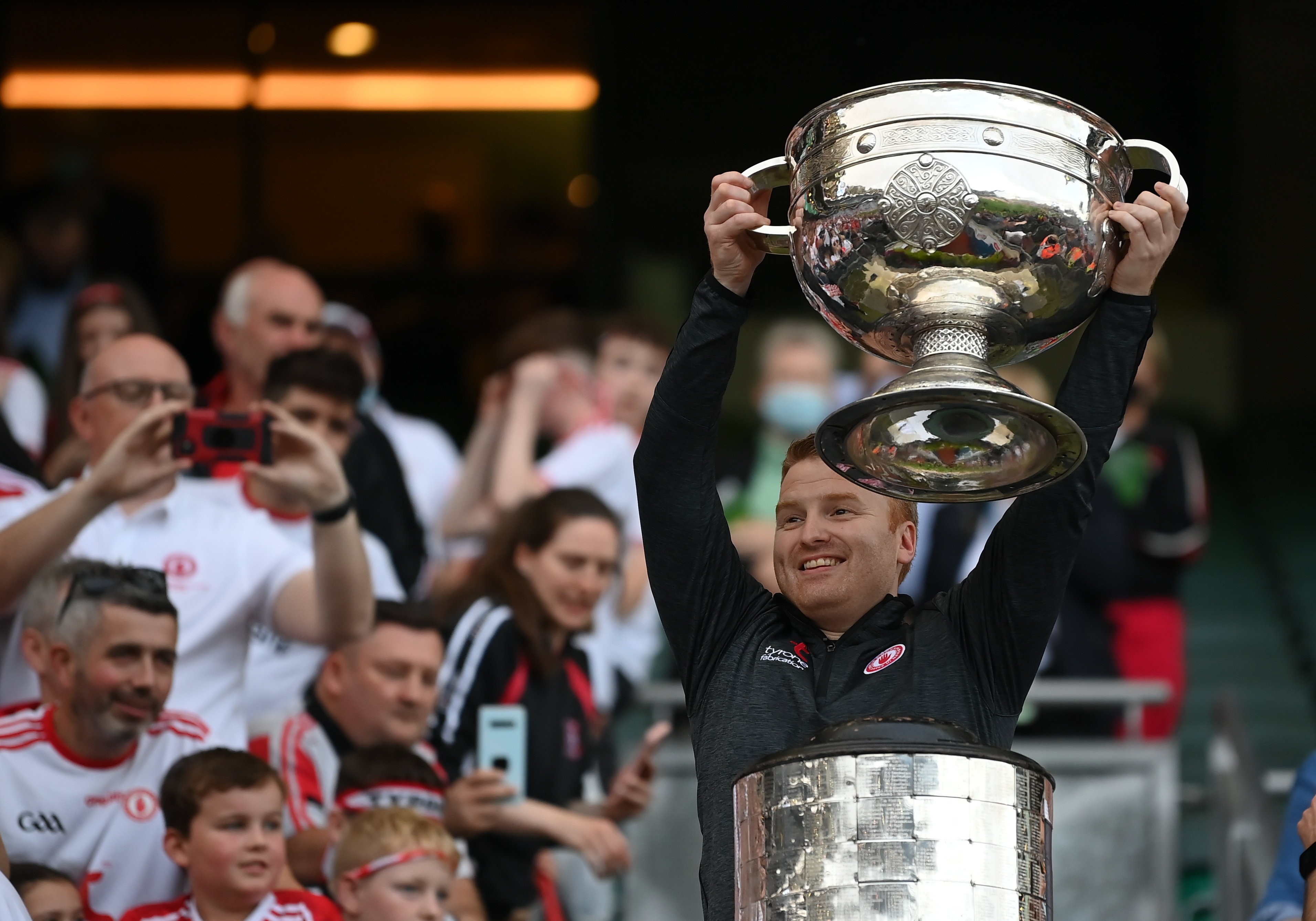
SAM TIME…Marty pictured with the Sam Maguire Cup in 2021
M McM: Then you have underage. In Tyrone, the U14 and minor were played in the same part of the season with U12 and U16 separate.
ML: That worked really well. The problem was the extended inter-county minor season pushed the minors into summer football.
It does need to get back to that. I would love to see a better schedule of consistent games.
If you go to play basketball, football, hockey, rugby, there’s a fixture list throughout the season. You’re playing every week but you’re not asked to play for U14s on a Monday and U16s on a Wednesday.
I’d like to see us play lots of football, but one game every week for 20 or 30 weeks. There’s just too much overflow at the minute and it’s the star performers that are usually paying the cost of that because they are playing for all these different masters. Everybody wants their pound of flesh from them.
M McM: What does the off-season need to look like for players?
ML: Having an off-season is physically and mentally really important, especially for county players.
Some of the Tyrone players who have been knocked out of the cub season, they’ve gone to yoga, reformer pilates, padel.
Not having that highly stressed, competitive environment, something different for the mental deload is really good.
It’s well known that the more sessions you complete in pre-season, the more likely you are to have an injury-free season.
Lads coming back from an Ulster or an All-Ireland club campaign, coming into a county season, the chances of them coming through the county season unscathed is really low.
Compare that to the lad knocked out in the first round of the club championship, came back and has done every single session in pre-season and built up properly.
Pre-season is vitally important. It’s not about cross-training or doing lots of different things from a physical perspective, it’s about completing those sessions.
When you have that cumulative load, it’s very hard to have a spike because your body has built up that resistance against it.
If you are being pulled in two or three different ways, go back to the county and it ramps up, you haven’t got that same robustness of the lad who’s been there from the start and done every session.
The other lad parachuted in January or February, the chances of him getting through a heavy stage of the season later on in the year is vastly different.
M McM: Is that the Kerry story with players coming back from a long club season?
ML: In Kerry, Jason McGahan is looking after that and has a PhD in this subject. He’s the best possible person you’d want to try to manage that, but it’s just an impossible situation.
You don’t have to go as far away as Dingle. Cormac Quinn has been playing for Tyrone all year but if you go back to that year Errigal went to All-Ireland Club final, Cormac didn’t play any National League football because he was injured.
This 52-week relentless season is leaving it very difficult for players in really top club teams. It’s just not sustainable.
M McM: Is there anything else you’d like add?
ML: A lot of players say they are tired or sore but there is a tradition where people think there is nothing wrong with them.
Then, the following week they do the cruciate.
A lot of times the signs and the symptoms are there but nobody picks up on it or wants to pick up on it. You want to squeeze that extra training session out of them.
The best managers I’ve worked with, they see it before the players will say it and tell them to take a night off.
They have that intuition, because they can see it in them and that massively helps reduce this.
I’ve been doing this over 20 year and very few boys like being laid up on the physio table.
Everybody wants to play football, if they’re complaining of something, there’s probably a genuine reason for it.
If we don’t heed that smaller niggle, chances are, it’s going to turn into something bigger down the line.
Receive quality journalism wherever you are, on any device. Keep up to date from the comfort of your own home with a digital subscription.
Any time | Any place | Anywhere
Get the app for the best Gaelic Life experience