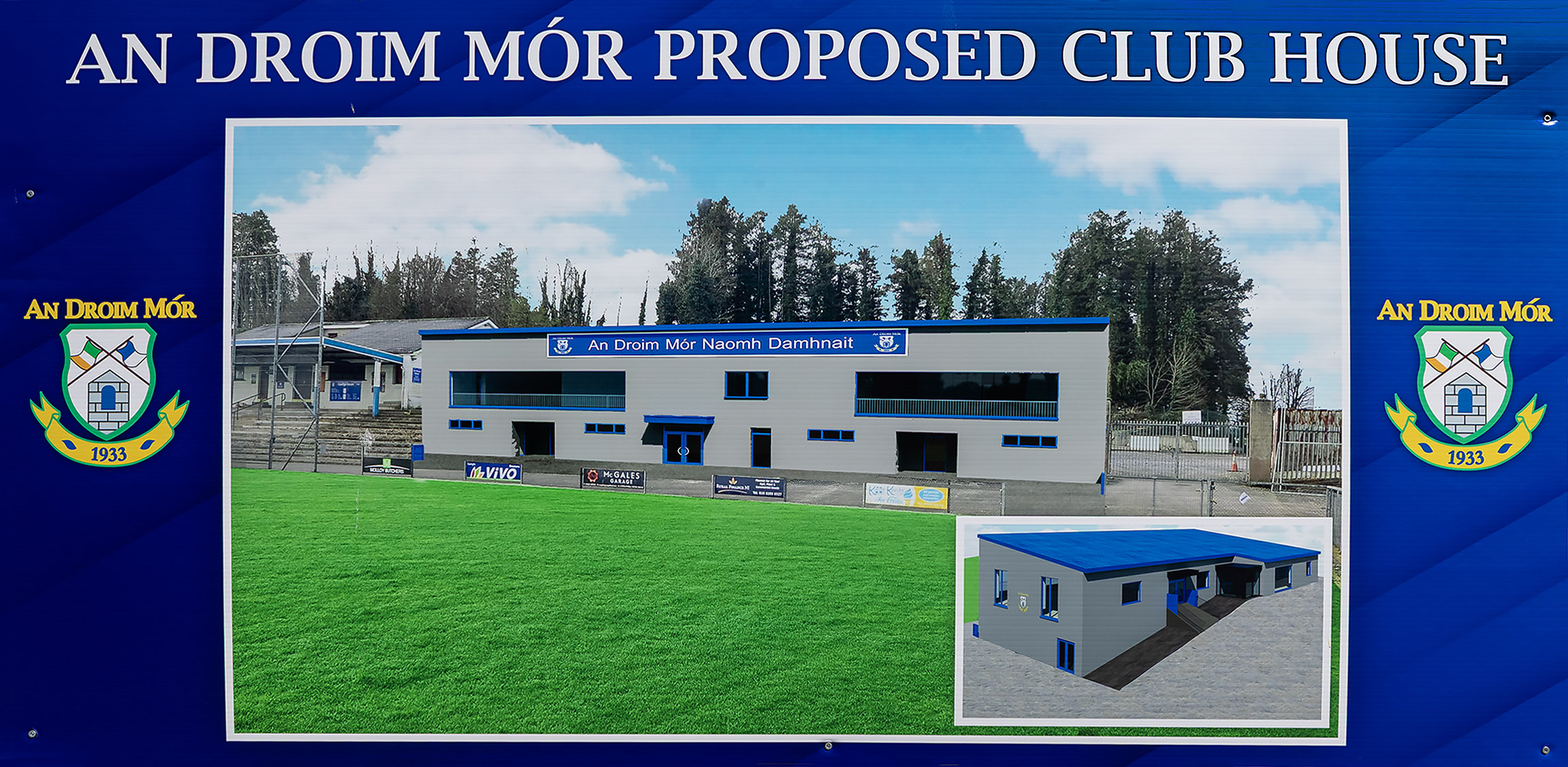


Dromore stars look back on special days at their home club ahead of its new development.
By Niall Gartland
MIGHTY oaks from tiny acorns grow. Back in the days before colour television, the home of Dromore GAA may have been fit for purpose and no more – but it certainly had its fair share of charms.
Players togged out in an unpretentious hut. The pitch itself was “basically a field”, defined by an unruly slope according to club stalwart Barry Campbell. In the corner of the pitch where the slope reached its peak, scoring was nigh on impossible.
A brand new pitch was unveiled at the grand opening of Gardrum Park in 1974, and it’s fair to say that the club hasn’t stood still in the meantime: its existing changing rooms were opened in 1985 with 100 Dromore gaels donating £100 each to make up the shortfall needed to bring the project to completion, a new stand was erected 10 years ago, and they can now proudly call upon three pitches for their members young and old.
There’s just one thing missing – the final piece of the jigsaw, you could say. The club needs modernised facilities and they’re set to commence construction of a pavilion that will contain four changing rooms, a hall, meeting room and more.
Dromore won’t consign their old changing rooms to the proverbial dustbin though. They’ll stay standing as a hat-tip to the club’s roots, and we’ve taken a trip into the past with a number of former players who have shared their memories about their second home.
Eugene McCann (played in the 1960/70s)
“I came onto the senior team when I was 17. We were football-mad. We hadn’t great facilities at that time. We had a wee shed and it was no hotel! Sometimes we togged out in Dromore St Patrick’s Hall and walked round.
“We won quite a few tournaments. We also won an Intermediate title in 1975 and I was on the panel that reached two county finals in the late seventies.
As a club we had to wait a long time to get our hands on the O’Neill Cup, and when we finally did (in 2007), it brought new life to the town. Anuncle of mine (Jack McCann), said that if Dromore ever won an O’Neill Cup, bring it to my grave and I did. I still follow the football all over – I’ve a young grandson playing, his name is Ryan Colton.”
Hugh James McDonnell (played in the sixties)
“There were loads of tournaments in those days. We sometimes togged out in the local hall, and if it was a good day, I’d get changed behind the hedge! We won tournaments but then we’d meet a lesser team in the championship and it just wouldn’t go for us. We had a lot of good footballers on our team – Ciaran McElduff, Seamus Donaghey, John McMackin – they’d have made any county team.
“I’m 83 now and I still go to any game I can get to. I’m living out in the country between Dromore and Irvinestown. I’m on the Fermanagh border, so I have to keep an eye on them!”
Barry Campbell (played in four county finals – 1977, 1978, 1982 and 1992)
“When I was a youngster, the pitch was just a field basically – very overgrown with long grass. There was a rise up until the corner, which was always referred to as the hill. If you were in there looking to get a ball or score, it was actually impossible.
“The first big development was the opening of the new pitch in 1974, and I suppose every decade after that, there’s been something added or improved on.
“We came back into senior football in 1975, won the Intermediate league and championship, and Dromore has remained there ever since. I think only Carrickmore has been there longer.
“I played in four senior finals alongside Tommy Fiddis, Ciaran McElduff and possibly a few more that I’ve missed out on. I don’t think we played particularly well against Carrickmore in the two finals in 1977 and 1978. In 1982, we played Augher, and in 1992 we came up against Moortown. Thankfully since then, we’ve made the breakthrough and we’ve had great success in league and championship.
“The new developments are going to be fantastic. The existing changing rooms opened in 1985 and involved a lot of voluntary work with a special mention to Liam McQuaid who would have led that construction.
“The work will be starting within the next few weeks which will be great to see. We have first-class playing facilities, we just need the changing rooms to finish it off.”
Ryan McMenamin (winner of three Tyrone Senior Championship medals)
“I first came to Gardrum Park when I was seven or eight. I remember the opening of the changing rooms – the floors were all being painted and everyone thought it was a great job, we were all jumping up and down! I’ve memories of togging out and if the pitch wasn’t available, we’d walk across to the croft, it’s a housing development now.
“On the same underage teams as myself were the likes of Collie McCullagh, Deccy Quinn, Joe Campbell, Kevin O’Brien. We all grew up together and won county medals as well. You had fellas like Barry Collins and Peter Ward a year or two below us. We’d plenty of good craic, they were brilliant times.”
“Especially going to school in St John’s, there was a lot of slagging with the Trillick and Fintona lads. Trillick would remind you that they’d won county championships and we hadn’t. It was brilliant to end up making that breakthrough – we’d lost six finals before we got over the line, and it was a special time for the club and the community. Gardrum Park is the hub of the community and it pulls everyone together. I was driving past last Tuesday night, the ladies were playing, and the place was full. There’s such a strong bond between everyone and that’s what makes the GAA so special.”
—–
THE new developments at Gardrum Park will help inspire younger generations coming through the club to fulfill their potential in the blue and white, according to its respective chairpeople.
Niall McNulty heads up Dromore St Dympna’s while Geraldine Teague is chairperson of the Dromore Ladies. Both recognise the importance of their planned new pavillion, with construction set to commence in the coming weeks by McCusker Contracts.
McNulty said: “We’ve done different developments in the past, Liam O’Neill was very prevalent with a lot of them, our 3G and our training field and our stand. This is the icing on the cake. Our changing rooms have served us well, coming from a tin hut here to our changing rooms.
“We’ve come a long way and it wouldn’t be possible without our members rowing in behind us, and we got the support of the entire GAA community in our big club draw.
“We need to provide top-class facilities for both our boys and girls and we feel we’re going in the right direction.
“I’d like to thank our general committee and our development community for all their hard work. This has been all-consuming for quite a while now. a lot of meetings have taken place and we’ve got there eventually.
“I’d also like to thank everyone who tended for this job – it was a very competitive tender and McCusker Contracts have got the job and we can’t wait for everything to come to fruition.”
Dromore ladies chairperson Geraldine Teague emphasised the importance of the new developments and expressed her gratitude for the hard work on the ground by a host of dedicated club members.
“It’s always a big club effort. We depend on everyone getting on board. We walked our feet off for a year selling tickets. There were big teams involved, everybody played their part. We did our bit and we’ll continue to do our bit. We’ll be very happy when we finally cut the ribbon on the new building – it will be the fruition of all our work.”
Teague also spoke warmly about the thriving youth scene in the club, and said that the young boys and girls from Dromore will stand to benefit hugely from the new facilities. She paints a scene of life at Gardrum Park on Saturday mornings – a sea of colour and noise as youngsters play with their friends.
“If you come to Gardrum Park, it’s always alive with activity. On a Saturday morning in particular, with all the youth involved, it’s just lovely to see the buzz and hear the noise. There’s a real community spirit and it would do your heart good.
“That’s what these developments and our games are all about – building a strong community where our youth can grow, develop, and become responsible people in the years to come.”
Receive quality journalism wherever you are, on any device. Keep up to date from the comfort of your own home with a digital subscription.
Any time | Any place | Anywhere
Get the app for the best Gaelic Life experience