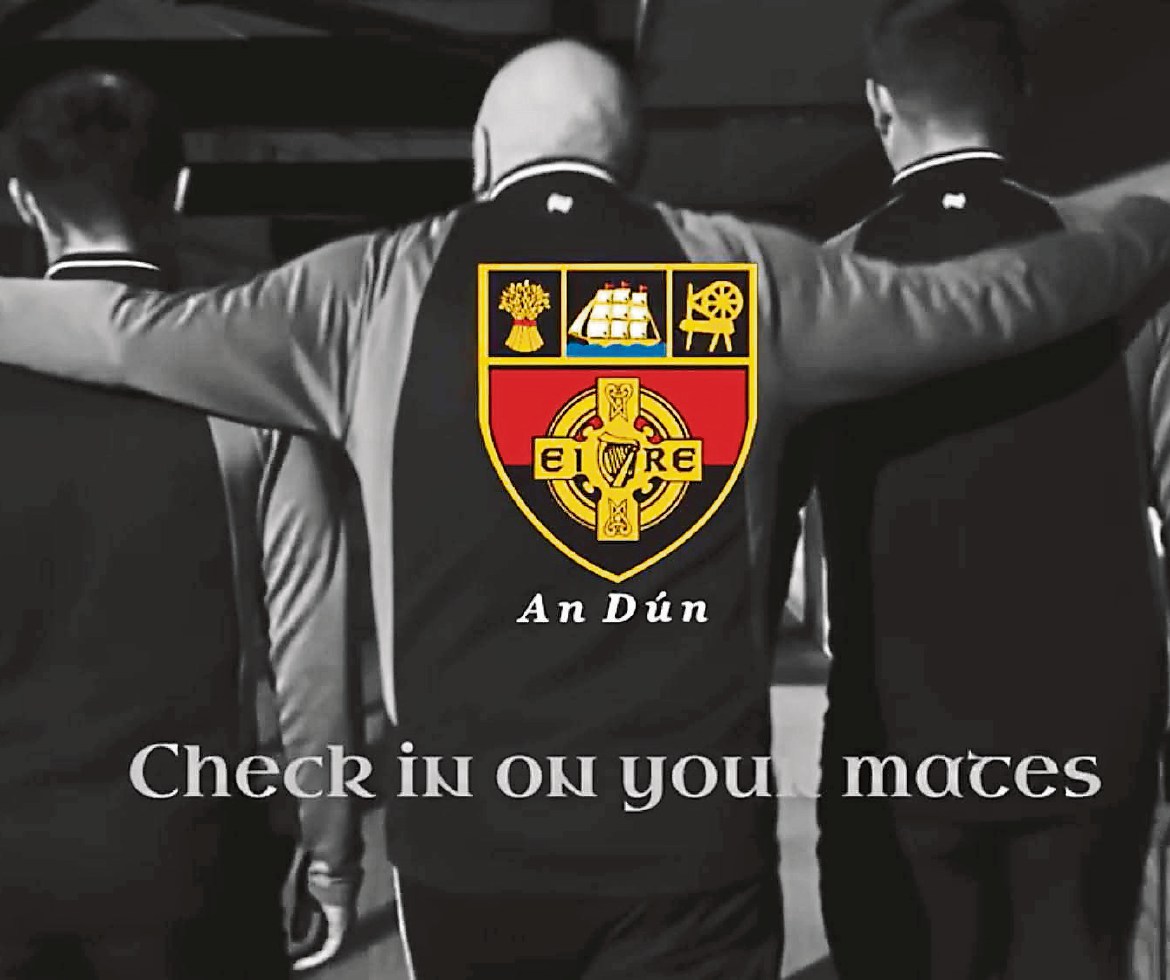


Down GAA highlight the importance of looking after one another off the pitch. Shaun Casey writes…
DOWN GAA’s campaign of “The best team-talks happen off the pitch”, promoted with a fantastic video on social media last week, shared an important message to everyone involved in the association.
With the arrival of the dark nights and that extra nip in the air, for most clubs up and down the country, the floodlights have long been switched off and the glowing hub of their community, the field, has been closed down for the winter.
For players, supporters and volunteers alike, there’s a lull until the preseason training returns, the lights go back on, and the chase starts again.
It’s a difficult time of year. Not just for GAA members, but for lots of people nationwide. A small chat, a message here and there, can make all the difference.
Men, by their nature, often find it tricky to open up, show some vulnerability and chat about their feelings. The video encourages them to do just that.
The GAA is the lifeblood of so many towns and villages. It gives people purpose. It offers an escape, no matter what’s going on in the world around them, they have the GAA. It belongs to everyone.
“It extends beyond players. Everything I do, every week, I’m doing something for the GAA,” said Dermot Donnelly, a Warrenpoint clubman who appeared in the recent video.
“I’m part of the Down Communications Team and we all have different roles, whether that’s taking photos, doing video clips or covering games on Twitter. We’re not actually on the field playing, but we’re on the sideline reporting the games to the public.
“We have a family ethos among ourselves, we have a bit of banter amongst each other, and it really is something to look forward to every week.
“I’d do a lot for the club as well and I find it very therapeutic. If something is stressing you out at work, then a match can be a release, meeting up with friends that you wouldn’t see outside of matches.”
Down Senior Championship winners Clonduff have suffered some tough times in recent years. They lost their teammate and friend, Lorcán Branagan, who passed away in Sydney in March of 2024.
When Charlie Carr and Stephen McConville, the Clonduff joint captain’s, accepted the Frank O’Hare Cup back in October, they held up the number two jersey. That was Lorcán’s jersey.
Recognising that it’s okay to reach out, to fall down, to both accept and offer support, is central when things aren’t at their lowest ebb.
After his passing, football was the last thing on their minds. “I remember when Lorcán died, you had the unknown, timewise, of when we would be getting him home, when the funeral would be,” Carr recalled.
“I remember after his funeral, and we were back training and, in a way, it was the last place you wanted to be. You could hardly even toe-tap a ball.
“Things were annoying you that shouldn’t have, but the football was an escape more than anything. You were going down to the field with boys who were in the same friend group.
“In the aftermath of it, you realise how important the whole club and community is. If you needed a shoulder to cry on, there were plenty of shoulders there.
“That was the thing about it too – talking about it. For us, the best thing for us to do was to keep Lorcán’s memory alive.
“Things like holding the jersey up for his mummy and daddy, his brother and sister, knowing that we still care about him as much as we ever did, and that he was as much part of that day as anybody.”
McConville added, “We didn’t realise it at the time, how important the club was. At different times during that period, the amount of people that would have reached out.
“For the community and the club, both playing members and non-playing members, it was a massive thing. We are really lucky to be involved in the GAA because some people aren’t as lucky.”
Life sometimes offers perspective. What happens inside the white lines for 60 minutes each week isn’t life and death, although it does feel like it sometimes.
“When you compare things to football, we get caught up in winning and losing and we’re more worried about the result than the affect a defeat can have on someone,” Carr added.
“Even regards injuries, we’re more worried about getting two points on the league table or getting through to the next round of the championship and you can sometimes forget to check in with people along that journey.
“I’m lucky enough I’ve been injury free but there’s others like Barry (O’Hagan). He touched on it after we won the championship that it can be a lonely road coming back from one cruciate never mind two. It’s really important just to check in to see how people are.”
McConville echoed that idea, “With how competitive and serious football is taken now, it’s important that we recognised that although it is very important to people, it’s not the be all and end all.
“There’s maybe something in the GAA that you have to appear to be strong, and sometimes that can be a wee bit confused with actually looking after the mental side of things.
“The winter can be long, especially if you’ve had a disappointing end to the season. The fact that the video is out there, it highlights the importance of staying connected.”
Donnelly is involved with the Down Senior Hurling team as part of Ronan Sheehan’s management ticket and when the county season ends, he’s straight back into club duty.
“The club scene has finished, and the county team are back training, with the exception of the Portaferry boys, but even having that, I would nip up when they are training,” he explained.
“It’s a bit of craic with the players and there’d be a bit of slagging and everything and you’re meeting different people from all different walks of life.
“There is such comradery and that connection, if I wasn’t doing something for the GAA, I’d be going bananas, so it’s keeps me sane and keeps be on my toes.
“It means different things to everybody, as the video emphasis, it’s those connections off the field. You’d be bumping into people even at work and you’re always talking about the next match or whatever it is.”
For people like Donnelly, who no longer play the sport, their contribution behind the wire is just as important.
“They are the beating heart of the football club because the club wouldn’t survive without them,” Carr said of the volunteers.
“Even in our senior management, Tommy Kelly and PJ McGreevey have put in so many hours down at the field.
“Take our President Finty (Mussen). I used to work in a local pub and Finty would have been in, and no matter how much we got beat by that day, he’d have always said that we’d get one championship.
“Many other people would have been putting the boot into you whereas he was always somebody that had your back and gave you that wee bit of belief that someday it will happen and thankfully, this year, it finally came.”
Donnelly added, “There will always be a job for you in the GAA. It doesn’t matter if you’re a player or whatever, once you hang the boots up there’s always something else for you.
“I might be coaching or whatever and all of a sudden, you have a whole new purpose. You find that spark again. Some people that hang up the boots, you maybe don’t see them again.
“There’s always something in the GAA to keep you going and keep you interested. It keeps you standing and that’s the magic of the GAA.”
On the older generation that keep the club in operation, McConville continued, “We’re lucky because our own club, we have unbelievable facilities and we can go down to the gym or go for a kickabout.
“For the older generation, I know how much our championship meant to boys that weren’t playing anymore. It wasn’t until you saw grown men crying and it was such a massive thing for them.
“That’s another thing from the video; you saw older volunteers gathering flags and different things and they grew up in an age where showing any sign of weakness wasn’t the done thing.
“It’s important for them to know that it’s not strange to give somebody a ring. Older people are great for just landing to the house for a bit of craic.
“For people that aren’t playing, their winter is extra-long because we can go back to preseason again, but their season doesn’t start until later in the year so it’s vitally important that they stay connected.”
The video, put together by Olivia McConaghy of omccphotography and Down GAA PRO Louise Kearney, offers an important message at this time of the year.
“It was the end of the championship season, I was sitting in Shamrocks Bar in Páirc Esler with a committee colleague, waiting for the traffic in Newry to ease before heading home,” explained Kearney on the idea for the video.
“Portaferry were celebrating their victory. Around us, groups of men were chatting, enjoying the occasion and catching up with one another. We were quietly reflecting on the championship being over and wondering what we would do now.
“Looking around the bar, I started thinking about the men for whom sport, whether football, hurling or something else, is where they make their connections, friendships and networks.
“There was a group sitting opposite whom I knew well. Their fathers would have sat chatting about matches in much the same way for years before them
“I’ve watched their children play and those men watching on together. These are the connections are carried through generations. They are part of what makes our clubs and communities so special.
“With November approaching, and inspired by the men around us, we began talking about what a men’s mental health campaign might look like.
“We also felt it was important that, as two women, we shouldn’t be making all the decisions about a campaign aimed at men. Fortunately, we have excellent men on our communications team, so we brought everyone together and started the conversation.
“The idea that the best team talks happen off the pitch became our focus: a reminder to keep connecting, to check in and, essentially, to look after our own mental health and each other’s.”
Scan the QR code below for the video.