

By Niall Gartland
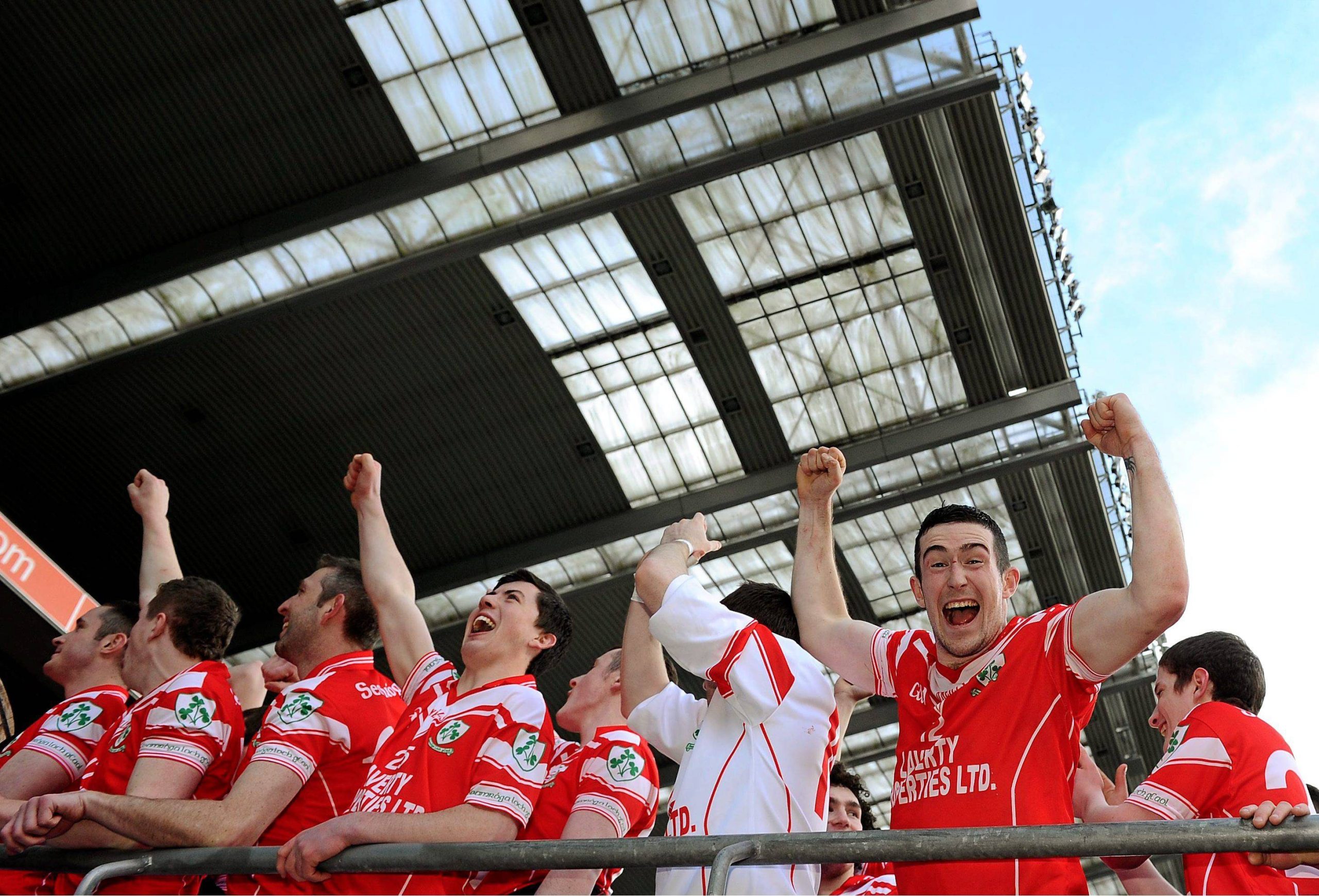
It stands as one of the supreme accomplishments in the history of Ulster hurling – Loughgiel’s All-Ireland final win over Coolderry in 2012.
The game itself is predominantly remembered for the superlative individual performance from Liam Watson. 3-7 in total – there wouldn’t have been much debate about the man of the match recipient, anyway.
But it really was a top-notch Loughgiel team across the board. That generation won four successive Ulster titles, five Antrim titles, and became the second team from the club to get their hands on the All-Ireland title on that famous day against Offaly side Coolderry. 14 years later, they remain the only team from the province to have won the Tommy Moore Cup.
Among their ranks was Eddie McCloskey, a gifted hurler for club and county who didn’t come from the typical hurling background in that part of the world.
Taking us back to the very start, he said: “My father quit hurling at 16. His father, my granda, died young, and my father was the youngest in the family. Before that, in Loughgiel, there was a fella called Nicky McGarry who was a legendary hurler back in the 1960s and ’70s. He lost an eye playing hurling. It was accidental, but he lost the sight in one eye. I remember my dad telling me that my granda didn’t play hurling because of that.
“My granda dying young put my dad off hurling, and my mother has no GAA background at all. Living in Loughgiel, it was really my friends more than anything else. I don’t have many cousins playing around here either. It’s your friends and your school – you pick up a hurl and away you go. My brothers just followed suit.”
Located 10 miles east of Ballymoney, Loughgiel seems like a fairly inconspicuous place. It’s claim to fame is the strength of its hurling and camogie teams.
“A lot of the boys who play come from farming backgrounds. It’s a big parish with a big catchment area, but there’s not a big built-up area as such. There’s a chapel, a shop, a school and a couple of estates around it, and that’s about the height of it.
“Living in Loughgiel, the first thing is hurling and camogie – you can’t escape it. You’re thrown into it and that’s it. You play until a certain age and then you make your own choice. I know boys who couldn’t wait to stop. They were only going for the craic and then work and girlfriends came along and away they went.
“For the rest of us, it gave us something to do. It was always something to look forward to.”
McCloskey’s own playing career picked up momentum when he was in his mid-teens. There were plenty of bad days to come though – Loughgiel lost six Antrim Senior Hurling Championship hurling finals between 2003 and 2008, but they turned a corner with their 2010 victory on county final day against Cushendall.
“I remember my first game in Casement. I scored two goals, although they both just trickled over the line. That gave me the bug.
“I wouldn’t have said I was an outstanding underage player, but I had a good birthday, so I was one of the older lads in my age group. Around 15 or 16 I really kicked on. You’d have wee moments in games where you’d think, ‘Maybe I’m not too bad at this.’
“I made my senior debut for Loughgiel when I was 16, away to Ballycran. It was after the championship and I suspect they were short of senior players, so they brought a few underage lads along. You’d never see an U16 playing senior now.
“I couldn’t wait to get going. I scored a couple of points and did alright. The following year I started championship matches and just seemed to kick on.”
He continued: “We lost six Antrim finals in a row. Out of those six, I think I was involved in four. In one of the semi-finals, I got injured against Dunloy in Casement. Then we played Cushendall in the final. I had ligament damage in my ankle and got an injection before the game, but it was no good. I had to come off after five or ten minutes. I think that was maybe the second or third final. I was only 17 or 18 when I played my first final.
“We went on that losing streak, then lost the semi-final the seventh year, and after that we went on a winning streak.”
The enlisting of Jim Nelson, who had led Antrim to an All-Ireland final appearance in 1989, was a key factor in their change of fortunes.
McCloskey said: “It was probably a combination of everything. You could see the older lads – those boys had lost six finals and not one of them walked away. They had a real hunger to win one.
“Then you had a good crop of young players coming through. The likes of myself, Shay Casey, Odhrán McFadden, Ciarán McKinley and Liam McKillop. We’d had success at underage and played county hurling, so there was that combination.
“But the big thing was probably the management. Jim Nelson came in and there had always been that wee seed of doubt: Can we do this? With Jim there at the helm, he gave us the confidence. We always felt if we won one we’d win a few, and that’s exactly what happened.
“The hunger and drive were the biggest things. You needed that first and foremost.”
And the players genuinely believed they had the ability to win an All-Ireland title – even before they made it to the top of the tree in Antrim.
McCloskey recalled: “When Jim came in at the end of 2009, he got us all to fill out questionnaires. One of the questions was, ‘What do you want to achieve?’
“He talked about it later when we were challenging for All-Irelands. He said all but two players had written that they wanted to win an All-Ireland.
“Most people would probably have looked at that and thought it was a bit delusional. But coming from Loughgiel, with the 1983 team having done it, you knew it was possible. Once you got out of Antrim, the Antrim champions usually won Ulster, so then you were only one game away from an All-Ireland final. It wasn’t impossible. We knew we weren’t that far away.”
In Loughgiel’s first foray beyond the fields of Ulster, they fell to a 3-10 to 0-10 defeat to Kilkenny side O’Loughlin Gaels. They were by no means out of their depth, and knew that if they tightened up their defence, they could out-hurl the cream of the crop. A year later they overcame Munster champions Na Piarsaigh in the All Ireland semi-final to set up an All-Ireland final date with Coolderry on St Patrick’s Day of 2012.
McCloskey said: “We played a lot of southern teams in preparation, and that was down to Jim Nelson, his contacts, his experience, PJ and the rest of the management.
“We ran Dublin close, beat the Wexford U21s and beat some really good teams. I know they were only challenge games, but you always came away thinking we weren’t far off.
“Going down to play Na Piarsaigh, looking at the teams left in the competition, we knew if we could beat them we’d be in a really good position to win the All-Ireland. We beat them after extra time.
“Shane Dowling and Kevin Downes were playing – they were both starring for Limerick at the time. Shane caused us all sorts of problems and Kevin struck over a point at the end to force extra time. It was one of the best points I’ve ever seen.
“But looking back, we were well prepared. We had the hunger and we got a wee bit of luck as well. You need the rub of the green, and thankfully we got it.”
An All-Ireland final is a different kettle of fish altogether, and the management team, spearheaded by PJ O’Mullan and Nelson, thought outside the box in their preparations for the big day.
“The management were smart too. Before the final they took us to Cookstown to train on a 4G pitch. They told us it was the same dimensions as Croke Park, I don’t know if it was or not, but it was clever.
“It meant when you walked into Croke Park you felt you’d already played on a pitch that size. It took away some of the novelty.”
Their date with Coolderry pretty much went off without a hitch. Loughgiel ran off 4-13 to 0-17 victors on a day where Eddie’s three brothers, Ronan, Dan and Tony, also featured. Of course, Liam Watson’s tour de force looms large in the national conversation.
Asked if his 3-7 haul still gets spoken about much in Loughgiel itself, McCloskey quipped:
“Liam will remind you of himself! But people forget his performance in the semi-final too. To put two performances like that together, back to back, was unbelievable.
“Every successful team needs a maverick and he was ours.
“I knew going into the final that I needed to get Liam on the ball as much as possible because he loved the big occasion and the limelight. I was more than happy to keep giving him the ball because if he was playing well, we knew we had a fantastic chance of winning.”
On the family element, McCloskey added: “Ronan started at corner-back, while Tony and Dan came on. Dan came on near the end and Tony a wee bit earlier.
“It was nice to have everybody on the pitch at the end. There’s a lovely photo in the kitchen of the four of us with the cup in Croke Park and the Loughgiel crowd behind us.”
McCloskey admits that he didn’t fully appreciate the significance of the win at the time. The innocence of youth and all that.
“I was only 23 or 24 at the time. I remember talking to Niall Patterson in a shop in Cloughmills a couple of weeks afterwards. He’d won it in 1983 and had been involved with Antrim teams as well.
“He asked me how it felt and I said, ‘To be honest, Niall, nothing’s really changed for me.’ In my own head I almost took it for granted.
“He told me, ‘It might not sink in for years, but you don’t realise what you’ve done.’
“He was right. I didn’t appreciate it as much as I probably should have.
“All I remember is wanting to get back to Loughgiel. We ended up in the Millennium Centre because there were so many people. I’ve never seen as many people in Loughgiel before. The hall was packed.
“My memories are limited. It wasn’t the drink – it was just a blur. I remember being mentally exhausted more than physically. The following week was brilliant though. Sitting in the pubs with the boys and all the craic – that’s what sticks with me.”
But while McCloskey enjoyed an astounding club career by any metric, his days with Antrim weren’t quite so cinematic. For one thing, it was stop-start – at one stage he opted out altogether as he felt standards weren’t as high as with Loughgiel.
“I joined the county panel at 19 under ‘Woody’ [Conor McKinley] and ‘Sambo’ [Terence McNaughton]. I couldn’t speak highly enough of them. They really developed me as a hurler.
“We had a great group of young players – Neil McManus, ‘Shorty’ [Paul Shiels], McNaughton and the rest. We’d been beaten by Limerick in a minor semi-final and Galway the following year by a point. Declan Hannon played for Limerick and Joe Canning was with Galway. We could easily have won those games.
“’Woody’ and ‘Sambo’ saw that group and wanted to develop it. My breakthrough at senior probably came under Dinny Cahill, with Gerry Wallace and ‘Dick’ [Gregory] O’Kane. They were a top-class management team and things became much more professional.”
“Later on I played under Kevin Ryan for a couple of years, but coming off the back of such a successful club team, the standards just didn’t feel as high. There were excellent players there, but I wasn’t fully motivated and I stepped away for a while.”
McCloskey returned to the fold when Tipperary’s Liam Sheedy was on board as an advisor to the team. The decision to return took a bit of gentle persuasion from ‘Sambo’ though.
“Later Liam Sheedy got in touch while I was in Boston. We met for coffee when I came home, but I told him I wasn’t interested.
“A couple of months later ‘Sambo’ rang and asked if I’d come up to Dunsilly to help out in an in-house game. I went along. Sheedy was there too.
“I played well and ‘Sambo’ cornered me outside the showers. I was standing buck naked and he wouldn’t take no for an answer. He talked me into coming back.
“I ended up playing for another couple of years. We reached the Christy Ring final against Meath. We thought we’d lost the first game by a point, only to find out it had actually finished level. We lost the replay in the end.”
McCloskey was only 28 when he called a halt to his intercounty career. He just didn’t have the stomach for it anymore. Coming off the back of Loughgiel’s latest Antrim Senior Championship success, he figured that he was going to be named as Antrim team captain, and he wanted to pre-empt that decision.
“I knew in the back of my mind that I wasn’t going to go through another season with the county. I also knew they were planning to make me captain because I’d be the club representative from the county champions, and Loughgiel had won the title. I felt I needed to make a decision before that happened.
“To be fair, I was doing well with the soccer at the time too. I was enjoying it and I’d had trials with Ballymena.
“I rang ‘Woody’ around the end of January or early February and told him I was going to step away. He was brilliant about it. He was disappointed, of course, but he didn’t hold it against me in any way. He said, ‘We were going to make you captain.’ I told him I knew, and that’s exactly why I wanted to tell him then rather than accept the captaincy and walk away afterwards. That was the end of it.
“Looking back, the word I’d use to describe my Antrim career would be underachievement. I never really reached the same heights with the county as I did with the club. That said, I still enjoyed it and I don’t have any real regrets.”
He continued to adorn the Antrim club scene but, like anything in life, that too would eventually come to an end. He could’ve stayed on for longer but didn’t want to outstay his welcome.
“I finished playing when I was 34. Some people would probably say it was too soon.
“The last few years I’d been struggling with my Achilles tendons and couldn’t train the way I wanted to. I just got old. My game was built around pace and you lose that.
“My brothers were gone – one was still playing for a while but the others had retired – and a lot of my mates had retired too. There were plenty of young lads coming through and I didn’t want to be the one keeping them out of the team.
“I’d always had it in my head that 34 was my number. I watched The Last Dance recently and Michael Jordan talked about retiring younger than he probably could have. Some players do hang on too long. You look at Messi – and I’m certainly not comparing myself to Messi – but he won the World Cup four years ago and now people are questioning him because of the way Argentina lost on Sunday, which is ridiculous.”
He’s still deeply involved in the game, though. He’s a PE teacher by profession, and managed Antrim side Carey Faughs to the Ulster Intermediate title two seasons ago. Now he’s embarking on a new challenge at Derry club Swatragh – who just so happened to lose that Ulster final showdown with Carey Faughs.
“I really enjoy management now. It’s probably as close as you’ll get to playing. Being a PE teacher, it fits naturally with the way I think because I’m doing that kind of work every day.
“I enjoy working with players, going into teams, trying to improve them and hopefully bringing a bit of success along the way. Since I finished playing, I’ve been lucky enough to enjoy some success with clubs, and I’m hoping to continue that with Swatragh.”
Receive quality journalism wherever you are, on any device. Keep up to date from the comfort of your own home with a digital subscription.
Any time | Any place | Anywhere
Get the app for the best Gaelic Life experience