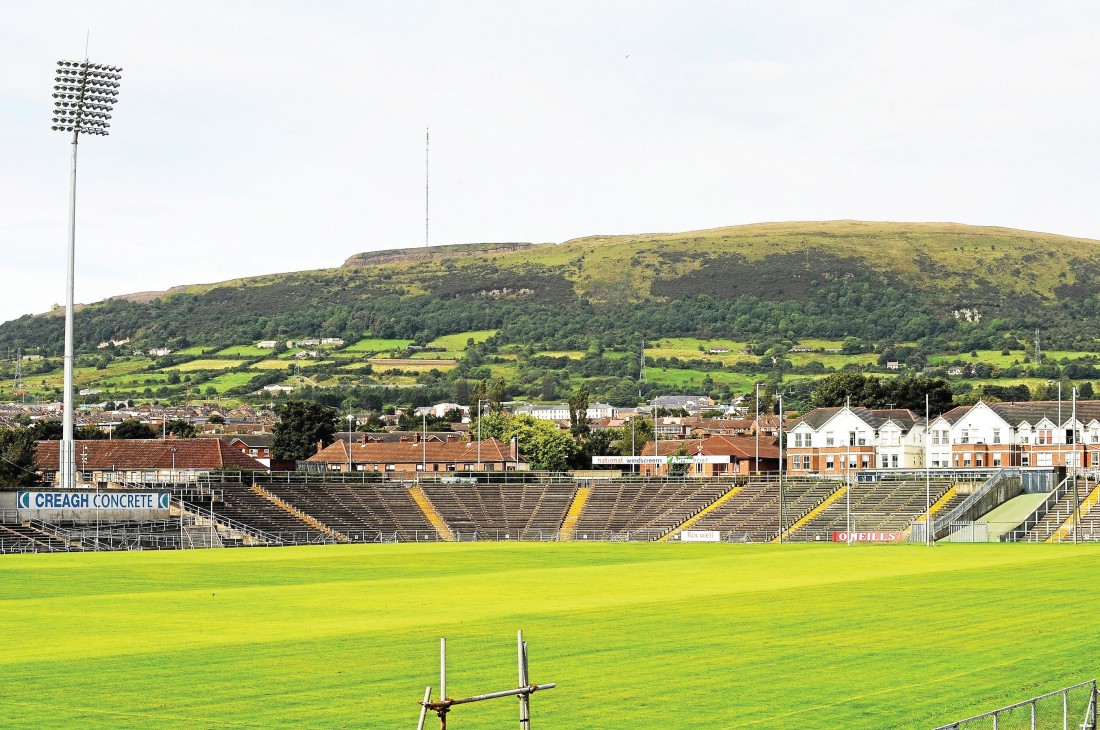


It now looks increasingly likely that a redeveloped Casement Park will have a much lower capacity than the 34,000 originally planned. Instead, it’s expected to hold around 15,000 spectators.
That’s a significant reduction, but in my view, it’s a positive development. I realised three or four years ago that Casement wasn’t going to happen as originally envisaged, and I think a lot of people involved with Antrim GAA felt the same.
The original plan was for Casement to be a host stadium for the Euros, which meant it had to be built with a capacity of at least 30,000. Once that opportunity disappeared, it was almost like starting from scratch.
Given the enormous costs involved, some sort of downscaling was inevitable. To be honest, I never liked the idea of a 34,000-capacity stadium in the first place. I could understand it from an Ulster GAA perspective, and I could also see why people from the outside thought it would be fantastic to have a venue of that scale.
But the question I always asked was: what good would it actually do for Antrim GAA? For me, the answer was always very little.
I also felt we made a big mistake when we signed Casement over to Ulster GAA. Personally, I’d like to see Antrim GAA regain ownership of Casement Park and restore it as our county ground. A modern stadium with a capacity of 15,000 or 18,000 would give us back what we had while providing something that’s realistic and sustainable.
Casement was a brilliant ground. I only ever got to see it filled to capacity once, for an Ulster Championship semi-final between Derry and Tyrone, but from an Antrim football and hurling perspective, a huge 34,000-capacity stadium was never what we needed. It wasn’t what would develop GAA in Antrim.
Maybe that sounds a bit inward-looking, but I’m not overly concerned about the progression of Ulster GAA. Ulster GAA is in a healthy position. It’s Antrim GAA that’s struggling. We’re slipping down the rankings, and what we desperately need is a county ground we can call our own.
So, I was quietly delighted to hear that the plans were being revised for a much smaller stadium. It’s a far more realistic proposal, and I think local residents will be happier with it too.
There’s no point saying it now, but with the benefit of hindsight, I think this is what should have happened from the very beginning. It would have avoided years of delays, disputes and uncertainty, and by now we’d probably have had a fantastic county ground serving Antrim GAA for the past decade.
Instead, it’s been an awful waste of time. I remember retiring 17 years ago and feeling genuinely jealous that the next generation of players were going to have this incredible new stadium to play in. That never materialised.
And Casement was about far more than just the pitch. It wasn’t simply Antrim’s county ground; it was the hub of the GAA community. Every primary and secondary school final was played there. There were blitzes, summer camps and countless other activities. It was constantly in use. Because it didn’t belong to any one club, it was neutral ground. People from every part of Belfast came together there, and that gave it a special place within the community.
Its loss has been enormous. That’s why I’m encouraged by the move towards a lower-capacity stadium. It feels like a sensible, achievable solution, and hopefully this time it happens sooner rather than later.
Looking ahead to Sunday’s All-Ireland final, I’ve been really impressed with Galway this year. They’ve jumped ahead of the curve under their new management. A lot of young players have come into the team and they’ve developed remarkably quickly.
They’ve had an excellent season. They won Leinster, enjoyed a strong league campaign, dominated Dublin in the semi-final and then completely outplayed Cork. They have a game plan that really suits the players at their disposal, and I’m delighted to see them reach the final.
That said, Limerick may just prove to be a step too far. Galway’s defensive system worked brilliantly against Cork because Cork are so heavily reliant on goals. When they don’t get them, they can become a bit anxious and lose their way. I really doubt Limerick would react the same way.
If Galway persist with leaving only one or two forwards up the field, I think Limerick’s defence could dominate those match-ups. You could easily see Limerick’s half-backs contributing 10 points from play if Galway sit too deep.
Of course, finals don’t always follow the script and Galway have already shown they’re capable of upsetting expectations. But if they’re going to bridge the gap, I think they’ll need more than an all-out defensive system and relentless work rate. Limerick are the masters of adapting to whatever an opposition throws at them, so Galway may need another tactical variation if they’re to pull off what would be a famous victory.
Receive quality journalism wherever you are, on any device. Keep up to date from the comfort of your own home with a digital subscription.
Any time | Any place | Anywhere
Get the app for the best Gaelic Life experience