

By Niall Gartland
“I had the height and I probably had the weight too. I wouldn’t have been the fittest – I was a bit plumpish. I wasn’t overly heavy, but I always had a big frame. I was built more for comfort than speed, put it that way.”
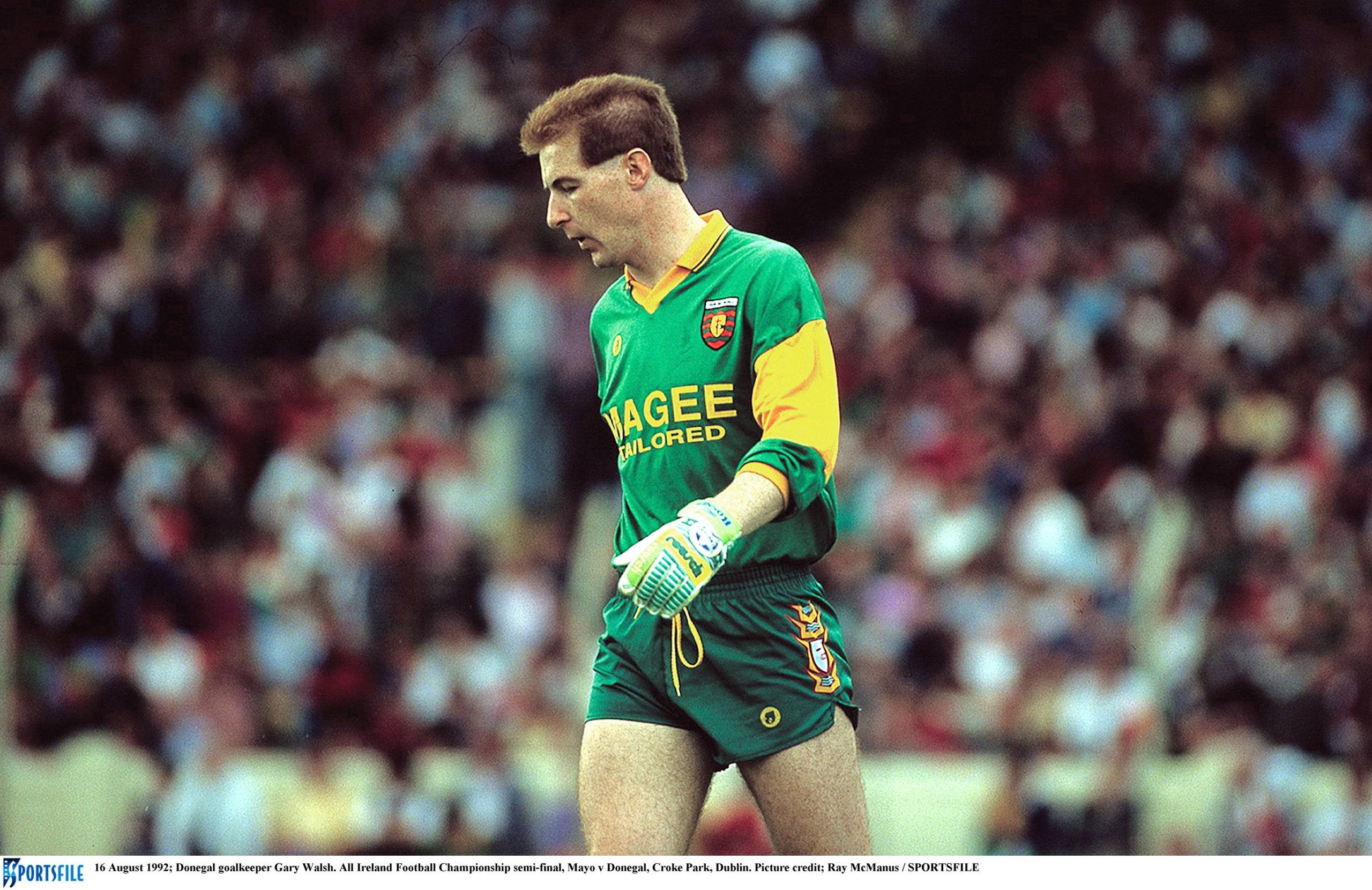
Former Donegal goalkeeper Gary Walsh is a modest man but there’s no doubting his importance to a team that brought Sam back to the hills for the first time in the county’s history.
Their victory over Dublin in the 1992 All-Ireland final will be remembered for time immemorial, but it was no overnight process. Indeed it’s sometimes forgotten that Donegal featured on Ulster final day for five successive years between 1989 and 1993.
Those were halcyon days for Ulster football in general and Walsh, who now lives and works in Derry, believes that they could easily have won a second All-Ireland had there been a safety net for losing teams. But still – one All-Ireland is immeasurably better than no All-Ireland.
Walsh was part of generational crop of players at Aodh Ruadh, Ballyshannon that ended up winning five county championships spanning the eighties and nineties. They gobbled up underage titles like smarties and it was no great surprise that Walsh was handed a chance to impress with the county minors in the early eighties. Things were done a little differently back then and he doubled up as sub goalkeeper on the senior intercounty set-up.
“There was no U15 or U16 at the time – minor was the first time you got onto the county squad. I played county minor in 1982 and 1983.
“In 1982 Donegal had a strong team. We won the minor league but were shocked by Antrim in the championship semi-final. The manager was from Ballyshannon, Jackie McDermott, and he was a great coach. There were seven or eight players from our club on the squad, which reflected how strong we were at the time.
“That was my first year with the minors. Then I was made captain of the minor team in 1983 and had also been called up to the senior squad as the substitute goalkeeper. So I was involved with the senior and minor teams at the same time.
“My first championship game was in 1984. I came on as a substitute. Noel McCole was the goalkeeper at the time, but he got injured up in Armagh in a championship match. I came on for the last 15 or 20 minutes. Armagh beat us that day.”
And from that point on, Walsh made the number one jersey his own for many years. He’d already crossed paths with the legendary Brian McEniff, who stepped down as manager after a narrow defeat to Galway in the 1983 All-Ireland SFC Championship semi-final. He’d be back for another stint six years later.
Walsh said: “When I was young, St Joseph’s were going well and I would have gone to watch them. I idolised the likes of him and all the great players on that team.
“The first time I really got to know him was when I was on the minors in 1982. We played the seniors in a training match one night in Ballybofey – minors against seniors. I did well against them and, based on that, he called me up to the senior squad that autumn or winter to be the substitute goalkeeper.
“I was only 17 at the time. You were just biding your time and getting experience. I was in Ballyshannon and he was in Bundoran, so I used to travel to training with him and got to know him quite well.”
Being a goalkeeper was different in those days. He’d leather the ball in the direction of Anthony Molloy and that was pretty much the height of it.
“Hindsight is a great thing in life and in sport. If you had a goalkeeping coach back then, or if you were doing this or that type of training, you wonder how much better you could have been.
“I kicked it out to Anthony Molloy. You kicked it as high as you could and let them battle for it – that was the way it was.
“There were no stats about how many kick-outs you won or where you kicked them. At one stage we talked about kicking the ball out to the wings a bit more, but it didn’t work that well. You’d hear, ‘Why did you kick it out there? Why don’t you kick it out the middle?’”
It wasn’t just about being blessed with a great big boot, however. Walsh says it was a highly pressurised position where mistakes were amplified.
“You can make a mistake as a corner forward and nobody remembers it. You make a mistake in goals and it ends up in the back of the net.
“The big thing was, if you made a mistake, you had to get back on the wagon again and get ready for the next shot.
“That’s all I ever said to young fellas and young girls when I was coaching: if you make a mistake, it’s not about making the mistake – it’s about how you react to it.”
Walsh says his goalkeeper hero as a youngster was a star of the soccer world – Pat Jennings. Jennings is a native of Newry, and as fate would have it, Walsh ended up working there as an accountant, and that took his playing career in an unexpected direction.
In 1989 he signed up with the famous Burren club, who had won All-Ireland titles in 1985/86 and 1988/89. He enjoyed his time at Burren and won three Senior Championships, though the two and-a-half hour commute to Donegal training wasn’t so fun.
“When I was growing up, it was always soccer on the TV and I supported Tottenham – and still do, maybe unfortunately! Pat Jennings was my hero when I was young.
“He was a Newry man and I was playing soccer myself. To me, he just made everything look so simple. There was no fuss about him. He probably caught more balls than goalkeepers do nowadays.
“He kept it so simple and straightforward. I wouldn’t say I copied him, but he just made things look easy. He was a big, big man with a great presence. He was probably my hero.
On his Burren adventures, he added: “I moved to Burren to work in Newry in 1989. I still played for Ballyshannon for a couple of years and travelled up and down for county training, but eventually it got too much.
“My first year with Burren was 1992, the year Donegal won the All-Ireland, so I had plenty to keep me going that year. They were in the county final a week before the All-Ireland final, so I had to miss that.
“After a week or two of celebrating, I got back into the swing of things and started playing with Burren again. They actually got to the Ulster Club final that year, where they were beaten by Lavey in a replay, unfortunately. That was on the 6th of December or somewhere around then, so it was a pretty long year.
“When I started playing in 1992, that Burren team was probably on the way down a little bit, but ‘Shorty’ was in his prime. Tony McArdle, God rest him, was a great player.
“Paddy was still playing for a couple of years, and you had Brendan McKernan, who was on the Down team. They were a great club at the time.”
“I was travelling up and down for county then. I’d be laughing at these boys now driving around in sponsored cars – there was none of that for me, unfortunately! It would have been a great job. I wrecked more cars driving up and down the road.”
For the county, the wheel started to turn in the late eighties. McEniff was back in charge and the team was backboned by stars of two All-Ireland U21-winning teams – 1982 and 1987. It was the perfect blend.
“The 1982 team had Martin McHugh, Anthony Molloy and all those boys. Then 1987 was the year after I finished U21. You had Manus [Boyle], Barry McGowan, Barry Cunningham, John Cunningham and all those lads. So you had a mix of teams that had already won All-Irelands, and that definitely helped us at senior level.”
While there was no disputing Donegal were full value for their historic All-Ireland final win over Dublin in 1992, there were a few hairy moments en route to the big day. Luck played its part – but it usually did in those days where a backdoor was unheard of.
“We were lucky to beat Cavan in the first round. Martin [McHugh] put over a free from about 60 yards out to get us a draw. We were fortunate. That’s just the way the Ulster championship was – it was a death trap. If you didn’t perform on the day, that could have been us.
“We were quite poor against Fermanagh in the semi-final. It was a game we were never going to lose, but we just didn’t perform. After that, we knew we had to get our act together, and we went on to win the Ulster final.
“The All-Ireland semi-final was a bit of a hoodoo for us. We were lucky that the draws were alternated and we ended up playing Mayo. No disrespect to Mayo, but they weren’t the team they had been in the late eighties. We were lucky we got them instead of a Dublin in the semi-final. Clare won Munster that year, so the way it turned out worked in our favour.
CONTINUED ON PAGE 6
CONTINUED FROM PAGE 5
“We built ourselves up, and I think once we got the pressure of the semi-final over, things really stepped up. I think, in fairness, we all relaxed a bit as well.”
While Walsh had a fine game in the All-Ireland final. He watched on as Charlie Redmond blazed an early penalty wide, and while it was a key moment, it possibly wasn’t game-defining either.
“It was early on. If he had scored, it would have been a big setback, but you just don’t know how things would have turned out.
“Really, what won it for us was the 10 minutes before half-time. We held them tight and were getting some great scores. We got ahead by four points, and we were able to hold onto that level of lead in the second half.”
The final whistle sparked scenes of euphoria at Croke Park. Post-match pitch invasions made for memorable scenes, but Walsh would have preferred to have seen his family. That came later in proceedings.
“I don’t think I realised at the time how big it was. Back then, people were allowed onto the pitch, so you were just swamped by people when you were trying to see your family and things like that.
“I didn’t see them directly on the pitch. We stayed in the Grand Hotel Malahide that night. I have an uncle living in Kildare, and a lot of the family were staying with him.
“They actually hired a minibus and came out to Malahide from Kildare. They got into the hotel, and that’s where you saw them for the first time.
“That meant a lot – seeing the family after everything that had happened. Getting home on the Monday evening was a big thing as well because, again, we were lucky.
“We got the train to Sligo and then the bus. Brian, being from Bundoran, probably wanted to get home as quickly as he could. Ballyshannon was the next stop after that, so we were lucky to get there early on the bandwagon.
“It was packed. You saw people you grew up with, your club teammates and everyone else. Some players had to wait until the Thursday or Friday before they got back to their own clubs.”
Walsh hung up the boots for the final time in 1996. He became heavily involved in coaching in the county, but now he’s crossed into his seventh decade, he’s decided it’s time for a break.
“I coached the county for a few years – minors, U21s, ladies coaching and everything. I was part of Brian McEniff’s set-up when Donegal reached the All-Ireland SFC semi-final in 2003, I was coaching Tony Blake.
“We had a good minor team a few years later, the one Michael Murphy was part of, and they got to the All-Ireland semi-final in 2006. I was coaching goalkeepers with that team.
“I did enjoy the coaching, especially the underage coaching. It was great to see young people who might be a bit raw at 14, 15 or 16, and then watching them develop.
The last couple of years I had done the U16 girls’ academy and U16 boys’ academy, and that was the last one. I finished up there two years ago. This is the first year I’ve really stepped back. I’m 61 now.”
Walsh still stays in touch with his teammates – be it out at matches or at more formal events. 1992 remains central to the Donegal story and Walsh can proudly say that he played a key part in their maiden All-Ireland win.
“We meet some of them informally. Some of them go to a lot of the matches, and you meet them in different places.
“The last reunion we had was a birthday for Brian McEniff. It wasn’t his 80th because there was a family party, but the following year, when he turned 81, he organised for us all to come to Letterkenny. We had a night out and stayed in the Mount Errigal.
He concluded: “We could have done with a back door and things might have been different. We could have won another one or two, but you could also have ended up with nothing.
“You just don’t know how things would have gone with a back door. Those four or five teams in Ulster – there was nothing between us at different stages. It was just brilliant to be a part of.”
Receive quality journalism wherever you are, on any device. Keep up to date from the comfort of your own home with a digital subscription.
Any time | Any place | Anywhere
Get the app for the best Gaelic Life experience