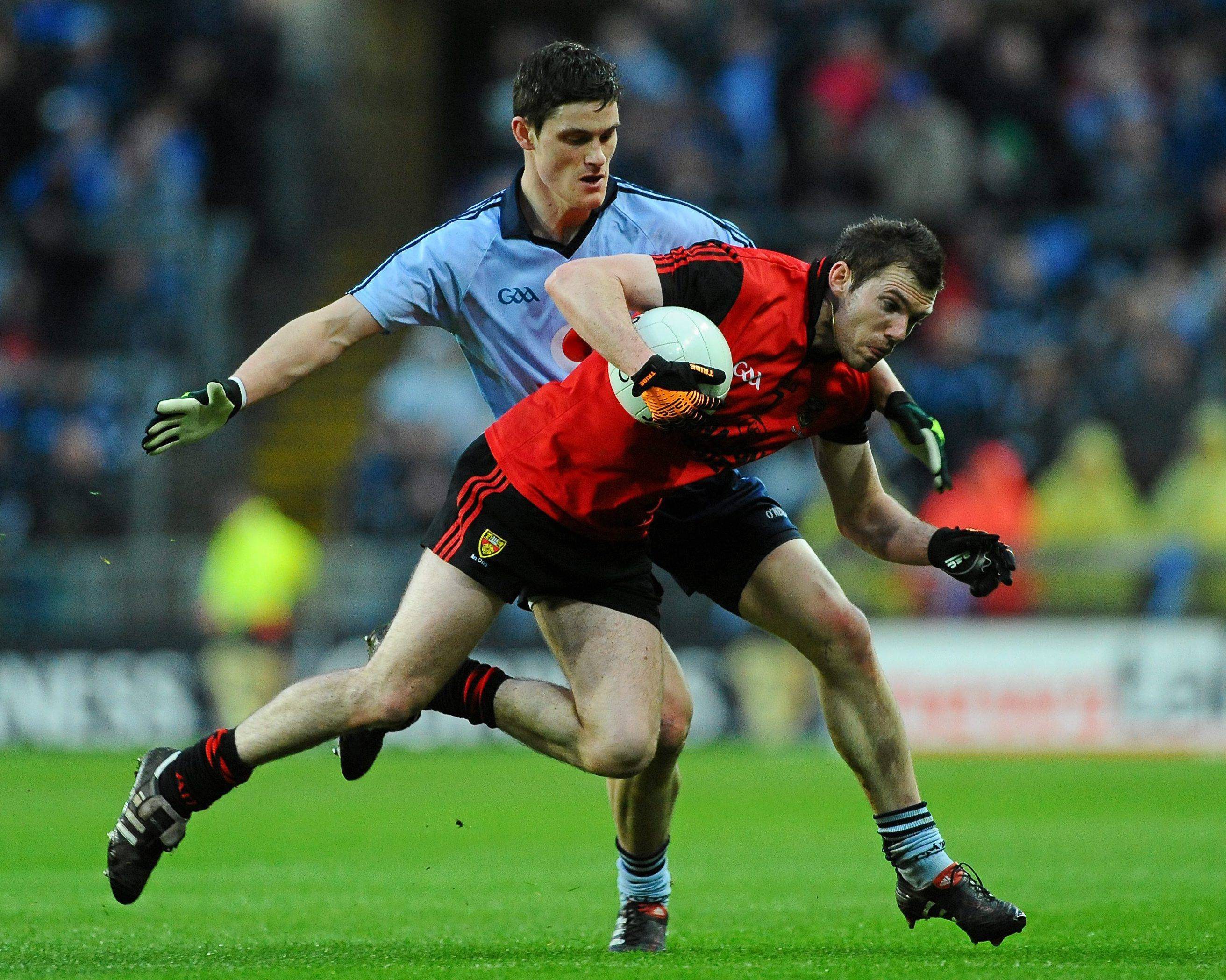


Down’s surge to All-Ireland final day in 2010 was spearheaded by some of the biggest names to emerge from the province this side of the millennium.
Benny Coulter, Martin Clarke, Danny Hughes, Mark Poland, Kevin McKernan…you get the gist.
Overseeing matters on the sideline was James McCartan, a bona fide legend of Down football. Lending more than a hand was a certain Paddy Tally.
It’s easy to forget that a young Conor Laverty was also involved. The Kilcoo forward came on in the final five minutes in a final throw of the dice.
But you don’t reach an All-Ireland final without a top-class defence, and Down weren’t lacking in that regard. One of their best defenders in that era was Declan Rooney, who was made captain of the team in his debut season in 2007 under then-manager Ross Carr.
Though his primary role was curtailing opposition dangermen, he’s a self-confessed purist who believes that his native Burren won’t topple Kilcoo until they embrace their attacking instincts. For him, the kickpass should be the first port of call.
While he’s Burren to the bone, Warrenpoint, a five-minute skite down the road, is home. He was always destined to line out for St Mary’s though.
“I’ve been in Warrenpoint nearly all my life, but I went to Burren school. My ma would’ve been a Burren woman, so she sent us there, and that’s how I ended up playing for them.
“When I first moved into the seniors when I was 17, I was playing alongside club legends like ‘Shorty’ Treanor and Gavin Murdock – he’s Odhrán’s dad. He was a brilliant free-taker.
“At the time, Mayobridge had a really good side. I marked Mickey Linden a few times. I was just thrown straight in there but that’s what I wanted.”
Rooney also aspired to line out for his county, but he didn’t really make much of an impression at underage level. Eventually though, the wheel would turn.
“When I was growing up, all I wanted to do was play for Down. I came up through the minors and U21s, but didn’t really get on. I certainly wouldn’t have been a regular starter for the minors or the U21s.
“But I was gaining experience with the Burren seniors since I was U17, and I kicked on from there. Paddy O’Rourke integrated a few of us, including myself, from the U21s into the seniors. He left and then Ross Carr took over.”
And it’s fair to say that Ross was a big fan. He more or less immediately named Rooney as captain, even though he’d yet to make his championship debut.
“I was hoping to just get on the panel and into the team, but Ross made me captain in my first year there, which was a great honour.
“I was just hoping to push on and get onto the team and the panel, so it was a bit of a surprise to be asked to be captain. I wouldn’t have been a big talker in the dressing room, but Ross was like, ‘You lead by example on the field,’ and that’s what they wanted at the time.
“Ross was there for two or three years. We probably didn’t do that well, but he was a brilliant manager. DJ Kane was there as well. They were top coaches and we probably just didn’t perform well enough at the time with them.
“Ross was well ahead of his time when it came to coaching. We were lucky to have him, Paddy O’Rourke, then James McCartan. They’re all brilliant managers and brilliant coaches.”
From the outside looking in, Down’s run to the 2010 All-Ireland final came as a bolt from the blue. Rooney argues otherwise.
“Things were probably building under Ross and Paddy O’Rourke before James came in. Some players came through under Paddy – players like myself and Aidan Carr – and then a few more followed under Ross.
“James took over ahead of 2010 at a time when so many players were coming through. We’d Marty Clarke, Danny Hughes, Benny Coulter, Dan Gordon, Daniel McCartan – there was so much talent in the team.
“We were building, and in 2010 we finished top of Division Two and achieved promotion which was a big deal for us. A lot of people probably thought we came out of nowhere, but it wasn’t the case. It wasn’t just one year’s hard work, it had been building over a period of years.”
It was all going swimmingly until they felt the full force of a vastly experienced Tyrone team in an Ulster Championship semi-final at Casement Park. Tyrone suffocated the life out of the Mournemn en route to a 0-14 to 0-10 victory, but they dusted themselves down in the qualifiers with successive victories over Longford, Offaly and Sligo.
And then they hit Croke Park. Kerry had played in the last six All-Ireland finals, winning four of them, so they were odds on favourites to clinch a first-ever championship victory over Down. James McCartan’s side had other ideas, running out 1-16 to 1-10 victors. A late David Moran penalty provided only a crumb of comfort for a Kerry side that had been thoroughly outplayed.
“We got a bit of momentum in the back door and I suppose we just said, ‘We’re going to give it everything.’
“We went down there with a plan, and it worked out in the end.
‘We had a lot of good forwards that year — Mark Poland, Ronan Sexton, Danny Hughes, Martin Clarke, Paul McComiskey. All top, top players. Benny was on fire that year as well.
“It was the same all over the field, and I remember Brendan McVeigh made a couple of great saves against Kerry. Looking back on it, we just took it all in our stride.”
Down booked their spot in the All-Ireland final with a two-point victory over Kildare in a gripping contest at Croke Park. Standing in their way of a sixth All-Ireland title was a Cork team nursing years of hurt having lost the 2007 and 2009 finals. They would have their day in the sun against Down, though only a point separated the teams at the final whistle. The pain of defeat has never really subsided.
“It is very hard to think that you were two points away from winning it. There was a lot of hype building up towards the final, which, looking back, and I know it was good for the county and all, was probably a bit much. It can be very draining for the players leading up to it.
“I’m not saying it was the reason we lost, but we were leading well at half-time and then we just didn’t get out in the second half. Cork had a lot of big men in the middle of the field and they were winning everything. The ball just kept coming back in and we just couldn’t put a stop to it.”
They’d come desperately close to reaching the pinnacle, but there was no tale of redemption. The following years were characterised by some desperately disappointing championship exits, and James McCartan stepped down in the wake of their qualifier defeat to Kildare in July 2014. It also turned out to be Rooney’s final game in the famous black and red.
Reflecting on McCartan’s departure, Rooney argues that county boards need to stay patient during the lean years.
“I don’t know if James wanted to leave. It just seems to me that managers get a few years and then they’re away again.
“I just think changing managers all the time isn’t good, including at club level. You get managers or coaches coming into clubs who don’t really know the club. They try to put their own stamp on it, and they seem to lose their DNA or style of football. It usually doesn’t work out.
“It’s probably happened too often in Down, the chopping and changing of managers. I appreciate it’s a big commitment, but knowing James, he probably didn’t want to leave. If there was noise, he probably just left.
I think you need to stick with the manager and try and build something, like the way Armagh has done with McGeeney. They have their All-Ireland in the pocket. They’re still right up there with the best teams in the country.”
Rooney’s own playing career took a detour in the 2013 season. He was living in Dublin at the time and signed up with St Sylvester’s. His time at the club was overshadowed by a shoulder injury, though he was still entrusted with marking a certain Diarmuid Connolly in a Dublin Senior Championship quarter-final against St Vincent’s.
“My wife’s from Dublin and we had our first wee boy. I was working in Dublin, so we decided to move down and I transferred to St St Sylvester’s.
“In our first league game, I went down for a ball, and when I was coming back up, a fella came in and did me in the shoulder and I damaged the AC joint. It was a bad enough injury.
“Jack McCaffrey’s dad, Noel, is a doctor down in Dublin, he gave me an injection and it kind of made the pain go away.
“I remember him saying ‘why are you even doing this?’ He could understand if I was playing in an All-Ireland final or something, but not the quarter-final of the Dublin Championship.
“I ended up having to do a man-marking job on Diarmuid Connolly. It went alright, but we were beaten by a point. They actually went on to win the All-Ireland that year.”
His brief time at St Sylvester’s ended in turbulent enough fashion with the abrupt departure of manager Gabriel Bannigan, who now oversees the Farney footballers.
“He was the manager there at St Sylvester’s. They had a really good team. Paul Clarke, who used to play for Dublin, was the coach.
“They took a few players in from outside the club, pushing to try and win a championship with St Sylvester’s. It just didn’t work out.
“Gabriel was just trying to do his best for the club, to try to win them a championship, and he ended up leaving. I think the players didn’t really want boys from outside coming in. I ended up going back home.”
Back he went to Burren. He’d won a championship medal with the club in 2010, though he missed out on their successful title defence due to an ankle injury. He was determined to play his part in another championship triumph, and in 2018 they overcame Kilcoo on the big day by 2-12 to 2-9.
“I said I’d go back up and try and win another championship with Burren. That was the main thing.
“I wanted to win another one for Burren. I knew I didn’t have that long left. Paddy O’Rourke then was the manager. He called down to the house, looking me to give it one more go, but it was a no-brainer for me as I wanted to win one more. We finally got over the line in 2018 with Paddy, which was great.”
Rooney has been content to play the role of supporter in recent times, but this year he made the decision to become involved with underage coaching in the club.
“I’ve only come back into it this year. My fella, Charlie, he’s U14 now. I’ve another two, Lola, she’s eight, and Jude, he’s five.
“Ciaran McGovern asked me to get involved. His fella’s there as well. Ciaran’s the manager there with the U12 and U14 teams, so he asked me to give him a hand this year.
“I’ve been in there and I’m enjoying it. It’s good to give back to the club as well.”
While the new rules have been a godsend according to Rooney, he believes that the mindset also has to change. He hopes that Mayo’s swashbuckling style will inspire clubs around the country to cast off the shackles, and he brings that approach to his own coaching.
“It’s definitely helped, the new rules. Something had to be done, didn’t it? For years, it was too defensive.
“The three up is massive now, and the two-pointers. But I still believe teams are stuck in the defensive mode a bit.
“There’s still too much negativity. Even with our own club, there’s a lot of passing sideways and not looking up. That’s one of the things we’re trying to drive into our young lads: as soon as you get the ball, look up. If the kick-pass is on, you kick it.
“The first pass you see is the right pass. You don’t see enough kicking, and hopefully, the way Mayo won it, it will come back in.
“I’d say it’ll probably take a few years for kicking to really come back into the game, which I think is what we all want to see.”
Receive quality journalism wherever you are, on any device. Keep up to date from the comfort of your own home with a digital subscription.
Any time | Any place | Anywhere
Get the app for the best Gaelic Life experience