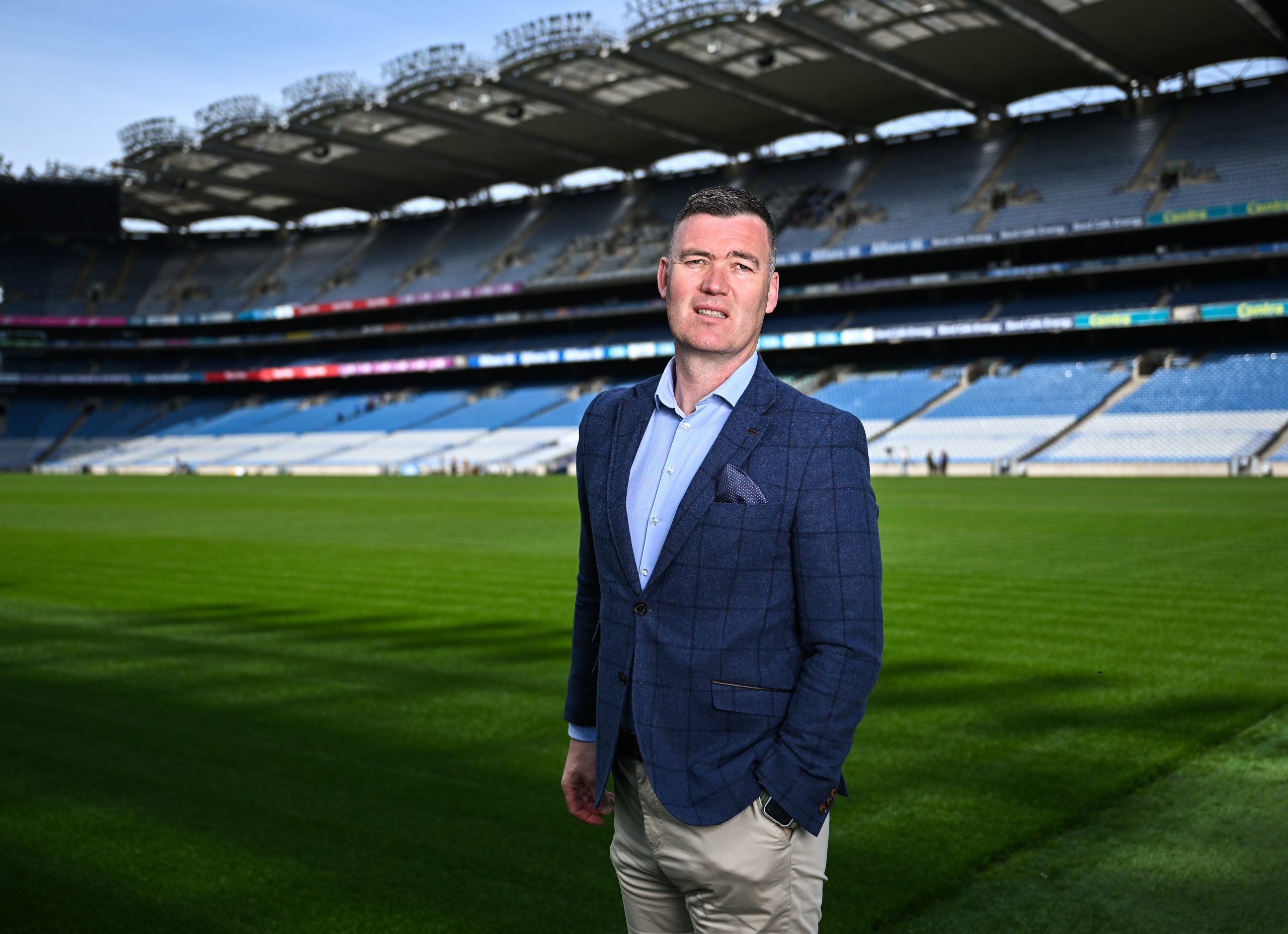


GAA National Head of Hurling Willie Maher brought his roadshow to Garvaghey last week. Niall Gartland reports…
By Niall Gartland
LAST Wednesday evening, the new GAA National Head of Hurling Willie Maher delivered a presentation to a stellar audience of dedicated hurling people at the Tyrone GAA Centre in Garvaghey.
He wasn’t alone on the floor; Belfast man Terry Reilly, chairperson of the Hurling Development Committee, and Tom Ryan, one of the biggest of big wigs at Croke Park (he’s the Director General) also set the sat nav for the mid-Tyrone facility.
In one sense, they’d a good news story to tell: 45 new hurling units have been formed in the last year – 17 of which are in Ulster, and seven of those are in Donegal alone.
Willie Maher is a Tipperary native who captained the county to an All-Ireland Minor Hurling Championship title before a freak eye injury sustained at a training match effectively ended his playing career.
He was appointed as the new National Head of Hurling back in January, and he passionately set forth his vision for the road ahead to all those local hurling people up in Garvaghey, stating that “We want hurling everywhere, hurling for all…we’re not here to ‘protect’ hurling, we’re here to grow it, and we will do that by investing in people and places and there’s massive potential in Ulster.”
So far, so idyllic and sweet. But we all know that hurling is a struggle for many clubs dotted around the place in the province, surrounded, or indeed sometimes engulfed by their footballing counterparts.
Attendees were allowed to have their say on the matter at a Q&A at last Wednesday’s roadshow, and here’s some of the issues that were brought up for discussion for your perusal:
AIDAN MAGUIRE (TYRONE HURLING OFFICER)
I met you [Willie] a couple of weeks ago in Armagh and was very impressed. You put up a map of all the new hurling clubs, but from a Tyrone perspective, a friend of mine, Peter Kerr, and his committee established a number of new hurling clubs in Tyrone about seven years ago and they’re still going. I don’t think Tyrone’s focus is on new hurling clubs – it’s about being offered help. Some of our new clubs are going very well and are competing with the more established clubs at the likes of U-14 and U-16 level. What would be the vision for helping clubs like those?
WILLIE MAHER:
I think it’s a very good point, we’re all excited by the 45 new clubs but we see where you’re coming from, and that’s why we have established a financial fund for existing clubs. Secondly, we need county-specific plans – how do we get a hurling plan into Tyrone in this instance and hit the markers across coaching and games to keep these clubs going. I’ve attended blitzes where Dungannon have beaten top teams so there’s no shortage of talent, but from a support perspective, it’s up to Tyrone to centralise hurling across three or four very measurable outcomes. So that would be coming from the ground up and then we’d hold the hurling committee to account if those actions are not met and not achieved.
KIERAN CRANNY (FINTONA PEARSES):
Fintona Pearses football has been going since 1907. We started hurling in 14 years ago and now we’re fielding at minor level. Because we’re in a minority, we require the support of our football colleagues, that they don’t see us as a threat. I think in Tyrone there’s a concern that hurling will dilute their own efforts to help football. The second thing I’d like to see is that we have to create a structure to allow our boys and girls to be dual players, and that’s particularly critical in relation to fixture clashes. It really needs to be addressed as we’re finding games being cancelled due to football. A space needs to be created for hurling to be played, both in counties and across county lines. Something also needs to be done to avoid a conflict where football and hurling development squads are playing on the same days. Boys are having to pick and invariably they’re picking football and that needs to be addressed. Finally, the other thing I’d like to say, is that I saw a great article in the Sunday Independent about hurling in weaker counties. Someone from Mayo said that when so-and-so dies or takes sick or moves away, hurling dies in that club. We need more hurling coaches – there’s only six in our club and we need something more sustainable.
WILLIE MAHER:
Taking the last point, sometimes there is a fear of coaching if you don’t have a hurling background. I’m living in Kilkenny and we’ve faced it in our own club. My wife is a former International Hockey player, with no hurling background, and she’s one of our best hurling coaches. Secondly there’s a guy from the north of England with a cricket background, and he’s one of our best hurling coaches. We need to break down those barriers and maybe that’s something we can look at in terms of educating people.
PADDY FLOOD (ST EUNAN’S):
There’s two issues I want to mention – as mentioned by the Fintona representative, when you have players going into football or soccer squads, it should be a source of happiness but we find that they’re basically being lost from hurling forever. The other is the potential of integration to maybe help us with recruiting numbers at underage level. It’s a big problem for us. We need leadership from on high to drive integration and what it means, that every club should be generally offering all the codes. I think all academies should be integrated across the board between football, hurling, ladies and camogie.
TOM RYAN:
I certainly agree with the sentiment, though I often find that what we might call football clubs have similar sentiments about their kids going into development squads, and that their involvement with the club is compromised. In the generality of things, we are taking a look at development squads and how best they can fit into things without cannibalizing resources. We are doing that and you will hear stuff on that shortly.
TERRY MULLIN (EOGHAN RUADH/ERRIGAL CIARAN):
How important is it to Croke Park in terms of making actual positive changes in terms of numbers playing hurling etc?
TERRY REILLY:
In relation to how serious the association is, I can only give my opinion, but it’s the opinion of someone in their fifth year in central council and their third year at management in Croke Park. I was urged by other Ulster delegates to take up the role, and I was then asked by Jarlath Burns would I do this, because it’s one of his three big priorities. The membership of the committee has already sat in 18 meetings and 20-something subcommittee meetings and they’re not going to be doing that if the association isn’t serious about it. Every single thing our committee has asked for has been granted. I personally wouldn’t be giving it the time and effort and commitment if I didn’t think it would be reciprocated by the association.
TOM RYAN:
There have been two main focuses over the last 18 months and for the next 18 months – improving football as a sport and improving the spread of hurling. It mightn’t seem like it sometimes but everything we set out to do is guided by those two things.
WILLIE MAHER:
I’m four weeks in the job and have been working on the job for four months before that, and the support I’ve got from Terry, Tom and Jarlath has been unbelievable. They’re always open to different ideas about where we want to go with the game. I want to reassure everyone on this point – the support I’ve been giving personally has been huge and now it’s up to me and us to development a plan to move hurling forward.
FEARGAL MCNICHOLL (NA MAGHA, DERRY CITY):
Derry City has a population of 100,000 people and we have 14 minor hurlers, four of which came from Faughanvale which is 10 miles out the road in Greysteel. Seven of them have played minor at development and county level for Derry. All of them have been playing since they’re U-8. I think seven came from one school, and now there’s no longer hurling in that school. I think there’s a massive opportunity in Derry in particular – a few passionate people can absolutely make a big difference but there needs to be a link with the schools. There’s 24 primary schools in Derry and we need a way to get into those schools so they don’t feel scared of hurling.
WILLIE MAHER:
That came out clear when we were in Belfast. There’s 450 boys at primary school in Ardoyne and they couldn’t field any GAA teams. We want to put hurls into every school to give children a chance to grow the game. It’s something that’s coming out loud and clear.
DAMIEN MCCONVILLE (WARRENPOINT):
I’m really supportive of the new clubs, and in Down we’ve seen quite a but, but the question is about support for existing clubs. We took a stand 10 years ago when our numbers were relatively club, targetting other local areas and setting up primary school coaching within the clubs. Roughly 50 percent of our members are Warrenpoint and the other 50 percent is from Burren, both Division One football clubs but very welcoming to us promoting hurling in the area. We’ve seen membership fees go up and parents getting priced out and it’s always the hurling that suffers, given their children egularly can’t get to their hurling sessions as football is on.
TERRY REILLY:
I will explain where we’re at with that. We’ve 45 new clubs with over 100 applications. A lot of that is borne out of working with provinces and making assurances to people on the ground that new units would be nurtured and supported. For those 45 successful clubs, a criteria was working with games development locally.
The next iteration is going to be working with existing units and we’ve a sub-committee coming out of our group, so watch out for advertisements for refresher packs. We’re putting out the message that we’re there to support people, and inject support into clubs that might be struggling.
CORA HARVEY (SETANTA):
In terms of schools coaching, is there an opportunity for every county to have a full-time schools coach to go into every parish and club in the county otherwise things will be ad hoc.
We’re very proud of our football team in Donegal but there’s also a ladies and hurling team and I would also make the point we need to do more for promotion and optics of hurling.
At Donegal men’s matches we have the team bus coming in with banners around it whereas hurlers are travelling together in cars.
TOM RYAN:
In terms of coaching for schools, none of us are here to say no to anything but one thing I’ve learnt from past experience is that the same solution doesn’t always work in every county. In some places, coaches may be needed, in another the job might be getting children to pick up a hurl in the first place, another might be keeping them involved when they’re U-14, U-16 or U-18.
If the message we get is that the same thing is needed everywhere, we’ll go with that, but we’re not starting out with the point of view of imposing one umbrella thing on people.
I don’t mean that as a negative response and I hope that isn’t how you’ll interpret it.
Receive quality journalism wherever you are, on any device. Keep up to date from the comfort of your own home with a digital subscription.
Any time | Any place | Anywhere
Get the app for the best Gaelic Life experience