

By Patrick Morrison
NOW that the round robin phases of the National Football Leagues have finished, we can concentrate on some fantastic finals in all four divisions.
On Saturday, Carlow will play Longford in the Division Four final followed by Down v Wexford in the Division Three final.
Then, on Sunday, we will be treated to another two great games with Cork playing Meath in the Division Two final and Kerry v Donegal in the Division One showpiece.
Over the seven rounds of the leagues, goalkeepers have been called into action of countless occasions. Nowadays with the new rules restricting the goalkeeper’s outfield involvement, most if not all of these calls to action are in the traditional form of protecting the goal from being breached.
Being involved with Leitrim seniors for the past two seasons has involved watching video analysis on both ourselves, and our opponents extensively.
I do also watch as many of the other divisions as much as possible, especially my home county of Armagh.
From all of the games I have been able to watch, the biggest takeaway I took from all of the goals conceded was that Gaelic football goalkeepers need to brush up on their basic goalkeeping skills.
Performing and executing skills such as one-v-one situations, high balls, defensive deployment, and basic footwork could all be worked upon before the business end of the season.
There was a good portion of goals conceded that would have been dealt with much better by simply advancing to meet the attacker as they approached the goal, but goalkeepers instead decided to stay on their goal-line giving the attackers all the advantage.
So, what do we do now? Do we now start implementing training regimes and drills that incorporate our goalkeepers joining the fray outfield?
The short answer is no. We as goalkeeping coaches (and coaches in general), need to continue with what we are usually doing and let your goalkeepers develop at their own pace. Not all goalkeepers will be comfortable trying to emulate roving ‘keepers and others simply can’t.
For the time being it is important for us all, both goalkeepers and coaches, is to continue to focus on the basics of goalkeeping.
Keep it out of the net
When playing in goal, the duty of the goalkeeper is to keep the ball out of their net, marshal their defence and to execute the restart. As much of an impact as a goalkeeper coming outfield to join the play will have, they will have a much greater impact in performing their original duties to the best of their ability.
A goalkeeper cannot be a proficient goalkeeper without first knowing and performing the basics of the position. From a young age these need to be taught and regularly coached to a good standard.
It would be prudent for every club to ensure their goalkeepers have a goalkeeping coach that can provide them the position specific training that they require to improve.
Without it their development will be severely hindered, and improvements will be made at a much slower rate than those who have availability to goalkeeping coaching.
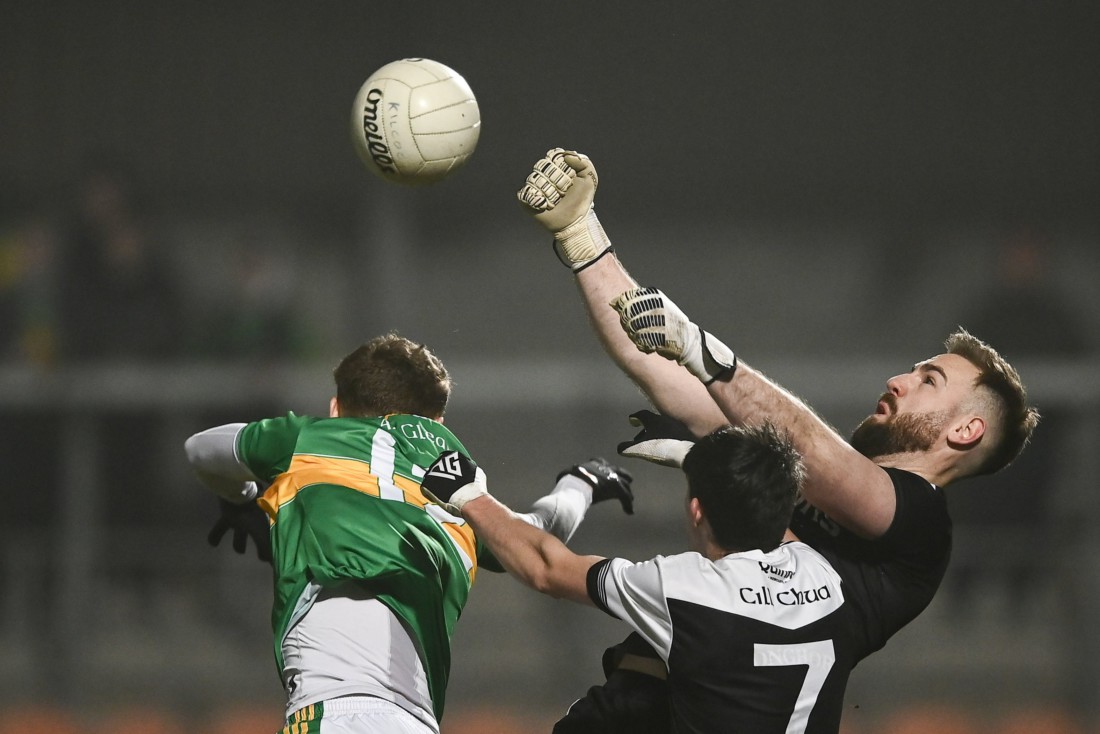
Kilcoo goalkeeper Niall Kane elects to punch
Starting at a young age, it is good to get kids running, jumping, climbing, skipping, moving in multiple directions, changing directions, accelerating, decelerating, hopping, rolling, diving, crawling, all fundamental movements that use their wee muscles in the different body planes both balanced and unbalanced.
As they grow a bit older and begin to show a shine for being a goalkeeper, you can then begin to coach them using goalkeeper specific training.
Firstly, teach them to perform the goalkeeping skills such as diving, catching, punching, kicking, parrying, set position, communication etc. Once they begin to become proficient in their goalkeeper skills, we want to develop them by having them perform them at speed.
As they develop their skills at speed efficiently, they now develop them further by having them perform skills at speed but now they must be able to perform them consistently.
Performing them consistently will be key for competition and as such have them perform skills consistently under pressure, under fatigue and under competition conditions.
You will also have to ready your young goalkeepers for the psychological pressures that playing in goal brings and this can be effectively counteracted by implementing a good spiritual base to your goalkeeper.
Spiritual
There is sometimes a misconception that spiritual is religious meaning but in terms of goalkeeping becoming spiritual means becoming more aware of oneself.
By becoming self-aware and have a core set of principles is a great way for any goalkeeper to help deal with the mental side of their game.
We have all seen the impact that having a goalkeeper who can join the play effectively can provide but it will be important not put too much pressure on them too soon.
What we also need to remember is that the future development of the goalkeeping position cannot progress without the goalkeeper first being proficient in their goalkeeping basics.
The goalkeeping basics are more important and will continue to have worse consequences whenever they fail than those of venturing up field.
Some would say that a goalkeeper’s kicking ability is the most important aspect of their game, but I would counter that by saying the other basics are just as important if now more due to the fact that they are performed far less during games.
A goalkeeper may perform 25 to 30 restarts during a game but only make one to three saves and for this reason their ability to deal with shots needs to be at a higher standard than that of their kicking because they perform more kicks during games than they do of saves.
It is now important for us all to get ‘back to basics.’
Email: pmgoalkeeping@hotmail.com
Facebook: @MSoG11
X: @MorSchGk
Related posts:


Receive quality journalism wherever you are, on any device. Keep up to date from the comfort of your own home with a digital subscription.
Any time | Any place | Anywhere
Get the app for the best Gaelic Life experience