


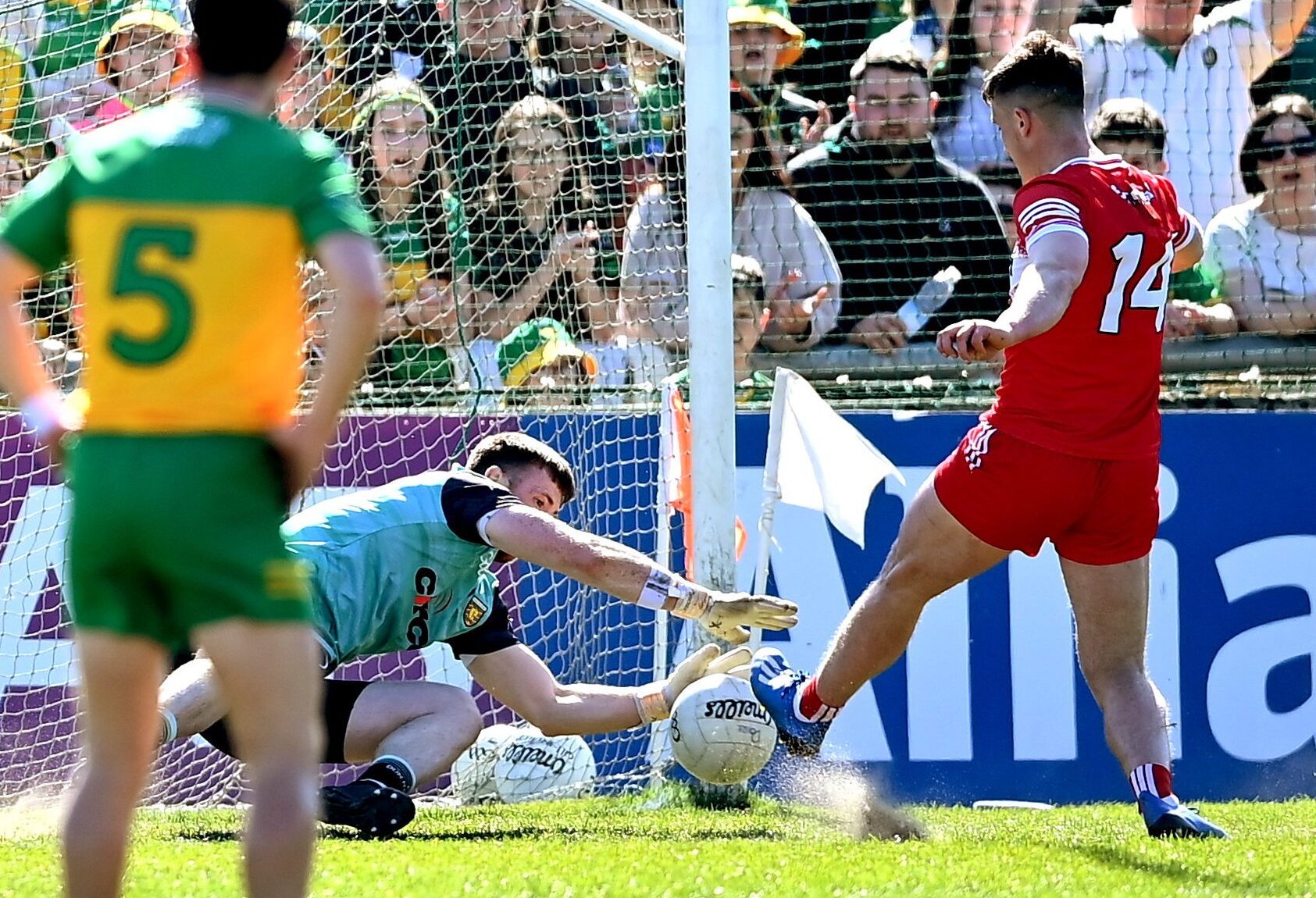


Whenever I am coaching different teams or individual goalkeepers during pre-season I complete their goalkeeping conditioning. They regularly ask me, ‘What is best way to improve conditioning for a goalkeeper?’ After praising them for being brave enough to ask the question I then answered it for them as best I can.
By now, the GAA fraternity have become accustomed to the phrase ‘Strength and Conditioning’ especially as the modern era of Gaelic Games has developed. The majority of GAA people will know something about the strength element of this phrase no matter how slight it may be and would be confident of providing a solid description if required to explain what they thought strength training was.
Ask the same people to give a good description of what they think is meant by the conditioning aspect of the phrase means and this is where most of them would begin to struggle and offer vague or general oversights. Without experiencing it first-hand or having some form of learning on the subject it would be difficult for any person to give a specific detailed description of what conditioning is.
Conditioning is training the body in preparation for both training or competition. Training programs will always differ from sport to sport, but the key principles will always remain the same. The purpose of conditioning is to optimise the performance of the player by focusing on the Specific Adaptation to Imposed Demands (SAID), meaning training the body using the exact movements the player will be using during competition.
In Gaelic football, each and every position on the field will have differing demands in comparison to other positions. This is why it is vital that any conditioning programs are both team orientated by also contain an aspect of individuality that is specific to that player so they can perform better in their position. For example, defenders would be required to be powerful, robust as well as having an element of speed. Forwards would be conditioned more towards the side of speed but would also require a sense of power and sharpness especially in changing direction quickly (acceleration).
Midfielders on the other hand would require more speed endurance as well as speed repeatability due to the nature of their position again mixed with that power required to make or take tackles. As well as this, players with specific team roles (sweeper, man-marker, link man) will all required individualised conditioning programs in order to optimise their performance.
So, what is goalkeeping conditioning? The goalkeeper position involves a lot of explosive movements that require maximal output within a minimal timeframe. In most goalkeeping situations, the goalkeeper is required to perform their duties at an extremely high intensity while also performing complex skills. These situations also require an ability to Think Clearly Under Severe Pressure (T-CUSP), and not having the correct conditioning program can cause indecision or failure in performance which ultimately leads mistakes and/or undesirable outcomes.
Game situations
Training goalkeeping conditioning places the goalkeeper into specific goalkeeping game situations using the various skills, movements, and pressures that they would usually face in any game. But, increasing the intensity to game pace or above for prolonged periods of time meaning that each drill or exercise would perform using a high number of reps as well as a high number of sets.
Training in this way allows fatigue to set in and it is when this tiredness takes hold that makes the body adapt to the loads that they are performing under. It is also important to recognise whenever the goalkeeper has become too fatigue to reduce the risk of injury. When goalkeepers are too fatigued the first thing to go is usually the correct technique so be vigilant for improper technique. Next, they will show signs of decreased intensity and may also find it difficult to get up or back to their feet quickly. Once you see these signs that signals the end of the drill for the goalkeeper.
With the majority of goalkeepers now a few weeks into their growth season, the part of the season when real growth work can be done, it would be a very good idea for goalkeepers to create a plan for the next couple of months and over the Christmas period that will lead them into the pre-season of 2027. In this plan they can work on the skills they are weakest in as well as develop any new skills they would like to add to their toolbox.
As well as this, they should also include some weekly conditioning exercises to ensure they keep up their base level goalkeeping levels. This will ensure that come January pre-season, the effects of the sudden increase in workload intensity will not be as severe compared to those who have done nothing.
It will also afford goalkeepers a headstart over their teammates especially if they have rested or enjoyed themselves all winter. An considering you could have two or three men competing for the one starting spot any advantage you can have over your teammate can make the difference.
There is an old adage that says: “practice makes perfect.” This, over the years, was then developed into “practice makes permanent” and then again into “perfect practice makes perfect permanent” but I have developed this further, especially to mirror the modern game, as goalkeepers must be able to perform complex skills under extreme conditions. To do this effectively goalkeepers must train effectively and as such:
“Perfect performance practice creates consistent perfect performance of critical movements, in critical moments when performing under competition conditions.”
Email: [email protected]
Facebook: @MSoG11
X: @MorSchGk