

By Patrick Morrison
LAST weekend saw the culmination of the National Football Leagues with each of the divisional finals taking place.
The four winners of Carlow (Division Four), Down (Division Three), Meath (Division Two) and Donegal (Division One) were all worthy winners overcoming Longford, Wexford, Cork and Kerry respectfully.
Both of the Division Three and Four games went to extra-time, the Division two final was a close affair, and the Division One final became a one-way spectacle early in the second half with Donegal scoring three goals in three minutes.
All four finals will be deemed great spectacles of attacking play and will correctly be used as strong examples of how the introduction of the new enhancements have improved the game. However, if you wish to evaluate the measure of the new enhancements with parity across the board, then you must look at it with a holistic approach and not with a single-minded viewpoint.
The new enhancements were introduced last year with the intention of improving attacking play. This was inevitable considering their design and application undoubtedly ensured that attacking play would thrive.
The extent to which the new enhancements have improved attacking play in contrast to the decline of defensive play has not been (and probably never will be) evaluated. Hell, it is almost blasphemous to suggest that the new enhancements have worked too well in certain contexts.
Now at this point I know exactly how many people will be thinking. If you haven’t skipped onto the next article already you are definitely thinking about it – ‘what is this Morrison clown on about? The game is far better because of the new rules!’
That is an argument that I cannot disagree with, yes in terms of an attacking spectacle the new rules have done exactly what they have been designed to do. In the words of Roy Keane “That’s their job!”
But please just hear me out and then decide.
I am all for the improvements of the game. I am all for having more attacking football. I am all for not having teams that are forced to play all out defence to have any chance of getting within ten points of the better teams.
We must remember that although Gaelic football can be seen as a spectator sport, it is primarily a competition sport meaning the very nature of our game is to win. Appeasing the crowd with playing style simply does not come into the equation for the teams involved.
The new enhancements have done exactly what they were designed to do and that was to give attacking football a massive shot in the arm and bring it to the forefront. But at what cost? Have we given attacking play too much of an advantage, so much so that we have almost killed defensive play altogether?
What do I mean by this? Over the past two years being involved with teams from Intercounty right down through club and underage, I have witnessed teams and players individually being put into situations that are simply not defendable. Situations that no matter what the teams do, they can have no tangible option to repel the attack they face.
Whether it be one-v-one, not being able to press or drop, being outnumbered inside your defensive third or even simply being outmatched with player ability, every team including the top teams are regularly put into situations that no matter what they do, they cannot defend.
Shootout
Simply put, Gaelic football has become an end-to-end shootout. This is great for the spectators and looks amazing for those who are watching but in terms of the competitive sport it gives massive unfair advantages to certain teams over others.
The introduction of the rules has also made teams vulnerable in situations that previously would have been seen as strengths. In the modern game a team is more vulnerable on their own kickout than defending the opposition’s kickout.
With the new kickout rules forcing more longer kickouts coupled with the mark rule and increasing the risk of going to the mid-range kickouts (there are no short kickouts anymore), if a team loses their own kickout they are at a massive disadvantage defensively to stop the other team from scoring because all players at the time of the kickout are 40-plus metres away from the goal.
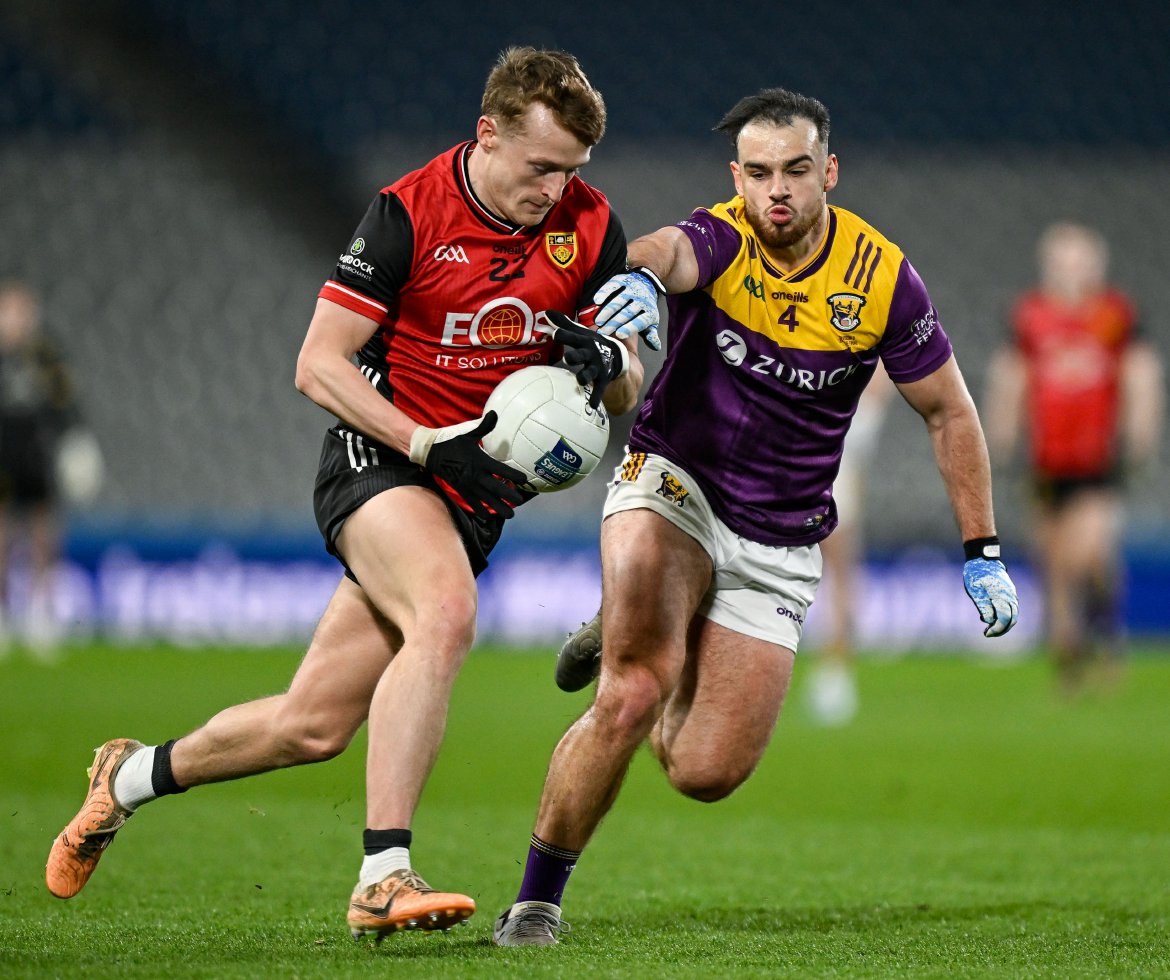
After the weekend’s games the only final that caused any controversy was in the Division Three final between Down and Wexford. The focus of the negative attention was surrounding the tactic Down employed of keeping the ball while ahead in the dying minutes of the game.
Some pundits claimed that it was not in keeping with the spirit of the game and that it gave an unsavoury look to our games. But, as I stated in my Gaelic Life article titled ‘Be Careful What You Wish For,’ this style of play is a direct outcome of the introduction of the new rules.
With all of the advantages now being afforded to attacking play, it is now more highly dangerous to not be in possession of the football because of the non-defendable situations the new rules put teams under. If a team wants to defend their lead effectively, they must now do so with their attacking play.
The old adage of ‘Attack is the best form of Defence,’ is now paramount to teams that wish to be successful. To ensure you see out games and win without giving your opposition a chance of a winner or equaliser, all teams must now defend their goal by being and keeping possession of the football. The second a team presents possession back to their opponents they are immediately placed in a massive disadvantage of getting the result.
Picture this, if a team is one point down with two to three minutes left on the clock and the opposition is playing keep ball, you could argue that this team would be better off allowing their opponents to score one point (going two down) simply to get the possession of the football back.
It is only with possession of the football that they have any chance of getting an equalising two-pointer or a winning goal. They could off course try for a double score by scoring quick and pressing the opposition kickout but that is dependent upon the swiftness of the first score.
Now, I am not campaigning for the new rules to be scrapped or done away with. My point is that we may need to evaluate the success of the rules and measure if that success has been achieved at the expense of the defensive side of the game.
I am also not advocating for a move back to the all-out defending models but can the rules either be tweaked or new introductions provided to give defending a fairer share in the advantage stakes.
At the moment, in my humble opinion, attacking play is holding all of the aces compared to defensive play and left unchecked or even furthered by more attacking rule tweaks, defending could disappear altogether.
Two examples of rule tweaks could be extending the two-point arc out to 45-metre line making it more difficult for teams to score orange flags. Removing the arc in the kickout rule while keeping the ‘no back pass to the goalkeeper’ allowing for the shorter kickouts. Two simple tweaks that I feel would give defensive play a fighting chance against the current all-out attack rule advantages.
If you would like more information on anything discussed in this article or if you have any queries in regard to goalkeeping, please feel free to contact me on the email address below.
Email: paddymorrison@msog11.com.
Related posts:



Receive quality journalism wherever you are, on any device. Keep up to date from the comfort of your own home with a digital subscription.
Any time | Any place | Anywhere
Get the app for the best Gaelic Life experience