25 years ago, Derry hurlers were back to back Ulster champions. Colin McEldowney was the last man to skipper the Oakleafers to the title. He sat down with Michael McMullan
The sands of time have passed since Colin McEldowney was the last man to captain Derry to an Ulster senior title.
Two memories have never faded. Firstly, it was a team rising towards the 2000 breakthrough, backing it up the following year.
The other emotion was regret from not finishing Offaly off in 2000. The Faithful County were All-Ireland champions two years earlier, but Derry hurled well enough to clinch an All-Ireland semi-final spot.
Derry were missing the quality of Declan Cassidy who was on honeymoon after the Ulster final. With seven second half minutes gone, Ollie Collins’ Achilles gave way.
On top of that, it rankles with McEldowney that Geoffrey McGonigle didn’t get enough protection from the officials.
On the other side of the coin, Offaly got their frees easier. With Johnny Dooley on song, his dozen points poured water on the brave Derry challenge before they beat Cork to book a final spot.
Seated in the An Croí café, in the heart of Sleacht Néill, McEldowney’s words are well chosen but there is an overriding sense of pride.
His passion has been passed on. Son Fionn is battling away on two fronts with the Emmet’s.
His younger son Dan is following in the footsteps while Céat has an array of medals with the camogs.
Having also played football for Derry, their father’s pride also comes from four years of hurling in Division One.
While results left them needing to dig deep in play-offs to keep their head above water, they swam through the waves.
“It definitely didn’t happen overnight; it was something that had been building,” he said of the origins of their success.
“Look at the quality of hurlers I came up through school with and in the years above. We were
regularly winning Mageean Cups at that stage.”
St Patrick’s Maghera won three titles in four years at the beginning of the nineties. Derry minor hurlers, meanwhile, were back-to-back Ulster champions, running Kilkenny and Cork very close.
“Those players went on into senior level and you could see it coming,” McEldowney added.
“We were becoming more and more competitive in Ulster, then, whenever we got promoted to Division One, it took off.”
Derry ran Antrim to three points in the 1998 Ulster final but were well-beaten the following season after securing promotion from Division Two.
“We did suffer some fair beatings in Division One at the time,” McEldowney recalled.
“We were also fairly competitive and gave a lot of good teams fair decent games. They pulled away in the last 10 minutes or sometimes got a goal or two to spoil a scoreline.”
McEldowney and Emmett McKeever were cut from the same cloth in defence. There was a pride in pitting themselves against the country’s top forwards.
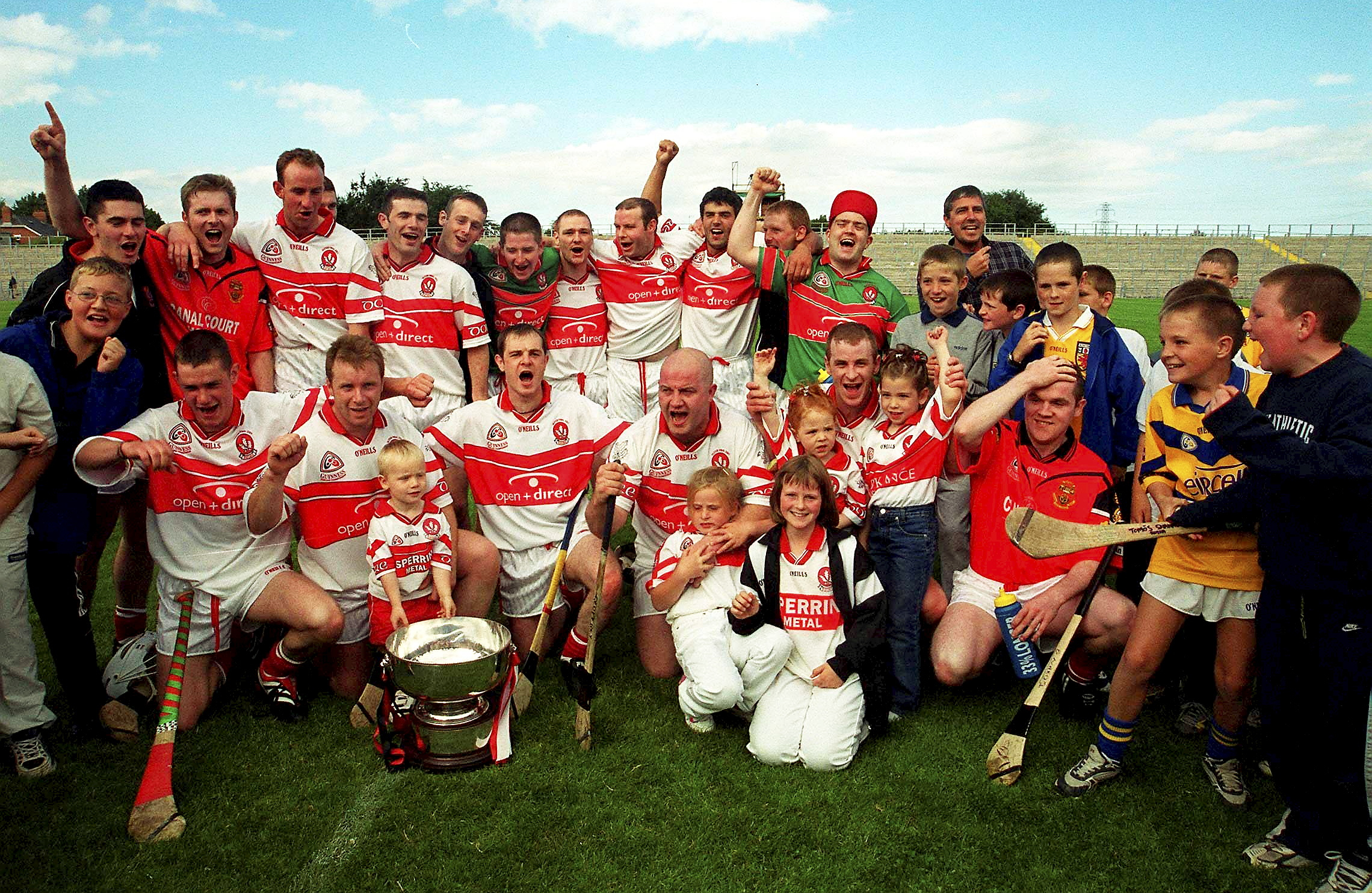
BACK-TO-BACK…Derry celebrate their 2001 Ulster final win over Down
When Kilkenny came to Ballinascreen in 2000, a young Henry Shefflin was the meat in the sandwich before being replaced.
McKeever and McEldowney didn’t do reverse. Everything was about winning the ball with that ‘thou shalt not pass’ school of thought.
“You were giving as good as you got,” McEldowney pointed out. “There was nobody thinking they (opponents) were just too good for us.”
While they got sucked into play-offs, Derry won key games against Kerry, Laois and Meath, extending their top-flight league adventure to four seasons. It was the perfect foundation for an assault on Ulster.
“I remember winning the first one (in 2000), and the unbelievable feeling we had after it,” McEldowney recalls.
“It was deserved and we didn’t believe it was a fluke. We showed that by backing it up.
“That first year, we played Offaly in the All-Ireland quarter-final. We were going into that game really confident because we were playing good hurling . We knew we were going to give Offaly a good game that day.
“Looking back, it still hurts that we didn’t come away with a victory because we were so close,” he said of their 2-23 to 2-17 defeat.
“Big Ollie (Collins) got the injury that day, a big blow to us,” he said.
“We know how animated Geoffrey (McGonigle) gets sometimes but he got a lot of abuse and deserved a number of frees that he didn’t get.
“On the scale of things, it would have left that game extremely tight, and maybe we would even have got over the line.”
Written off beforehand, Derry didn’t get respect after the game either. Many pundits wrote Offaly off as a team on the decline, even though they went on to beat Cork in the semi-final.
It was a star-studded Offaly side but McEldowney listed the Derry players he soldiered with. He could’ve kept on listing. Where do you stop?
“If you put those boys individually into a Cork or Kilkenny team, they’d have held their place on any team,” he said.
********
Cushendall man Kevin McNaughton came in as Derry manager for that golden era, having been involved with Swatragh camogs.
He headed up a management team of Tom Magill, Gerard McCloskey, Sean Sands and Roger Anthony Quinn.
“Kevin probably deserves credit, he took a job many weren’t putting their hand up for,” McEldowney said.
“He was a nice man, had a good way about him and was just easy to get on with.”
It was a Derry dressing room full of big characters. McNaughton steered them on the hurling front without trying reinvent the wheel in terms of team dynamics.
“He let the changing room do the talking for itself,” said McEldowney, the captain in 2001, succeeding Emmett McKeever from the previous season.
The Derry group were serious about their hurling but there was no shortage of craic, bonding a group away from club hurling.
McEldowney was on the 2000 Sleacht Néill championship winning team, an outlier in a sea of success for Lavey and Kevin Lynch’s, a rivalry that was always to the fore. While feisty, it never had any impact in the county scene.
“There was a very good atmosphere within the camp,” he stressed as one of the key factors in success.
“The players were all pulling in one direction. Kevin Lynch’s and Lavey had a serious rivalry. They’d have been cutting lumps of each other but when it came to Derry, that was all put aside.
“They pulled together, the same as the rest of us. I can’t remember a wrong word in the changing room, nor one disagreement at training or anything like that.”
Conor Murray lifted the cup when McKeever missed the 2000 final through suspension. The late Collie McGurk, who went on to manage Derry, was another leader.
“Collie was the man that stands out in the changing room,” McEldowney added.
“He would have had the hair standing on the back of your neck before you went out onto the pitch.
“He was a fantastic man for getting you up. You were ready to take the door off the hinges when Collie finished his speech.”
County footballers Kieran McKeever and Seamus Downey also played for a season too.
Niall Mullan was another leader in the dressing room while players also knew when it was time to hurl and time to enjoy themselves.
“You worked hard but you still enjoyed it,” McEldowney added. “It brought that sense of togetherness and camaraderie into the games with us.”
In terms of hurling, the games were a blur of just battling and scraping for every inch.
There was never a guarantee Derry would be back in the Ulster final the following year. It was about going all in, expending every ounce of energy out on the grass and seeing where a game would flow.
“I think we were well worthy of the success, winning twice proved that,” he added. “We were ultra-competitive at that time.”
After winning the first Ulster title, the bus ebbed its way up the M1, towards the border back into Derry. There was a deep significance attached to taking the cup into the county. It was a long time since 1908.
“We stopped at the bus in Toome, everybody got off and we walked the cup over the bridge,” he added. “It wasn’t pre-planned, it was just something we decided coming up the road.”
Sleacht Néill had a club bus at the time. Later that night, it was packed to the gills with revellers, who were heading up the Glenshane for a night of celebration.
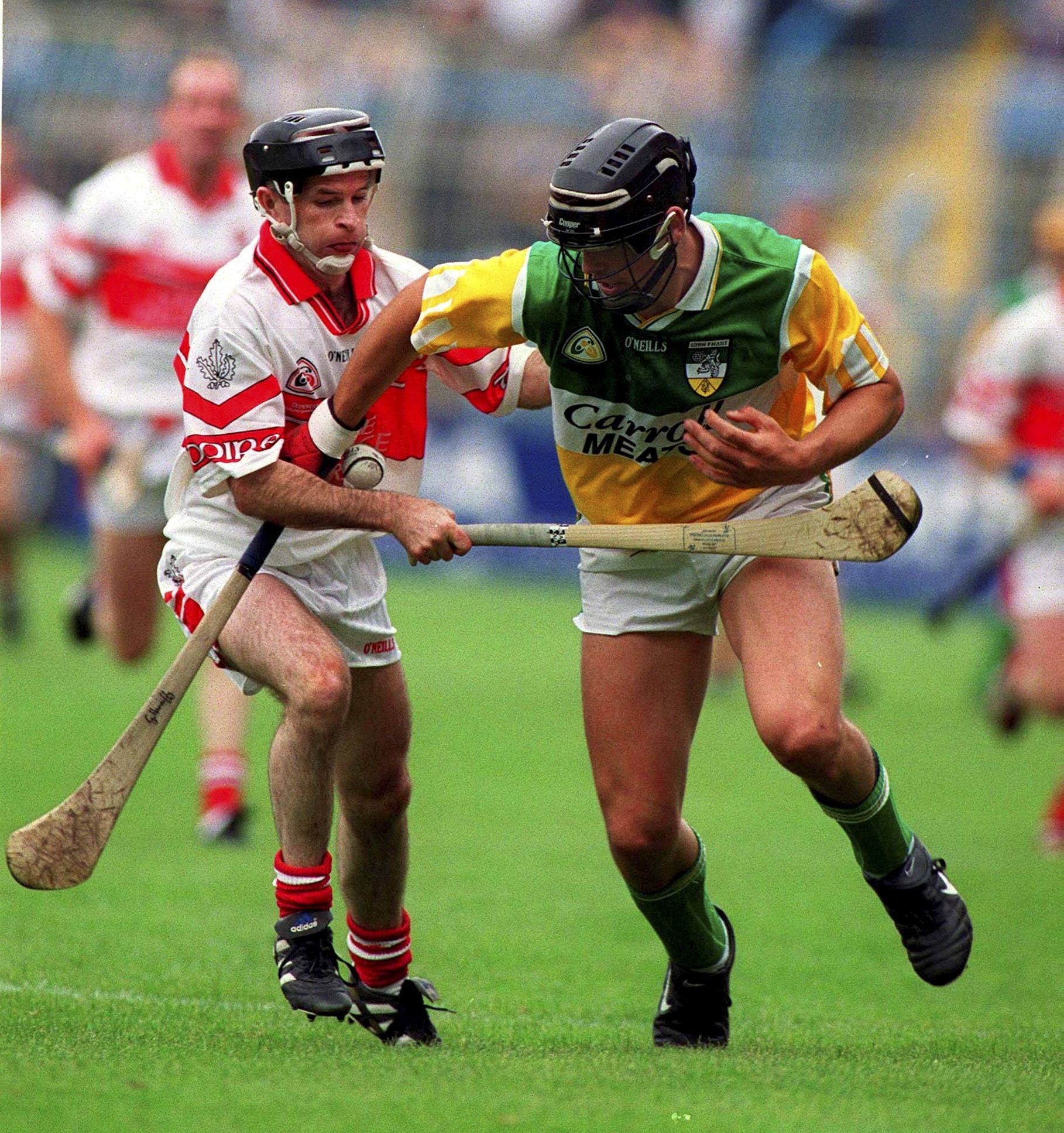
TEAK TOUGH…The late Collie McGurk in action against Offaly’s Gary Hannify
“A load of us ended up in Dungiven club,” he added. “I can remember Collie jumping off the stage and splitting his head. There was some atmosphere that night.”
When Derry retained the Harvey Cup the following year, a semi-final win over Antrim set up a showdown with Down.
This time, McEldowney was captain. He remembered how his defensive compadre Emmett McKeever missed lifting the cup on that occasion.
“I said to myself ‘that man deserves to be on these steps’.” McEldowney recalls.
“He didn’t want to come up but I insisted and more or less dragged him up so we’d lift the cup together.
“The microphone didn’t work that day so I didn’t have to make a speech. I wasn’t a bit sad about it either. I didn’t want to tempt fate and had nothing prepared, so I don’t know what I would have said.”
It was Galway in the All-Ireland quarter-final this time but the Tribesmen ran out comfortable winners on their way to the All-Ireland final.
Derry have not been back at the top level on the national stage since. McEldowney adds his name to many who have campaigned for the return of the Ulster Championship.
He’d love to see it back but there is an immense level of pride among the men of 2000 and ’01. Ollie Collins arranged a reunion last year that rekindled so many memories.
“We played in two All-Ireland senior quarter-finals and we were in Division One,” McEldowney summed up.
“We were playing Tipperary, Wexford, Clare, Cork, Kilkenny, that level of teams week in and week out, elite hurling teams.
“Whenever you do look back at it, we should have appreciated it more. At the time, you were just looking to the next game.
“That second year, Galway were too good for us, to be fair. Whenever you do look back on it, it does fill you with pride that you were on the pitch and competing at the top table. We were deservedly there.”
Also significant was how much of a thrill it was to run out on Casement Park. It was a sign you’d arrived and were challenging for the right to get to Croke Park.
“It was a great pitch,” McEldowney added. “As far as Ulster was concerned, that was the place you would go to play hurling.
“You heard the people standing above you, the vibrations coming through the concrete from the crowd.”
There are the memories of the narrow tunnel and the echoes. If it had ears, it would have a mountain of stories to tell. Not all of them printable. Closing Casement was a travesty.
From seeing his own family growing up now, McEldowney can see the level of commitment.
His younger brother Francis captained Sleacht Néill to Derry and Ulster titles, before being part of Mark Doran’s management team with the club’s footballers. His twin brother Fergal is part of the current setup under Austin O’Malley.
Nowadays, being a club player has surpassed the level of preparation from Colin’s own playing days with Derry.
It’s all about gym sessions and video work. When his son Fionn was playing with Derry minor and U20 teams, it was a 10- or 11-month season between club and county. A social life is squeezed into what’s left.
“I will not reveal much but we did enjoy ourselves,” Colin said with a smile of his own playing days with Derry.
“You wouldn’t get away with some of the things that we did but when it came to playing and the build-up to the games, everyone was fully on board.
“We took it to the line, that’s one thing we did now, we certainly enjoyed ourselves.”
Next month, Sleacht Néill and Kevin Lynch’s will do battle in the Derry hurling final. Emmett McKeever is part of Davy McCloskey’s management team.
For an hour, McEldowney and McKeever will be in different camps. Competitors to the core. The more things change, the more they stay the same.
Receive quality journalism wherever you are, on any device. Keep up to date from the comfort of your own home with a digital subscription.
Any time | Any place | Anywhere
Get the app for the best Gaelic Life experience