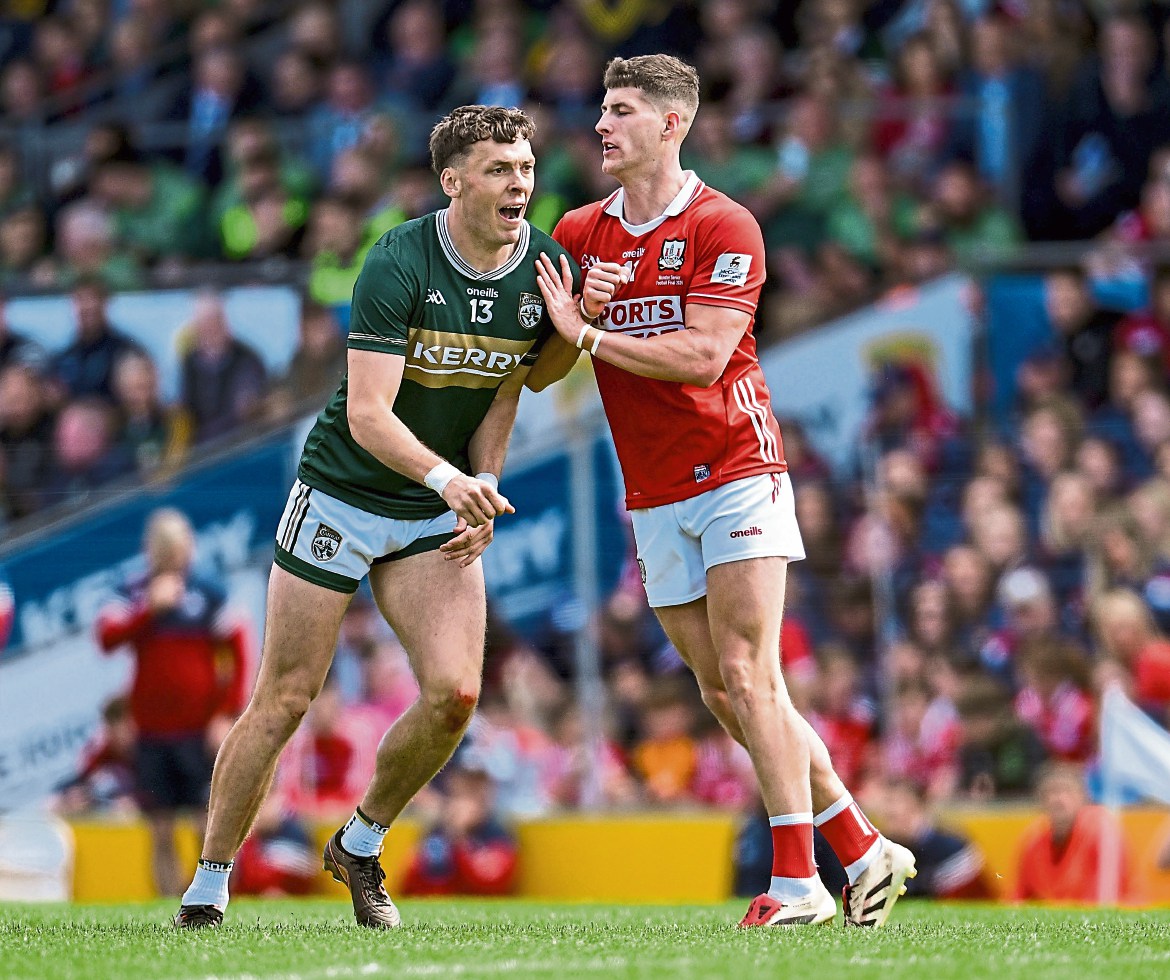


THE decision to hold the All-Ireland draw last week turned the provincial finals (except Connacht) into the biggest anti-climax since Cork football.
During the week, I posed the question in the Trinity Old Boys Group (free staters to a man): What is wrong with Cork football? The answers came flooding in: Hurling. Donal Óg. Frank Murphy. Solo running. Handpassing. Roy Keane. Bred in awe of Kerry. Soft. These are only the printable responses.
If it is true that hurling is more respectable in the county, their hurlers are suffering from the same mental malaise.
The problem is that they play with fear. This explains their fixation with holding possession at all costs. Watching them is a maddening merry go round of solo – handpass – solo – handpass – solo – handpass. This is the worst possible mindset for Gaelic football, and a disease that afflicts my own county.
If your priority is not to lose the ball, then you will not play with freedom. Put another way, you will be unable to play the game. This is because the game demands adventure. It makes risk taking compulsory. Without that risk, there is no reward. So, a Cork player wins possession, then scans the pitch ahead, before giving a short (generally lateral) handpass, or soloing full steam ahead into the space in front of him, before giving a short (generally lateral) handpass.
The last Cork footballer to give a kick pass was charged with bringing the game into disrepute and banned for12 months. The county footballers are in the Guinness Book of Records for most solo running in a 70 minute game, having broken their own record on seven occasions since.
Because of this stifling culture, we no longer see any Jimmy Barry Murphys or Stephen O'Briens. While Kerry are encouraging individual expression and a reverence for the skills of the ancient game, producing eye catching, original footballers, Cork's culture promotes players who are immensely athletic and immensely cautious.
This laborious, absolutely predictable style of play means that they do not offer any surprises. So, Cork's opponents know that they will have all the time in the world to set up their defensive system against them. They know that their dangerous forwards will be getting the ball too late to do any lasting harm. They know that because of their hard solo running, hand passing game, they will be exhausted come the final quarter.
Dystopia
The outcome of this dystopia is that they are incapable of a definitive contribution in big games and have become indifferent to defeat. They play hard to a certain extent, but because their formula is not a winning one, they play in the full knowledge that they are going to lose. This is why, scanning the papers and listening to the pundits, the best they can do when they talk about Cork’s chances is sugary rhetoric.
Joanne. What do Cork need to do to beat Kerry?
Lee: They need to throw down the gauntlet to them.
Gooch: I agree with Lee, their big players need to really show up.
Lee: Yeah, they need to show up big time.
Gooch: And play with serious intensity.
Lee: Yeah, serious intensity for 70 minutes Gooch.
Brian: And throw off the shackles.
Lee: Throwing off the shackles is probably the most important thing. I’d agree with Brian there.
Joanne: If they do all that, they can beat Kerry?
All three: No
Their championship meeting in 2025 was in round two of the All-Ireland series. It was the perfect summation of Cork football. They started off at 100 miles an hour, rushing about, tackling ferociously, going on lung bursting solo runs and either kicking the ball at the Kerry ‘keeper or being blocked down. By half time they were three points up and Padraig O’Hora, one of the TV pundits, said, “Cork can push on here.” Cork duly pushed on to a 1-28 to 0-20 defeat (They don’t make pundits like they used to).
The Munster final on Sunday was a carbon copy of that defeat, the only difference being a slight variation in the final score – 1-23 to 1-15. They should give up football altogether and throw in their lot with the hurlers.
Receive quality journalism wherever you are, on any device. Keep up to date from the comfort of your own home with a digital subscription.
Any time | Any place | Anywhere
Get the app for the best Gaelic Life experience