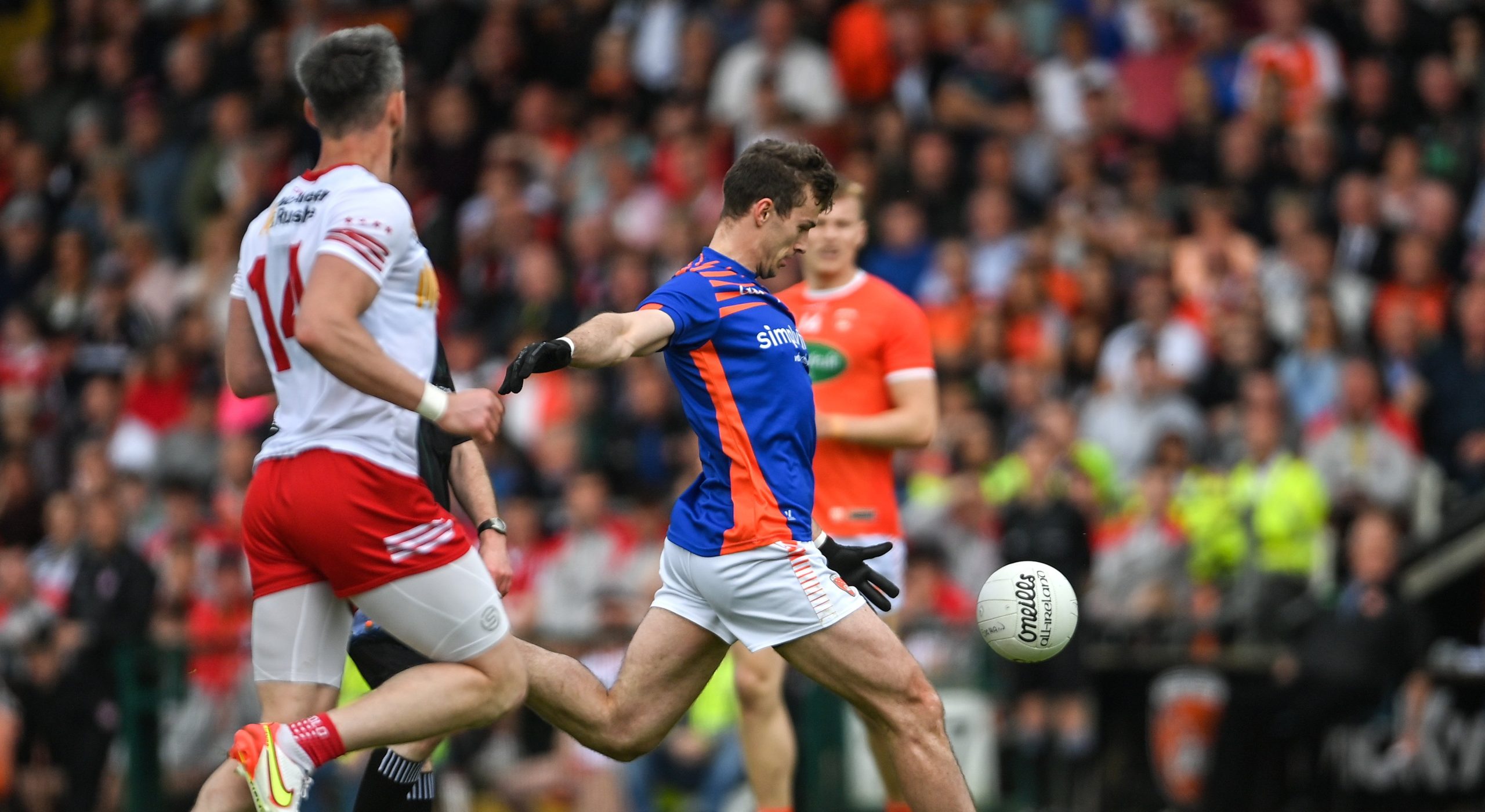


By Patrick Morrison
STEVEN Pressfield’s 2004 novel, ‘The Virtue of War’, follows the life of Alexander the Great and his story is told through the eyes of a Hellenic-Persian scribe who was serving under him during his campaigns into India. In the novel there is a quote from Alexander himself which states:
“Always attack. Even in defence, attack. The attacking arm possesses the initiative and thus commands the action. To attack makes men brave; to defend makes them timorous.”
Alexander was of course referring to war but so much of sport mirrors conflict and struggle. The notion of being proactive can be applied to every sport imaginable as gaining the upper hand and being on the front foot are always seen as a more favourable position to be in.
With the introduction of the new rules, teams have been looking more and more into having that attacking edge over their opponents. The game has long since developed into a possession-based game whereby retaining the ball and minimising the risk of turnovers is paramount for maximising attacking opportunities.
With the new rules comes the need to move away from defensive concepts. This does not mean that teams need to remove tackling and methods to stop the other team from scoring from their game-plans, but a change in mindset must be installed. In the modern new rules’ era of Gaelic football, teams are now only always attacking both when in possession and when not in possession of the football. The concept he had created came in two parts – both in an out of possession:
1) ATTACKING THE GOAL LOOKING TO SCORE
When a team is in possession of the ball, they are constantly moving out of position to create space to give options for the ball carrier, so they can receive the ball and attack the opposition goal looking for a score.
2) ATTACKING THE BALL LOOKING TO TURNOVER
When a team is not in possession of the ball, instead of defending their own goal, they move into a counter-attacking position as they attack the ball attempting to turn the ball over back into their possession.
Goalkeepers are now seen as one of the most, if not the most important position on the field as they are year on year becoming more specialised in the duties they are being expected to perform. One of the main roles that they will perform in this concept will involve being the eyes, ears and part of the decision-making process for all players in front of them. The goalkeeper is gifted in that the position that they play affords them a favourable vantage point that allows them to see and foresee patterns of play evolve in front of them.
With this advantage and by using effective communication skills they can essentially increase the rate at which their team can get into position once they lose possession of the ball. It is also possible for the ’keeper to anticipate a turnover and have the counter attacking structure in place before their team actually loses possession of the ball.
Once the counter-attacking structure is in place and by using effective communication, the goalkeeper becomes the command centre for the players when they are attacking the ball trying to force a turnover. It is essential for the team to have an agreed set of terminology or language which allows them to communicate using the three Cs: clear, concise and constant.
Like a commander in Alexander’s Great army, the goalkeeper must project their vocal commands to their soldiers so they can put them into action.
If the goalkeeper’s team loses the ball and find themselves out of the counter attacking structure, the goalkeeper can become a ‘sweeper-keeper’ positioning themselves in front of the forward line until such times as the counter attacking structure is in place or it becomes riskier to stay there due to the opposition’s field position. By taking up this sweeper role in front of the forward line it delays the speed at which the opposition can transition forward when attacking.
As Gaelic football has evolved into a possession based, tactical attacking game teams are now more methodical and structured in their play. Now players have various roles, targets and expectations to meet in every game. Although outfield players may need to know their own specific roles/expectations, the goalkeeper must know every position’s role and expectations, especially those of the defenders.
This is because of the vantage point they have from their position, the more in depth the ‘keeper knows every role and every structure, the better equipped they are to command teammates into their positions. This is very much like how a toboggan driver must know every inch of the track they are racing on. The driver must know every turn, every gradient as well as what parts of the track are best for gaining or losing speed.
When the goalkeeper’s team is in possession of the football, they are moving out of their counter-attacking position with the purpose of attacking the goal looking for scores. Depending on the position of both the ball and the goalkeeper, they can become an outlet ball for their teammates if caught possession.
Even though the new rules have tried to stop goalkeepers coming up to join the attack, we still have a few goalkeepers like Ethan Rafferty regularly venturing from the safety of their crease to join their team’s attack with great success. This will eventually encourage the rest to follow suit, if they feel comfortable mind.
In terms of restarts, the goalkeeper is the first line of attack when in possession and then the last line of attack whenever their team is out of possession.
With restarts of a consistent good quality the goalkeeper can regularly be the springboard for many attacks and with any possession-based game the more attacks a team has the more scoring opportunities will also increase.
This is why restarts in Gaelic football have been and are becoming even more important to the success of teams and their importance is only set to increase exponentially going forward. As teams get to grips with the new 40m arc rule they are becoming more and more aware of how things have not really changed at all as the top teams are now getting away short kickouts and teams have again begun dropping off kickouts whenever they are ahead or cannot get set up in time.
With all of the above traits required for this new concept of Gaelic football, the goalkeeper will need an innate confidence in their ability.
Becoming a fearless leader who leads by performance will become more and more important as this kind of confidence is highly contagious and will quickly spread to those players positioned around you.
As the actions of the goalkeeper are extremely amplified during games, it is clear to see the confidence of a team grow in conjunction with the growing confidence of the goalkeeper.
Alexander was ‘Great’ because he didn’t defend, so in that sense we must follow his example and ‘attack, attack, attack’.
Email:[email protected]: @MSoG11X: @MorSchGk
Receive quality journalism wherever you are, on any device. Keep up to date from the comfort of your own home with a digital subscription.
Any time | Any place | Anywhere
Get the app for the best Gaelic Life experience