

By Patrick Morrison
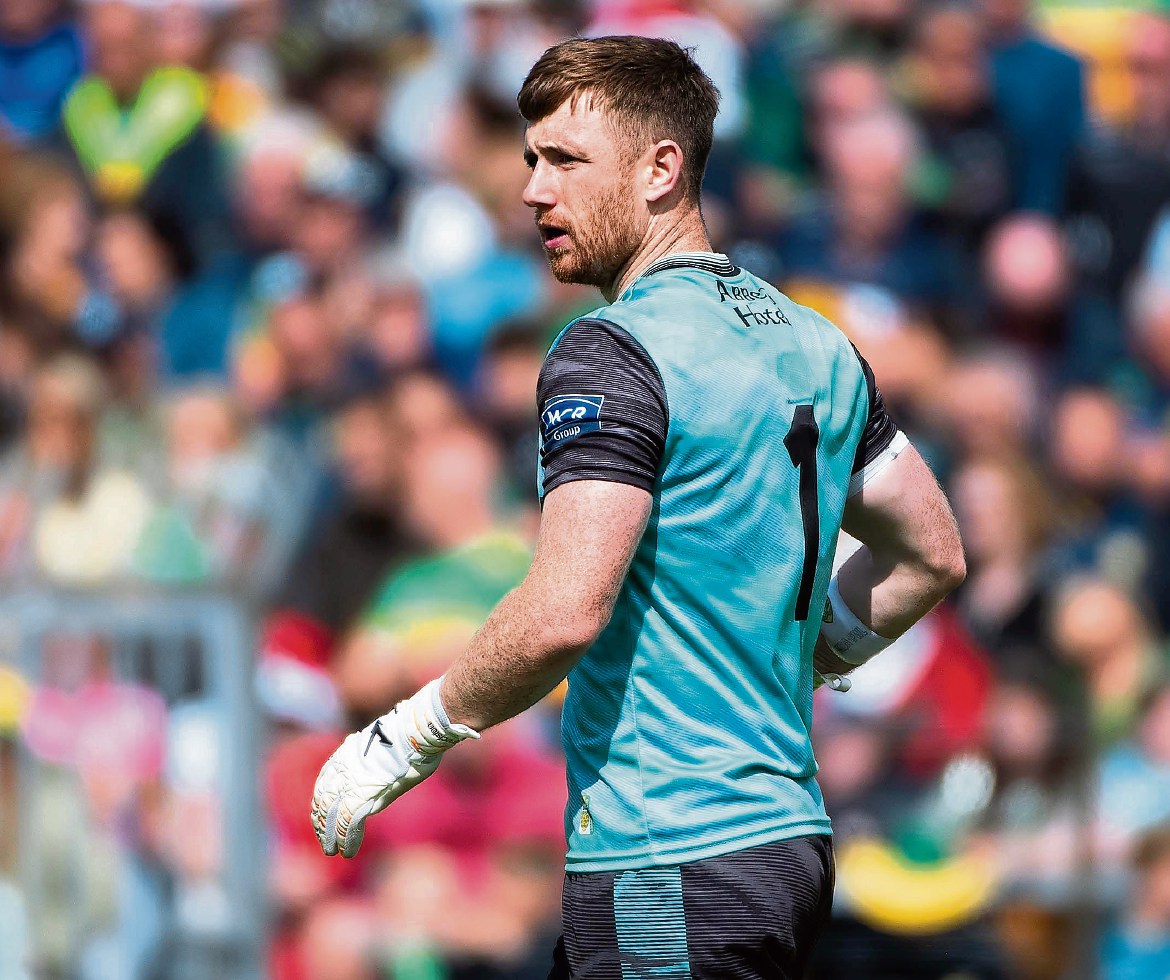
WITH the inter-county season in full flow but breaking for two weeks and the club season drawing ever closer, it may be prudent for goalkeepers to focus their attentions on what areas of their game they may or wish to improve upon for the coming season.
Breaking them down into three main areas is one way to allow the goalkeeper to decide which areas need most attention first. By cataloguing needs into Physical, Technical and Mental Abilities the goalkeeper can then determine the most pressing area(s) they need to focus on first before the season begins/continues.
Here are some examples for each of the Physical, Technical and Mental Ability areas:
Physical Ability: Keepers can use bodyweight circuits to maintain their physical strength as well as their explosive power. There are hundreds of various exercises that can be used, and each exercise also has a progression for when you find your body has adapted to that exercise so the difficulty can be increased.
There is also going for runs/walks/cycles to maintain your cardiovascular output while also allowing you to get outdoors and clear your head looking after your mental health. SAQ (Speed Agility Quickness) training, which usually involves ladders and hurdles as well as plyometrics, is great to train your explosive power. Incorporating the hurdles and ladders into your usual drills will increase your footwork as well as your speed of thought.
Another part of your game that can be trained is position-specific conditioning. This involves increasing the intensity of your sessions as much as you can while also minimising the amount of rest that you take. This allows you to condition yourself to a higher intensity than that of a competitive game.
Technical Ability: While trying to further your physical development, you should also be striving to develop your technical ability by completing three things – Skill Acquisition/Skill Reinforcement/Skill Progression.
My first example of this would be learning to take restarts with your other foot, an excellent weapon for any goalkeeper especially when being able to strike the ball off both sides to a competent standard.
Even if a goalkeeper could comfortably and accurately kick a ball from the tee to a range of 45 metres, it would mean they would have an unprecedented restart ability at their disposal.
Another feature could be to learn or perfect your current diving technique. Currently I use my own pendulum roll technique where the principle is keep your body in an arc as you land, rolling onto your shoulder and then by weight transfer roll back onto your hips and up to a standing position without the use of your arms.
It did take me time to perfect as well as learn how to use it effectively during games. The idea came from reading about how Cirque de Solei acrobats use similar techniques when performing their shows.
Other technical progressions a goalkeeper can make could be creating your goalkeeping arc, which is used to provide a visual aide in regard to your positioning in the goal relative to the ball position, handling can be improved by learning skills like juggling or catching different sized balls rebounding off a wall or uneven surfaces.
Fine-tuning your kicking technique and increasing your accuracy can also be achieved with an intensive plan using effective drills that involve increasing levels of difficulty. It is important that drills are also measurable and are recorded for future reference for when you are going to perform them again. Something as simple as fastening a hula-hoop to the top of a broom handle makes an excellent target to aim for.
Mental Ability: The last area that I am proposing you can work on extensively over the next few weeks is the mental side of your goalkeeping.
With the normal Irish climate working its magic this time of year, it can be very unpredictable as to when you will be able to get out onto grass to work on your physical or technical abilities. This is why it is important for you to have a contingency plan in place should the weather take a turn for the worse.
You can focus creating or developing your own set of goalkeeping principles and use them as your guide to become the best goalkeeper you can be. Set yourself some S.M.A.R.T. goals for the rest of the season making sure to have them in both short- and long-term categories as well as personal and team goals.
Also ensure that your goals are measurable, recorded in your training diary and are reviewed regularly by both you and your coach to ensure you are on course to complete as many of your goals as possible.
It is also a great time of the season to conduct a performance review of the year thus far. Discuss with your coaches/management about how you have been performing and gather their feedback as well as providing your own honest self-appraisal to give you a better idea of what exactly you need to do going forward.
Another part of your game you could work on is your goalkeeping theory, which involves things like developing a team language or phrase book that everyone can understand as directions are called on-field and in-play creating better team cohesion during games.
Create your own goalkeeping language that would be specific to you whenever you need players to complete certain tasks. Make sure to have this circulated to your teammates inclusive of a full description of each call, what it means and what is expected whenever you have given that instruction. This will make your goalkeeping a lot easier especially when communicating with a sweeper.
Email:
pmgoalkeeping@hotmail.com
Facebook: @MSoG11
X: @MorSchGk
Related posts:

Receive quality journalism wherever you are, on any device. Keep up to date from the comfort of your own home with a digital subscription.
Any time | Any place | Anywhere
Get the app for the best Gaelic Life experience